Graphite
 Introduction
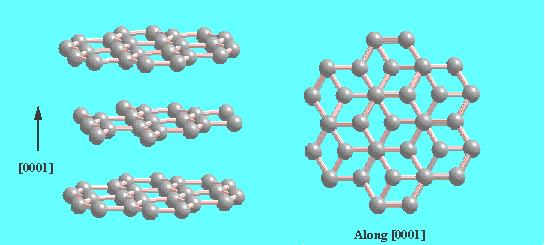
| Graphite, the other allotrope of carbon, is completely different from diamond. Graphite has a layer structure. Each layer is composed of carbon atoms covalently bonded in hexagonal rings. The bonding in these layers is very strong and the layers are packed together. Graphite is black, opaque and metallic in luster. |
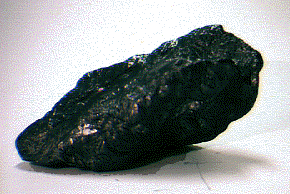
A real graphite
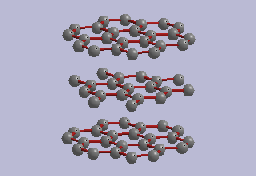
Layer structure of graphite
Formation
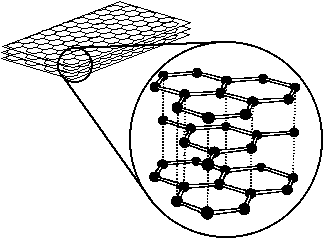
In graphite, the carbon atom are all sp2 hybridized, so that each is bonded planar trigonally to three other atoms by single, rigid covalent bonds, forming a hexagonal layer lattice. It is made up of hexagonal arrays of carbon atoms arranged in layer. The unhybridized p electrons in the bonding carbon atoms overlay with each other, and are delocalized above and below the layer lattice, thus holding the lattices together by van der Waals' forces. The C-C bond in graphite is formed by overlapping of two sp2 hybrid orbitals of carbon and delocalization of electrons by overlapping of the unhybridized p orbitals of the carbon atoms. |
|
Hexagonal structure of graphite |
Properties
1. Soft and slippery (weak van der Waals' forces of attraction between the layers allow one layer of bonded atoms to slide easily over another layer) 2. High melting point, boiling point and latent heats of graphite(bond between adjacent carbon atoms of the same layer is strong) 3. Good conductor of electricity(non-bonding electrons are delocalized and are free to move) |
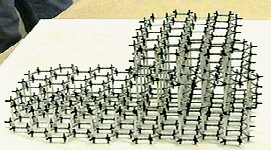
A model of graphite
Application
1. Used as electrodes in electrochemical industries where corrosive gases are given off, and for electric furnaces that reach extremely high temperatures. 2. Used as a lubricant 3. Used as a moderator in atomic reactors 4. Used as pencil lead |
Difference
between graphite and diamond
Although diamond and graphite are made up of the same element, carbon, diamond differs from graphite in its physical and chemical properties because of the differences in the arrangement and bonding of the atoms. Diamond is transparent, strong, very hard and chemically inert whereas graphite is black, soft, and an excellent lubricant and is very useful for absorbing and catalyzing reactions. The carbon atoms in diamond are each bound to 4 others in a 3-dimensional network. To change the shape of a diamond or break it requires that many of these strong bonds be broken simultaneously. So, diamond is very strong and hard. Since there is little room for other molecules to get into the structure, diamond is very unreactive. However, graphite consists of sheets of strongly bonded hexagonal rings. Each sheet is far from and weekly bound to the next. A few carbon atoms are bonded vertically to those above and below, but most are attached to neighbours in the same horizontal plane. Thus, the sheets can slide past one another, making graphite a soft lubricant. The spaces between the layers allow other molecules to enter, explaining the absorbing and catalytic properties of graphite. Diamond is denser than graphite, but it follows that in order to transform graphite into diamond, pressure must be applied. Diamond can be produced from graphite only by the action of high pressure. High temperatures are necessary for an appreciable rate of conversion. |

 Send us
email if you have problems.
Send us
email if you have problems.