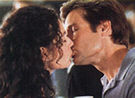
Return to Me completed production as it began: a labor of love
about life by first-time feature director/co-writer/co-star Bonnie Hunt, who designed the
film as a valentine not only to the possibilities of romance, but also to her native city
of Chicago. Composing the script with writing partner Don Lake - whom she both wrote and
performed with on the famed Second City comedy troupe - Hunt deliberately and tenaciously
set out to create a love story which was at once timeless and timely, comedic and tragic.
"This is a movie about everyday life," notes the filmmaker, "rooted in real characters
with average lives, who are almost supernaturally touched by the events of the story."
Adds writing partner Lake, "Bonnie and I wanted to make a really nice love story with
lots of romance that had a fairy tale quality to it but also a slice-of-life quality that
like life you laugh one minute and cry the next ... or vice versa."
It made perfect sense that Hunt and Lake would choose to set their story against the
backdrop of the city in which the filmmaker has her roots -that great monolith of the
Midwest, Chicago. "Bonnie has written this in an environment that she fully understands," notes
producer Jennie Lew Tugend, "but it's a movie that will translate all over the world because
it's populated with people we all know. We all have overbearing best friends, worried
grandfathers, difficult relationships. It's universal."
As Hunt and Lake's script came to fruition, the production team decided that the entire
film (save the final two days in Rome) would be shot in Chicago on "practical" locations - real
settings rather than studio sets - that would lend complete verisimilitude to the story
without any Hollywood artifice. "Chicago is a character in itself," Hunt says. "There's a
certain kindness, that permeates the story, and a lot of these characters are from my
childhood ... especially the older folks who populate O'Reilly's Restaurant. Don and I felt
very strongly that the story had to emerge through the characters."
Once Hunt and Lake completed their script, it didn't take long for some of film's most
popular stars, both recent and veteran, to respond with enthusiasm. "Casting is so important
in a movie like this," notes Tugend. "Romantic stories only succeed if the charisma and
chemistry of the leading players works out. We had to find stars who could pull off the
twists and turns of the story and keep the audience with them every step of the way."
Hunt
very quickly focused on two major international stars to essay the challenging roles of
Bob Rueland and Grace Briggs: David Duchovny and Minnie Driver. "David and I acted in
Beethoven together a few years ago," recalls Hunt. "We had a scene together that didn't
have a lot written into it, and the director encouraged us to add something of our own.
So David and I quickly worked something else out, and it became a really funny scene in the
movie. I could see David's potential; he's funny, wry, charming and debonair. We kept in
touch."
Hunt had written a role for Duchovny which would certainly call on his dramatic
skills apparent to viewers of The X-Files, but at the same time demonstrate the actor's
considerable comic abilities as well (anyone who watches Duchovny's occasional appearances
on late night talk shows swiftly gets a taste of his endlessly dry and smart sense of humor).
As for Duchovny, the attraction was mutual. "The script of Return To Me was so simple and
direct, and it wasn't tainted with the kind of cynicism which seems to affect everything else
these days. It had a kind of simple inevitability to it, beautiful, emotional and funny.
The script earns its sentimentality through truth, honesty and integrity. I just read it and
immediately wanted to do it, knowing that Bonnie would be the best director for her own
screenplay."
For the demanding role of Grace, who undergoes a physical and psychological transformation
in the film, Hunt chose her star, Minnie Driver, in a somewhat orthodox way. "I called her, we
had lunch and she loved the role of Grace and she loved the material. She was on board soon
after that first lunch." Driver reacted as enthusiastically as fellow star Duchovny when
she read Hunt and Lake's screenplay. "Return To Me isn't solely a romantic comedy, because
there are some very serious and dramatic moments in it. It's very, very real and honest and
funny and sad, and there's a twist at the center of it all, which makes for good cinema."
The extraordinary supporting cast - which combines such great professionals as Carroll
O'Connor, Robert Loggia, Eddie Jones and William Bronder with younger veterans like Jim
Belushi, David Alan Grier and Joely Richardson - quickly fell into place. A lure for
O'Connor was that his role of Marty O'Reilly would call upon him to affect an authentic
Irish accent ... ironically for a man who both studied and performed in Ireland early in
his career, it would be the first time he would ever do so on film. "When I was acting
in Ireland and playing Irish characters, considering my name and the accent I used on
stage, everyone thought I was a native," he reminisces with a smile. "But when I came
back to the United States, I was never asked to play an Irishman. Instead, all of the
Lithuanian actors from the studio played them!"
The casting of Robert Loggia as Angelo Pardipillo, Marty's Italian brother-in-law and
partner in their Irish-Italian restaurant, was just as authentic. "I've done so many films,
and many of them were violent, so it was refreshing for me to come across a script about
romance and camaraderie without bloodshed or profanity," the actor notes. "It was also nice
to see the older generation represented in such a way that they're alive and kicking, with
their own passions and romantic drives. I also loved the fact that Return To Me has some
insight into who and what we are as human beings. We have this mechanical body, but we
also have a soul and a mind. The body is just some sort of conveyance quite apart from who
we are inside, and there aren't many movies that deal with such notions."
Another cast member who shared a history with Hunt was David Alan Grier, chosen to portray
devil-may-care Lincoln Park Zoo vet Charlie Johnson. "I first met Bonnie on the plane to
Vancouver to begin filming Jumanji, and it was like we had been talking for a billion years
and had picked up an old conversation in mid-sentence. I felt like I knew her, and from
then on, we spent a lot of time together on the Jumanji set. Bonnie's emotionalism is a
throwback to old Hollywood movies, and it's a refreshing take on films today."
"I thought that the script was really wonderful, sweet and charming," says Joely Richardson,
who portrays the brief but pivotal role of Elizabeth Rueland, "and that's why for me to come
to Chicago for three weeks was an adventure in itself. The story is so lovely, funny and
fresh."
As for Jim Belushi - another Chicago favorite - working with Hunt was both personal
and professional. Although they were ten years apart at Second City, they met there when
Belushi came back to visit as an alum and Hunt was a new cast member and they have maintained
a friendship ever since. "Bonnie and Don's writing has a very Second City feeling to it for
me, very spontaneous and real. When I read the script, I was just delighted at the charm that
came across, and the spirit of humor and romance. Bonnie has a great capacity for
understanding human behavior, and she's not afraid of capturing its sentimentality or
pain. She was also raised in a big family, and so completely understands the loving chaos
in a family like Joe and Megan's ... and that Joe and Megan can still have romance, even
with five small kids running around."
Return To Me began principal photography in early May 1999 with an elegant party scene
shot inside of the lavish Gold Room in the historic Congress Hotel on Michigan Avenue, built
in 1903. It was here that the cast and crew were put in the right mood by a swinging version
of the classic Daniel DiMinno/Carmen Lombardo title song, with the arrangement produced by
Bonnie Hunt and Return To Me composer Nicholas Pike and sung on camera by the talented Joey
Gian. (Classics from Frank Sinatra, the Gershwins, Cole Porter, Rodgers & Hart and the like
provide a deep-rooted musical backdrop throughout the entire film.) This sequence kicked
off a shoot marked by almost three months of production in Chicago, a production in which
the cast and crew became part of the director's extended family. Hunt was not only born and
raised in Chicago, she also studied and worked as a nurse there before utilizing her
performing gifts for the city's Second City troupe and then moving on to television and film
work in Los Angeles.
True to the nature of a film about love and family, the director would encircle herself with
a group of fellow performers and friends from the metropolis, with Second City alumni and
members of the Hunt clan sometimes appearing in small roles. Making notable appearances in
the film are writer/actor Dick Cusack (of the famous Chicago clan which has also spawned
John and Joan); Second City-ites Holly Wortell, Chris Barnes, Tom Virtue, David Pasquesi,
Tim O'Malley and Darryl Warren; and a few Hunts popping up here and there, including the
director's brothers Tom (as a construction worker) and Kevin (a medical doctor typecast
as a medical doctor), nephew Patrick as a young neighbor of Bob Rueland, and sister Carol
Hunt as Nurse Alice. And that's co-writer Don Lake, a familiar face in film, television and
commercials, as the "hair transplant guy" at O'Reilly's.
"We first came to Chicago in the winter in pre-production," recalls Jennie Lew Tugend.
"It was freezing, there was snow on the ground, but wherever we went, Bonnie's name opened
every door. She's a favorite child of this city, and that made my job so much easier." Joely
Richardson notes, "Wherever we filmed, people would just pass by and say 'Hi, Bonnie,' whether
they knew her or not, She's the Chicago Girl, and has included us into that big family,
so it's very, very welcoming."
With her creative team - headed by greatly respected
cinematographer Laszlo Kovacs (who had recently tackled Chicago in another big-screen
romance, My Best Friend's Wedding), production designer Brent Thomas and costume designer
Lis Bothwell - Bonnie Hunt set out to integrate Chicago into the story rather than just
exploit its visual beauties. It was also incumbent upon Thomas and his crew to amend the
settings just enough to bring them in line with the fairy tale element of the story.
"We sought a kind of poetic realism," explains Thomas, "and in the context of the real world
there are little trill notes that make it a little more magical ... such as twinkle
lights, a certain color of petals blowing across the courtyard behind O'Reilly's or the
light in Grace's paintings."
The two key locations in Return To Me are O'Reilly's Restaurant, the comfortable
Italian-Irish joint where Grace works with her "family," and the Lincoln Park Zoo, where
Elizabeth Rueland serves as a devoted trainer, and for which her husband Bob is designing
and building an expanded gorilla habitat. The perfect location for O'Reilly's was discovered
at the popular Old Town barbecue restaurant Twin Anchors, a classic neighborhood hangout.
And, despite Brent Thomas' considerable (and temporary), alterations, O'Reilly's maintained
the real restaurant's air of warmth and hospitality. "The most important change in the
transformation of Twin Anchors into O'Reilly's was that in the script, there's a courtyard
in back of the restaurant," notes Thomas. "This necessitated moving the kitchen to the side
and adding doors and windows in the back. Because we're moving in and out of Twin Anchors
during the course, of the shoot, it's become a little ballet of people moving in at midnight
the day before we film and setting everything up."
O'Reilly's was Gaelicized by copious amounts of colorful Irish bric-a-brac found by set
decorator Daniel Clancy and his team. Meanwhile, the O'Reilly courtyard was actually filmed
a few blocks away in the front of a comfortable Old Town residence. The art department also
constructed the facade of a typical neighborhood brick building directly to the left of Twin
Anchors, giving the impression that the comer restaurant is really in the middle of a street.
Without question, the most remarkable location of all was the Lincoln Park Zoo.
Director/CEO Kevin J. Bell and curator of primates Dr. Kristen Lukas provided the production
unprecedented access to its grounds, including the Lester E. Fisher Great Ape House - and
to a magnificent resident gorilla named Kwan. "Kevin, Kristen and everyone else at the
Lincoln Park Zoo were great to us," says Jennie Lew Tugend, whose previous experience working
with large mammals included producing all three entries in the popular Free Willy series
of motion pictures. "They liked the project from the very start, and told us that they
had turned down a lot of other requests to film there ... mostly because those projects
required the animals to behave in unnatural ways. "What we all agreed upon, both production
and the zoo," continues Tugend, "was that Kwan would not be specifically trained for
anything he does in the movie. Everything that we see Kwan do is within his regular
behavior."
In Return To Me, Kwan plays Sydney, Elizabeth Rueland's "student" and friend. "He was
amazing," enthuses Tugend. "He would do take after take like a professional. We asked for
a lot, and got more." Don Lake adds, "People are going to think that Sydney is a guy in a
monkey suit, but that's Kwan, the Real McCoy!" Kwan was called upon to interact in different
scenes with David Duchovny, Minnie Driver and Joely Richardson. The actors were enthralled
once they got past their expected nervousness at being in such close proximity to such a
powerful primate. For Duchovny, an important scene in which he speaks to Kwan while sharing
his food was a great learning experience. "We did four or five takes and Kwan was cool,"
recalls Duchovny. "But then, every time I handed him a zucchini strip, he would throw it down.
Finally, Kwan started handing them back to me. So we switched to apple strips, and he
liked that. So it was five takes with zucchini, two or three takes with apple. He's a
true actor. His motivation got tired on him and he had to go to a new one."
More Chicago and area locations were found in the Lincoln Park district (Bob and
Elizabeth's lovely home), Oak Park (Megan and Joe's more informal working class
environment), Michael Reese Hospitals, the famed Buckingham Fountain in Grant Park and an
aerie high above the city on a West Wacker Drive skyscraper, which is one of Bob Rueland's
buildings in the film and his place to be alone in thought.
As Brent Thomas was decorating
the town, costume designer Lis Bothwell was appropriately attiring the cast. "Bonnie
was very collaborative regarding wardrobe, but also had strong ideas. The great thing
about Bonnie is that she's chosen a lot of people to work on this movie who she trusts, which
makes it easier for you to do your job. You feel like you can bring something new to the
table." For much of the film, David Duchovny's look is considerably less buttoned-down than
Fox Mulder. "The last thing Bob worries about is styling his clothes," Bothwell notes, "so
he usually pulls out a pair of jeans and throws on a tee shirt. The thing is, David looks
absolutely sensational in jeans and tee shirts!"
Reflecting Grace's joy in a new-found life, Bothwell dressed her in colorful prints and
patterns, many of them from the charming Dutch fashion line, Oilily. While selecting the
wardrobe for Jim Belushi as Joe Dayton, Bothwell received a quick lesson in how Chicago
really works. "I told Jim that I wanted to put a Cubs tee shirt or hat on him, or maybe
something from the Bulls. Something that blares out 'Chicago' loud and clear. But Jim said
that it had to be the Blackhawks, the Chicago ice hockey team. I told Jim that I knew what
had been legally cleared and what hadn't been, and it had to be either the Cubs or the
Bulls. "Jim told me not to worry ... it would be cleared. It turned out that the owner of
the Blackhawks is one of Jim's best friends!"
As the filming progressed, the cast became something of a mutual admiration society,
with Duchovny definitely winning the admiration of his leading ladies. "Everything about
David is sexy," says Driver. "His manner and delivery are so quiet and slow that you're
usually not prepared for how hilarious what he's saying turns out to be." "Minnie's a great
actress," says Duchovny, returning the compliment, "always prepared, upbeat and a team
player." Of course, the tone was set by director Hunt, who while carefully guarding the
screenplay so meticulously worked out by herself and Lake, also utilized her strong background
in improvisation to encourage her cast to organically develop their characters.
"All directors are different," notes Hunt, "and I've certainly worked with so many
different types and personalities. But I think it's important to be nurturing. I was a
nurse before I was an actress, so that comes in handy.... "What I'm most impressed by is
the teamwork," continues Hunt. "The cast and crew amazed me everyday. I come from a
family of seven, so teamwork is second nature for me. I love to see it in its practical,
application on a movie set." Says Driver, "Bonnie looked out for me, as a girl, which is a
really good thing. She just understands, from acting and emotional points-of-view, how to
protect other performers." "Bonnie opened the floodgates on improvisation for the scenes
inside of O'Reilly's," notes Loggia. "There's singing, dancing, gambling and lots of
talking. Bonnie brings out the best in her players. She has a wonderful spirit without
being a goody-two-shoes." Belushi adds, "Bonnie makes the actors feel very confident and
free, and she stimulates you to be real and make the dialogue your own. And consequently,
it's like a playground here. She brings out a great joy with the ensemble, and I'm sure it
will be captured on film."
Indeed, the cast and crew often reacted quite emotionally to the heartfelt drama and
comedy that was taking place in front of the camera. "We cry behind the camera," admits
Tugend, "and it's not just because we're a couple of women making this movie. The cameramen
are crying, the grips and gaffers are crying, the craft service people are crying. And
then, with other scenes, they're often laughing so much that they have to hold their hands
over the mouths so that they don't ruin the take."
On some sets, the company can't wait
until Friday wrap so they can disappear back into their apartments or hotel rooms. But on
Return To Me, there were Friday night post-wrap dinners at a popular Old Town restaurant
frequented by Hunt. "I think it's a unique situation on any movie where we become friends
outside the set," notes Tugend. "Often, productions are either tense or difficult, and as
soon as you wrap, it's 'thank goodness it's over.' But, on this film, some very long-lasting
friendships have been forged." After completing work in Chicago, the company alighted
across the Atlantic to the even more wildly romantic environs of Rome, filming in and around
the baroque precincts of the Pantheon, which further internationalized the film's
romantic heart.
"Return To Me says that there are all different sorts of love," notes Richardson, "that
come to you at different times of your life. Different people that you love can bring out
different things in you. And life does indeed go on, despite the seemingly insurmountable
obstacles that are thrown into our path by fate."' "There's a magical element to the entire
movie," concludes Driver, "which you must give yourself over to. What happens between
Bob and Grace is a little farther over from coincidence, but in the spirit of the film,
it's not unbelievable. You like these characters so much, you want them to be
together ... and the film allows the audience to fulfill their wishes."