Madhya Pradesh is the land, where Nature's efforts complement those of man, to provide a setting, awe inspiring in its sheer magnificence. It is a land which calls for an open mind, for the essence of Madhya Pradesh is, as you interpret it.
Geographically, the centre of India, Madhya Pradesh is a plateau straddled by the meandering Narmada, Chambal, Betwa and Shipra rivers, surrounded by the mighty Vindhya and Satpura mountain ranges and boasting some of the richest tropical forests anywhere. It is the largest state of the Indian Union.
Madhya Pradesh has a colourful history that can be traced through the ruins of monuments built by emperor Ashoka, the Sungas, Chandragupta Vikramaditya, King Harsha, Raja Bhoj, the Chandela warriors, the Delhi Sultans and the great Mughals. The mingling of diverse religions: Hinduism,Buddhism, Jainism and Islam has also given rise to vibrant art and architectural forms in the state.
Madhya Pradesh has at least four agro-climatic zones, and thus, has the most interesting mix of people and ways of life. It is home to about 40 percent of India's tribal population. There are three distinct tribal groups in the state. The largest chunk is formed by the Gonds, who once ruled a major part of the state and after whom Gondwana, the central portion of the state is known. Western Madhya Pradesh is inhabited by the Bhils, a colourful group of warriors and huntsmen. Eastern Madhya Pradesh is dominated by the Oraons, most of whom have now turned Christians.
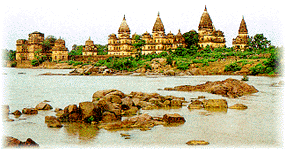
Orchha Temples
 Madhya
Pradesh is replete with unique handicrafts. Delicately woven Chanderi and
Maheshwari saris, carpets from Vidisha, Mandsaur and Sarguja, intricate
gold and silver embroidery, leather toys, stuffed animal miniatures, and
bead handbags, dazzling lacquer work, cigarette cases of Jabalpur stone
are all proof of the excellent craftsmanship of the people of the state.
Madhya
Pradesh is replete with unique handicrafts. Delicately woven Chanderi and
Maheshwari saris, carpets from Vidisha, Mandsaur and Sarguja, intricate
gold and silver embroidery, leather toys, stuffed animal miniatures, and
bead handbags, dazzling lacquer work, cigarette cases of Jabalpur stone
are all proof of the excellent craftsmanship of the people of the state.
Predominantly a Hindu state, Madhya Pradesh holds festivals throughout the year. Dussehra in Bastar (September/October), Diwali (October /November), Ram Navmi in Chitrakoot, Shivaratri and Holi and in Khajuraho and Ujjain (February/March) are the main attractions. The Gonds, Bhils and Banjaras have several vibrant tribal dances like Phag (a sword dance), Lota (dance by women balancing pitchers full of water on their heads), and other stilt dances.
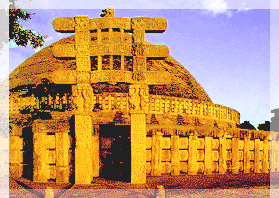
The oldest and most famous of Buddhist stupas - the Sanchi Stupa; murals of the Bagh caves; the world famous Khajuraho temples - which breathe the very essence of life; the serene loveliness of the Marble Rocks; the Gwalior fort; the royal legacies of Shivpuri; the prestigious wild game reserve at Kanha; the saga of a love story embossed in stone at Mandu are some of the interesting faces of this multi - faceted state.
The dense forests, covering one-third of the state, produce the country's best teak wood and also have some of the finest game reserves in Asia. Gwalior, Bundelkhand and Baghelkhand in the Malwa region of the state is abundant in rich black soil, Chattisgarh has a lighter sandy soil while the Narmada valley in the state has rich alluvial deposits. Principal crops of the state are rice, wheat, pulses, sugarcane, soyabean and mustard.
The major industries of the state are electronics, telecommunications, petrochemicals, food processing and automobiles. The state has also taken a lead in the production of cement. Madhya Pradesh occupies an important place in the sphere of mineral production. Prominent minerals of the state are coal, limestone, iron-ore, diamond, silica, phosphorite and tin. The state is also famous for its traditional handicrafts and handlooms manufactured at Chanderi and Maheshwar.
Contact
Madhya Pradesh Tourism Office, Gangotri, T.T. Nagar, Bhopal.
Tel: +91-755-554340, Fax: 552384



