An alluring atmosphere of mystery, a land wrapped in velvety silence, is what instantly strikes a visitor to Manipur, which literally means 'the land of jewels'. Described by Lord Irwin as the 'Switzerland of India', Manipur boasts of an exotic landscape with gently undulating hills, emerald green valleys, blue lakes and dense forests. It is the sheer tranquility enveloping it, interrupted only by a soft breeze, that sets it apart from the other North-Eastern states, and makes it the ideal getaway.
Bound by the states of Nagaland, Assam and Mizoram, Manipur shares an international boundary on the east with Myanmar. It is geographically divided into two distinct tracts - hills and plains. Predominantly a hill state, it is watered by the rivers Imphal, Iril, Thoubal, Irang and Barak, all of which flow from north to south.
Originally a princely state, Manipur was ruled by a succession of kings, who were descendants of Pakhangba, an Indian adventurer. The dynasty reigned uninterrupted, for a long time, till Manipur was made an integral part of the Indian Union, in 1949.
The characteristics of the Manipuri people vary according to geographical divisions. The Meitees who speak Manipuri, inhabit the plains, while the Kukis and Nagas of the hills, speak different Tibeto - Burmese dialects. Early Manipuris were followers of Hinduism, and believed in the hierarchy of the Gods. The advent of Christianity resulted in the conversion of the people residing in the hills, while the majority of men from the plains continued to be Hindus. Manipuris are enthusiastic polo players, and the game of polo is said to have originated here. 'Mukna - Kangjei', Manipuri free style hockey - cum - wrestling and 'Yubi-Lakpi', a game involving coconut - snatching, are traditional Manipuri games that are simply fascinating to watch.
Manipuri dancers
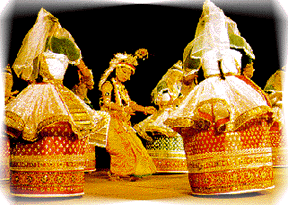 In
the field of art and culture, Manipur is best represented by the classical
Manipuri style of dance. A style peculiar to itself, its inspiration is
purely religious, and the dance usually relates to the Raas Lila, the love
story of Radha and Krishna. Lai Haroba (feast of dances, representing
celebrations of Gods / Goddesses), Pung Cholem (Mridanga dance),
Mao Naga dance, the Priestess dance of Malbe Jagoi, Thangal
Surung dance etc. reflect the vibrant culture of the 29 different tribes
of Manipur. Witnessing the exquisite Manipuri dance - drama, in its original
colourful settings, is simply an unforgettable experience.
In
the field of art and culture, Manipur is best represented by the classical
Manipuri style of dance. A style peculiar to itself, its inspiration is
purely religious, and the dance usually relates to the Raas Lila, the love
story of Radha and Krishna. Lai Haroba (feast of dances, representing
celebrations of Gods / Goddesses), Pung Cholem (Mridanga dance),
Mao Naga dance, the Priestess dance of Malbe Jagoi, Thangal
Surung dance etc. reflect the vibrant culture of the 29 different tribes
of Manipur. Witnessing the exquisite Manipuri dance - drama, in its original
colourful settings, is simply an unforgettable experience.
Important festivals of Manipur are the Dol Yatra (Holi) in March, Rath Yatra (Car fesival) in June-July and Durga Puja in September-October. Manipuri Hindus celebrate New Year Day, in the second week of April.
The handlooms and handicrafts of Manipur are renowned all over the country. Every house possesses a loom, and Manipuris weave with a passion and style, unrivalled by any other state. Manipuri bed covers of Moirangfee and flower designs, silk and cotton sarees, scarves, blankets and shawls, in distinctive shades and weaves, make for an enchanting collection. A wide range of artistic handicrafts from bamboo, papier mache, decorative ivory, dolls and jewellery make for prized souvenirs. These exquisite handlooms and handicrafts are sold at Khwairamband market, the largest exclusive women's market in the country, which is a must on every visitor's itinerary.
Agriculture and allied activities is the single largest source of livelihood, for a majority of the rural masses, and is also the mainstay of the state economy. Industry in Manipur is not very well developed. However, the state is now making rapid strides towards industrialisation, with the setting up of many large and small scale industrial units. The main industries of Manipur are pharmaceuticals, steel re-rolling, plywood, bamboo chipping, cement, vanaspati and electronics.
Manipur has a lot to offer to tourism enthusiasts. Imphal, the beautiful capital city in the valley; Mao and Ukhrul, the picturesque hill resorts; Taminglong, with its exotic landscape; Chandel, home to amazing tribes; Khonggom and Moirang, reminders of the British Raj in India; and a glimpse into the neighbouring country of Burma, through Moreh town on the border... a visit to these magnificent places, leaves a lingering impression on the mind of the visitor.



