Perched like a lone sentinel on the tip of the north eastern border of India, idyllic Mizoram is an amalgam of the former north and south Lushai hill districts. Mizoram is a land of great natural beauty, an endless variety of landscape with rich flora and fauna, clusters of whispering pines, and quaint villages with houses on stilts.
Mizoram, or the land of Mizos (highlanders), has international boundaries with Myanmar and Bangladesh while it shares its domestic borders with the states of Assam, Manipur and Tripura. The Tropic of Cancer runs through the heart of Mizoram, and hence, it has a pleasantly temperate climate throughout the year. A land of steep hills and deep gorges, Mizoram's highest peak 'The Blue Mountain' rises to a height of 2165 metres. Important rivers that flow through this hilly state are Tlawang, Sonai, Tuivawl, Kolodine and Kamaphuli.
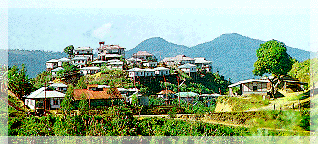
A view of Aizawl city
 The Mizos belonging to the Mongoloid race, are original settlers of the Shan
State of Burma. Two of the tribes, the Lushai and Himar, migrated to India
and occupied the Lushai hills. Mizoram was annexed in 1891 by the British
as Lushai Hill district, and made a part of Assam. With Independence, Mizoram
became a district of Assam. Mizoram was made a State of the Indian Union
on 20th February 1987, following the historic Mizoram Peace Accord, signed
between the Central Government and the Mizo National Front in June 1986.
The Mizos belonging to the Mongoloid race, are original settlers of the Shan
State of Burma. Two of the tribes, the Lushai and Himar, migrated to India
and occupied the Lushai hills. Mizoram was annexed in 1891 by the British
as Lushai Hill district, and made a part of Assam. With Independence, Mizoram
became a district of Assam. Mizoram was made a State of the Indian Union
on 20th February 1987, following the historic Mizoram Peace Accord, signed
between the Central Government and the Mizo National Front in June 1986.
The Mizos are divided into several tribes - the Lushais, Pawis, Paithes, Raltes, Pang, Himars, Kukis etc. Previously believers of the good spirit called Pathan, the Mizo community today is greatly influenced by Christianity. Mizos have accepted English as their medium of instruction, but the Mizo language is still widely spoken.
Culture
Though mostly Christians, the hill people have kept alive their rich cultural heritage, colourful customs and lively traditions. Festivals and dances of the Mizos have a unique tribal flavour. Other than Christmas and New Year's Day which are the most popular festivals, Chapchar Kut (after clearing of jungles for cultivation of the jhum crop in February-March), Pawl Kut (after the harvests when the granary is full in December) and Mim Kut (dedicated to departed souls after the maize harvest in September), are the other occasions celebrated with much gusto. The most popular dances of Mizoram are Cheraw (Bamboo dance), Khuallam (dance for visitors or guests), Chheih Lam (at the end of a day's work) and Solakar or Sarlamkai (prevalent among the Mara and Pawl tribes).
Sightseeing
Aizwal, the scenic capital of Mizoram, its surrounding areas and the rest of the state have been developed to meet the influx of domestic and foreign tourists. Aizawl, located at nearly 4,000 feet above sea -level, is a religious and cultural centre of the Mizos. Champai, Tamdil, Vantawng fall and Thenzawl are some of the other important tourist centres in this state.
Agriculture is the main profession of the Mizos. The main pattern of agriculture followed in Mizoram, is jhum or shifting cultivation. The government is now taking steps to do away with this pattern of agriculture, which is very harmful. They have now introduced a new system of contour farming, with trenches and hedging, with the intention of switching over to permanent cultivation on hill slopes. Mizoram is famous for the fibreless ginger grown in this area. Paddy, maize, mustard, sugarcane, sesame and potatoes are the other prominent crops grown in this area.


