รูปแบบต่างๆ
ของ Balanced
repeated measures (Kleinbaum,
1998)




2.
A Balanced Repeated Measures Design With Two
Crossover Factors
Table 4 Data layout for balanced repeated measures design with two crossover factors.
|
|
|
Factor
B |
|||
|
Factor
A |
Subject
Number |
1 |
2 |
… |
B |
|
1 |
1 2 : s |
Y111 Y211 : Ys11 |
Y112 Y212 : Ys12 |
|
Y11b Y21b : YS1b |
|
2 |
1 2 : s |
Y121 Y221 : Ys21 |
Y122 Y222 : Ys22 |
|
Y12b Y22b : YS2b |
|
|
: |
: |
: |
… |
: |
|
a |
1 2 : s |
Y1a1 Y2a1 : Ysa1 |
Y1a2 Y2a2 : Ysa2 |
|
Y1ab Y2ab : Ysab |
Yijk
= m
+ Si + aj
+ bk
+ djk
+ Sij + Sik + Eijk
(2)
Where
i = 1,…,s (s = number of
subject)
j = 1,…,a (a = Number of level of Factor A)
k = 1,…,b (b = Number of level of Factor B)
m
= Overall mean
aj
= Fixed effect of level j of Factor A (and
åaj
=0)
bk
= Fixed effect of level k of Factor B (and
åbk
=0)
djk
= Fixed interaction effect of level j Factor A with level k of Factor B
(and
ådjk
=0 for each k, ådjk
=0 for each j)
Si = Random effect of subject i
Sij = Random effect of level j of Factor A within
subject i
Sik = Random effect of level k of Factor B within
subject i
Eijk = Random error for
level j of Factor A and level k Factor B within subject i
And
we assumed that
{ Si },{ Sij },{ Sik } and { Eijk
} are mutually independent.
Si is distributed as N(0,sS2)
Sij is distributed as N(0,sSA2)
Sik is distributed as N(0,sSB2)
Eijk is distributed as
N(0,s2)
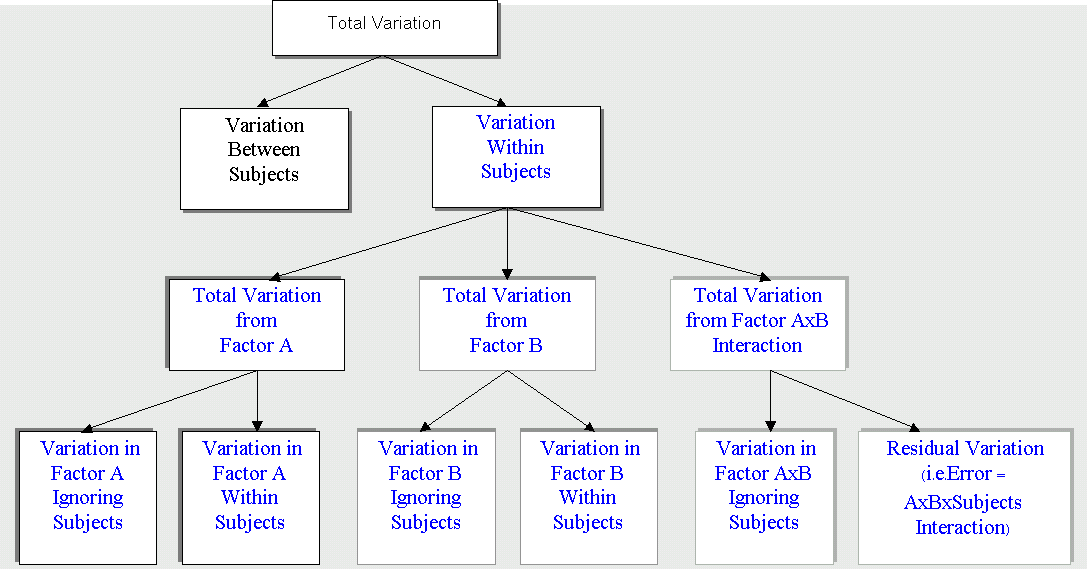
Figure
2
Partitioning the total sums of squares for balanced repeated
measures design with two crossover factors.
คลิกขยายภาพ
Table
5 ANOVA table for balanced repeated measure
design with Two crossover factor.
|
Source |
d.f. |
MS |
F
(Both Factor Fixed) |
F
(One or Both Factors Random) |
|
Between
Subjects |
s-1 |
MSS |
|
|
|
Within
Subjects |
(s-1)ab |
MSW |
|
|
|
Factor
A |
a-1 |
MSA |
MSA
/MSSA |
MSA
/MSSA(adj) |
|
Subjects
x Factor A |
(s-1)(a-1) |
MSSA |
|
|
|
Factor
B |
b-1 |
MSB |
MSB
/MSSB |
MSB
/MSSB(adj) |
|
Subjects
x Factor B |
(s-1)(b-1) |
MSSB |
|
|
|
A
x B |
(a-1)(b-1) |
MSAB |
MSAB
/MSError |
MSAB
/MSError |
|
Subjects
x A x B (i.e.Error) |
(s-1)(a-1)(b-1) |
MSError |
|
|
|
Total
(corrected) |
sab |
|
|
|
(ตัวอย่างการวิเคราะห์ สามารถศึกษาตัวอย่างการวิเคราะห์ด้วย SPSS ได้ที่ Using SPSS: Two-way Repeated-Measures ANOVA และคำอธิบายโดยละเอียดที่ (Research Methods 2): Two Way Repeated Measures ANOVA )