W A MOZART
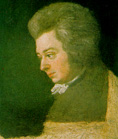
( 1756 - 1791 )
[Major Works]
[
Introduction to some of his works]
Mozart's Life
As we all know that Mozart was a
child prodigy. Born on the 27 of
January, 1756, in Salzburg, Austria,
he could pick out tunes on the
harpsichord at three, play a violin
at four and was composing his own
music by the time he gave his first
public performance at five and a half.
By the time he was twelve he had
written three operas, six symphonies
and hundreds of other works. Mozart's
father was an accomplished
violinist in Salzburg playing for
the Archbishop.He saw the potential
earning power of Wolfgang's
extraordinary talents, and set about
arranging tours of Europe to show
off this unique musical gift and
also to secure an independent future
for his son. From the age of six,
Mozart spent the next eleven years
of his life on tour. Together with
his sister, who play the harpsicord,
they gave exhibition performance
in all the great cities and in all
the best houses. This unnatural life of
continuous travel took its toll on
Mozart's health and personality. As
a result, he was smaller and thinner
than other children of his age and
was constantly laid low by lifethreating
illness, including tyhoid, which
dogged him all his life. His sunny
disposition gained him popularity
and he was instantly at ease with
all the new people he met. As he was
always on the move, he had very little
opportunity to form any close
relationships and he had no real
friends. At the age of 17, Mozart
returned home from his tour. Four
years later, he, with the company
of his mother, went on a concert
tour of Germany. He accepted a steady
jod as organist to the Archbishop of
Salzburg after his mother died in
July, 1777. However, he did not stay
long. Finding out that the restrictions
were
intolerable, he resigned and went to
Vienna. In 1782, he married
Constanza ignoring his father's
objection. Their relationship was not
passionate, but both were fun-loving
and enjoyed each other's company.
Even though Mozart was very well paid,
but neither he nor Constanza had
any idea how to organise their finances.
Therefore, they are always shot
of money. He needed a post at Court
to provide him with the patronage
and stability he can depend on. The
opportunity presented itself in 1787.
The Emperor Joseph II was enthusiastic
about Mozart's work but the
Court favoured his rival, Italian
composer Antonio Salieri. He was bitterly
disappointed when the Emperor
appointed Salieri royal orchestra master,
and he had to be content with being
composing dances and light music
to order. During his last four years
of his life, in extreme poverty and
debt, Mozart created some of his finest
works, including Don Giovanni
and the Magic flute. By autumn
1891, Mozart was very ill and was
confined to his bed by 20 November.
On first of December he was
appointed musical director of St
Stephen's Cathedral in Vienna, which
would have solved his finance problems,
but he died four days later.
Though Mozart was not able to
develop a personality capable of
achieving a happy or fulfilled life,
but somehow the most beautiful music
just flowed from him. He was one of
the greatest creative geniuses ever
known.
His Great Works
41 Symphonies
Symphony No.31 in D 'Paris', K297
Symphony No.35 in D 'Haffner', K385
Symphony No.36 in C 'Linz', K425
Symphony No.38 in D 'Prague', K504
Symphony No.40 in G minor, K550
Symphony No.41 in C 'Jupiter', K551
27 Piano Concertos
Piano Concerto No.20 in D minor, K466
Piano Concerto No.21 in C, K467
Piano Concerto No.23 in A, K488
Piano Concerto No.26 in D 'Coronation', K537
5 Violin Concertos
Violin Concerto No.3 in G, K216
Violin Concerto No.4 in D, K218
Violin Concerto No.5 in A, K219
4 Horn Concertos
Horn Concerto No.2 in E#, K417
Horn Concerto No.3 in E#, K447
Horn Concerto No.4 in E#, K495
Other Concertos
Clarinet Concerto in A, K622
Basson Concerto
Oboe Concerto
Flute and Harp Concerto in C, K299
Flute Concerto No.1
Flute Concerto No.2
Chamber Music
String Quartet No.17 in Bb, K458
String Quartet No.18 in A, K464
String Quartet No.19 in C, K465
Charinet Quartet No.17 in A, K581
21 Piano Sonatas
Piano Sonata in A, K331
Piano Sonata in C, K545
Operas
Marriage of Figaro, K492
Don Giovanni, K527
Cosi Fan Tutte, K588
Magic Flute, K620
Choral
Requiem Mass in D minor, K626
Introduction to some of his works
Piano Sonata in A, K331
-
Andante grazioso, Variations 1 - 6
-
Menuetto
-
Alla Turca - Allegretto
In Parisian style, this Mozart's Sonata
in A, K. 331 begins with a theme
and variations movement. The theme
and variations opening movement
replaces the Allegro which usually
opens a traditional Sonata. Except
for minor variations, the theme
remains constant through the movement,
resulting in an expressive melodic
line. The second movement is a Minuet
which replaces the slow movement in
the middle of a traditional Sonata.
The final movement "Alla Turca", is
well known among music-lovers. It is
a perfect example of the French rondo,
containing major and minor
sections, and concluding with a da capo.
Piano Sonata in C, K545
-
Allegro
-
Andante
-
Rondo
The Sonata in C, K.545, was written by Mozart
primarily as an instructional piece. It contains
elements of piano technique that Mozart expected
his beginner students to master. Nonetheless, it
gives hints as to the brilliant nature of its
composer.
Piano Music
-
Fantasy in D minor, K397
-
Variations on "Ah! Vous dirai-je, maman"
-
Mozart's Fantasy in D minor, K. 397 is considered
one of the composer's finest works
for piano. It is not technically difficult to play.
The beauty of this work is in the many
contrasts of mood that Mozart achieves.
-
The melody which we commonly know as
"Twinkle Twinkle Little Star" first
appeared without words in 1761 as "Ah!
Vous dirai-je, maman". While keeping in
mind that Variations on a theme often
reveals the essence of a composer's creativity,
it is fun to listen to Mozart's 12 Variations
on this children's melody.
Eine Kleine Nachtmusik in G, K525
Allegro
This serenade written for a string quartet and
a double bass was completed on the 10 of August,
1787. It was composed as entertainment music,
speciically as after-dinner music as its name
'a little night music' implies. Originally
there were five movements but one, the second
movement, has been lost. It was probably
removed by Mozart himself prior to publication.
[Vienna City]
[Music Hall]
[Beethoven's page]
[Chopin's Page]
[Music Game]
This page hosted by
 Get your own Free Home Page