Colonial Mexico
(Day 7) Patzcuaro
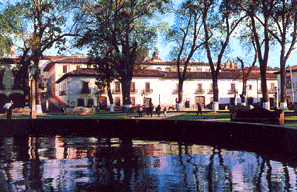 Pátzcuaro,
built on the hills sloping back from Lake Pátzcuaro, has
a 16th-century atmosphere. Along with its red and cream-colored
churches, mansions and other buildings erected during 3 centuries
of Spanish rule, the city boasts one of Mexico's loveliest colonial
plazas. Several of the 17th century mansions around the Plaza
Vasco de Quiroga have been turned into elegant colonial style
hotels, all with restaurants. One of the most attractive is the
Hotel Los Escudos, on the west side of the Plaza. This is the
hotel we choose to stay in as it has secure parking (about two
blocks from the Plaza), an excellent restaurant and within walking
distance of all the historical sights. Be sure to try the Tarasco
soup and the local pescado blanco (white fish) caught in the
nearby lake.
Pátzcuaro,
built on the hills sloping back from Lake Pátzcuaro, has
a 16th-century atmosphere. Along with its red and cream-colored
churches, mansions and other buildings erected during 3 centuries
of Spanish rule, the city boasts one of Mexico's loveliest colonial
plazas. Several of the 17th century mansions around the Plaza
Vasco de Quiroga have been turned into elegant colonial style
hotels, all with restaurants. One of the most attractive is the
Hotel Los Escudos, on the west side of the Plaza. This is the
hotel we choose to stay in as it has secure parking (about two
blocks from the Plaza), an excellent restaurant and within walking
distance of all the historical sights. Be sure to try the Tarasco
soup and the local pescado blanco (white fish) caught in the
nearby lake.
Patzcuaro was the Tarascan
Indian capital from probably about 1325 to 1400. Then, on the
death of the powerful king Tarikuri, the Tarascan state became
a three-part league comprising Patzcuaro, Tzintzuntzan and Ihuatzio,
the last two both on the east side of the lake. First Ihuatzio
dominated, then Tzintzuntzan. The league repulsed Aztec attacks
and the Spanish first came to the area in 1522, when they received
a friendly reception. They then came back in 1529 under Nuno
de Guzman the conquistador of legendary cruelty. Guzman's inhumanity
to the Indians was so severe that the Catholic church and the
colonial government sent Vasco de Quiroga, a respected judge
and churchman from Mexico City, to straighten out the mess he
had left. Quiroga, who arrived in 1536, established a bishopric
(based initially at Tzintzuntzan, then from 1540 at Patzcuaro)
and pioneered Indian village co-operatives based on the humanistic
ideas of Sir Thomas More's Utopia. To avoid Indian dependence
on Spanish mining lords and landowners, Quiroga successfully
encouraged education and agricultural self-sufficiency in the
villages around Lago (lake) Patzcuaro with all villagers contributing
equally to the community. He also helped each village develop
its own craft speciality. The Utopian communities declined after
his death in 1565 but the craft tradition continues to this day.
Not surprisingly, Tata Vascu, as the Indians called him, is much
venerated for his work; streets, plazas, restaurants and hotels
in Michoacan are named after him.
Tarasco Indians from villages surrounding Lake Pátzcuaro
bring handicrafts into town each Friday on market day. Available
craftwork includes copper items from the nearby village of Santa
Clara del Cobre (also known as Villa Escalante), as well as lacquerware,
sisal mats and rugs, silver jewelry, pottery, fabrics and woodenware.
The city's commercial center, a block north of the main plaza,
is filled with vendors and crowded with handicraft shops.
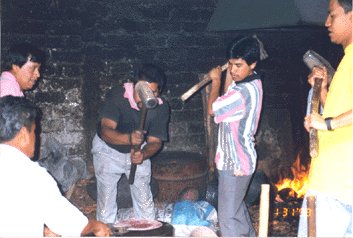 A ride
out to Santa Clara del Cobre (about 20 miles) is well worth the
effort. Here, local copper artisans still make copper artwork
as they did hundreds of years ago. This author's favorite place
to observe craftsmen in operation is at the home of Senior Ramiro
Ramirez. Simply ride to the Plaza and ask directions. Young boys
often hang around the Plaza and will lead you to the Ramirez
home and foundry (two blocks from the Plaza) for ten Pesos (about
a dollar).
A ride
out to Santa Clara del Cobre (about 20 miles) is well worth the
effort. Here, local copper artisans still make copper artwork
as they did hundreds of years ago. This author's favorite place
to observe craftsmen in operation is at the home of Senior Ramiro
Ramirez. Simply ride to the Plaza and ask directions. Young boys
often hang around the Plaza and will lead you to the Ramirez
home and foundry (two blocks from the Plaza) for ten Pesos (about
a dollar).
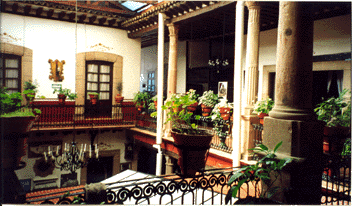
La Casa de los Once Patios (House of the Eleven Patios), half
a block south of Plaza Vasco de Quiroga, was once a Dominican
convent in the 1740s. Even earlier, it was the site of one of
Mexico's first hospitals. It now houses the studios and galleries
of painters and artisans, whom visitors can watch at work. The
building also contains boutiques selling handicrafts.
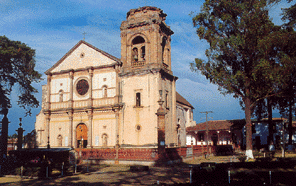 Basilica,
on a hill 2 blocks east of the plaza, dates from 1554. The venerated
Virgin of Health, on the main altar, is made from a paste of
crushed cornstalks mixed with a substance extracted from orchids.
Created to attract the Indians of the region to Catholicism,
the image is credited with miraculous healing powers. On Dec.
8 a fiesta honors the Virgin. Every morning women set up shop
in the church's park to serve a breakfast of corundas, triangular
tamales wrapped in corn husks, and atole, a warm drink made of
ground cornmeal or rice that has a thick consistency and often
is flavored with vanilla.
Basilica,
on a hill 2 blocks east of the plaza, dates from 1554. The venerated
Virgin of Health, on the main altar, is made from a paste of
crushed cornstalks mixed with a substance extracted from orchids.
Created to attract the Indians of the region to Catholicism,
the image is credited with miraculous healing powers. On Dec.
8 a fiesta honors the Virgin. Every morning women set up shop
in the church's park to serve a breakfast of corundas, triangular
tamales wrapped in corn husks, and atole, a warm drink made of
ground cornmeal or rice that has a thick consistency and often
is flavored with vanilla.
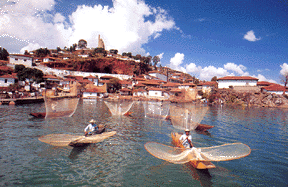 Lake
Patzcuaro, is one of the highest lakes in the country. Around
the lakeshore are a score or more of tiny Tarasco villages, many
accessible only by boat. Fishing is the chief occupation. The
distinctive ''butterfly'' nets that once were the main tool of
local fishermen now appear mostly for photographers; the fishing
fleet has adopted more modern means, although traditional canoes
carved from a single tree trunk are still used. the lake still
yields the pescado blanco, a small, almost transparent whitefish
that has long been a local delicacy.
Lake
Patzcuaro, is one of the highest lakes in the country. Around
the lakeshore are a score or more of tiny Tarasco villages, many
accessible only by boat. Fishing is the chief occupation. The
distinctive ''butterfly'' nets that once were the main tool of
local fishermen now appear mostly for photographers; the fishing
fleet has adopted more modern means, although traditional canoes
carved from a single tree trunk are still used. the lake still
yields the pescado blanco, a small, almost transparent whitefish
that has long been a local delicacy.
Once the capital of a powerful
Tarascan kingdom, Tzintzuntzan (about 10 miles from Patzcuaro)
is now a small village on the shores of Lake Pátzcuaro.
The curious name means ''the place of the hummingbirds'' in the
Tarasco Indian language. This area is one of the largest sources
of inexpensive hand-painted pottery in Mexico. Local artisans
decorate their pottery with simple, childlike drawings of swans,
fish and native net fishermen. The Tarascan also weave figurines
and table and floor mats out of reeds. Another cottage industry
is woodcarving; items range from small wall decorations, dishes
and flowerpots to doors, windows and columns.
The restored 16th-century Franciscan Convent of Santa Ana can
be visited. The church courtyard is noted for its olive trees,
which were planted by Don Vasco de Quiroga despite a Spanish
injunction against planting the trees in the New World. Restored
yácatas, ruins of Tarasco pyramids, are visible from Mex.
120; a paved side road leads to the edge of the site.
A full day in Patzcuaro and a ride to Santa Clara del Cobre prepare us for the short ride to Angangueo and a visit to the winter hibernation grounds of the Monarch butterfly. Head back to Morelia on the four lane highway. When you reach the circle by-pass around Morelia you will head east on the by-pass until you are generally on the east side of the city looking for signs to highway 15 to Cd. Hidalgo, Zitacuaro and Mexico City. This is a major road and you should have no trouble finding it. You will begin climbing to altitude and enjoy a great ride through some fantastic mountain roads! Watch the pine straw on the road as it gets slippery in the corners where it tends to build up. Continue on highway 15, going around (by-pass) Cd. Hidalgo. Just before you come to Zitacuaro (about 40 miles from Morelia) you will turn off the main road heading north to Angangueo (about 12 miles). This will be your base for visiting the Monarch butterfly reserve.