General
Directions Cutting
Layout Outershell
Innershell Assembly
Innershell Construction
Pocket
features:
All the
pockets (for 2 rulers (3"x 18", 6"x 24"), small mat (6"x1
8"), rotary cutter and scissors (one pocket stores both), calculator, thimble, and
needle case) are constructed in the same manner and all the pockets, except for the
thimble pocket and the needle case, have flap closures to prevent accidental loss of
contents. The pockets and flaps are completely finished before being applied to the
background.
Pockets
Cutting
Dimensions
|
|
|
|
|
Quilted
Fabric |
|
To Store |
Label |
Print |
Print |
Backing/ |
Pocket |
Flap |
Mat 6x18” |
A |
3 |
8x28 |
9x29 |
7x19 |
6x6 |
Ruler
3x18" |
B |
4 |
5x255 |
6x26 |
4x19 |
3x5 |
Ruler
6x24 |
C |
5 |
8x35 |
9x36 |
7x25 |
6x6 |
Pencils |
D |
6 |
* |
* |
* |
* |
Magazines |
I |
3 |
* |
* |
* |
* |
Thread |
J |
3 |
* |
* |
* |
* |
Needles |
E |
3 |
5x5 |
6x6 |
4x4 |
none |
Thimbles |
F |
4 |
3x5 |
4x6 |
2x3.5 |
none |
Rot.
Cutter/Scissors |
G |
4 |
6x16 |
7x17 |
5x10 |
4x4 |
Calculator |
H |
5 |
6x12 |
6x13 |
5x7 |
4x4 |
* See
individual pocket directions for specifics. All dimensions are in inches.
Pocket Construction
Cutting
Pocket Fabrics
Using the
table above, cut print fabrics and matching backing fabrics and batting to the
measurements specified. To save time, stack the pieces that go together in one pile and
label them according to the chart. Keep label attached until finished.
Quilting
the Fabric for the Pockets
Place
backing fabric wrong side up, cover with the batting, and top with the print fabric which
is right side up. Secure layers with basting or pins. Hand or machine quilt (use an
evenfeed foot if you have one). Use either matching thread, monofilament nylon thread
(only in the needle, never in the bobbin), or white thread.
Cutting
Pockets and Flaps
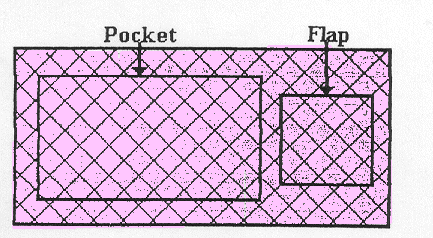 From this quilted fabric, cut out the
pockets and their matching
From this quilted fabric, cut out the
pockets and their matching
flaps, refer to Table 1. All the pockets are rectangular. The flaps
may be rectangular or you may prefer to cut the corners off
Preparing
the Binding for Pockets and Flaps
From #1
(navy) fabric, cut 10 strips 2"x42". Place one of these
strips aside, it will be used to make the flap the flap closure. Join
the strips to form 1 continuous binding strip.
Preparing
Flap Closures (optional: velcro may be used instead)
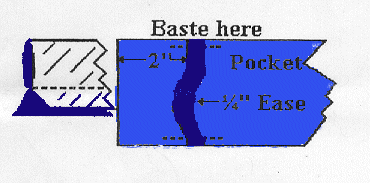 Use the strip that was put aside, fold
in half with right sides together,
Use the strip that was put aside, fold
in half with right sides together,
stitch, turn and press. Measure the width of each pocket, add 1/4" for
ease (ie. allows enough space to insert the flap), and cut to this
measurement. Baste to the upper edge of the pocket; on the larger
pockets baste it about 2" down from the top, and on smaller pockets,
baste it about l" to 2" down from the top. The raw edges will be
caught by the binding.
Sewing
the Binding
All pockets
and flaps have binding all around their perimeter (except pocket C, it has binding on 3
sides only. With raw edges (of prepared binding and quilted fabric) even, stitch all
around the pocket or flap using a 1/4" seam. Turn binding to the back. Pin the edge
of the binding so that it just covers the stitching line on the back. The binding along
the long sides and along the bottom of the pockets need only be basted because it will be
caught in the seam when the pockets are sewn to the background fabric. However the top
edge of the pockets will be open and needs to he finished, slipstitch it by hand, starting
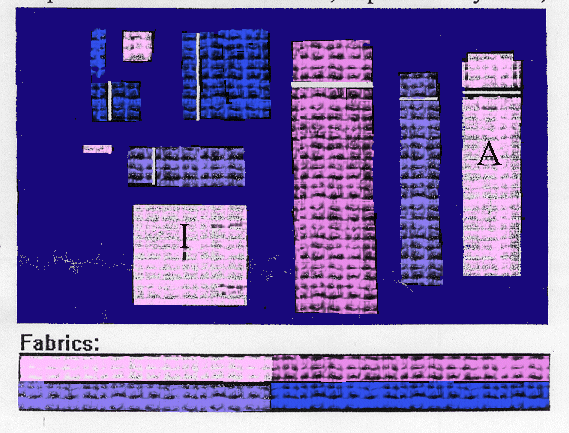 just below the
corner, going across the top, and stitching just past the next corner (cleaner corners are
produced in this way). The flaps are finished by hand.
just below the
corner, going across the top, and stitching just past the next corner (cleaner corners are
produced in this way). The flaps are finished by hand.
Pocket
"C"
The binding
does not extend all the way around "pocket C" because the bottom end of the
pocket will be caught in the tote binding during the last steps of tote construction.
Apply the binding along the 2 long sides and 1 short side of the pocket, making sure that
you have applied the flap closure to the end of the pocket that is finished with binding.
Pencil
Case "D"
The pencil
case has a decorative zipper closure. The zipper is inserted before the case is quilted.
·
From print #6 and backing fabric, cut: one 3"x 10" rectangle
"A", and one 7"x 10" rectangle "B".
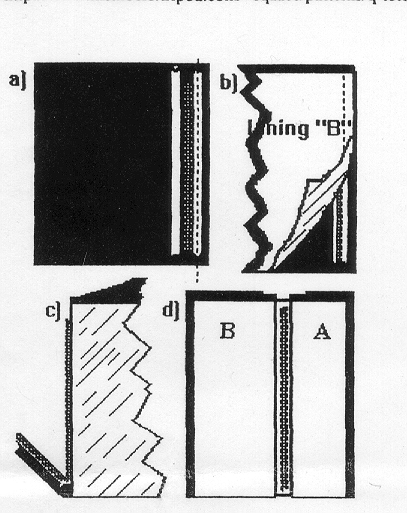
To sew the zipper, place it face down on right side of "B" at the longer upper edge, line up raw edge of "B" with zipper tape (a). Roughly centre zipper on the fabric, excess will be
cut away after quilting.Baste zipper to "B". Place backing "B" right side down on on the "print B/zipper" piece, so that
the zipper is sandwiched between the two fabrics (b). Stitch close to zipper teeth using zipper foot. Fold both fabrics away from the zipper (c), press, being careful not to touch the zipper with the iron (d). Repeat with other side of zipper and the 2 "B" pieces.Quilting the fabric: slip a piece of batting between the layers of print "A" and backing "A", and between "B" and "B". Pin or baste. Machine quilt. Trim quilted case to approx. 6"x8".
Bind all around with prepared binding
Needle
Case "E"
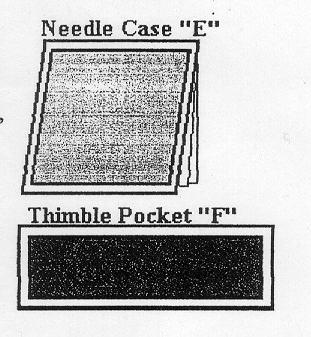 It is not a pocket, but a flap. It is
secured in the same way as the other flaps. One or 2 pinked "sheets" of fabric
could be inserted under the "flap", they could even be labeled if you have a
permanent ink fabric pencil (ie. sharps #7, quilting #8, etc.). Baste the
"sheets" to the quilted fabric at one end, bind, catching the "sheets"
in the seam at the one end only, like a book.
It is not a pocket, but a flap. It is
secured in the same way as the other flaps. One or 2 pinked "sheets" of fabric
could be inserted under the "flap", they could even be labeled if you have a
permanent ink fabric pencil (ie. sharps #7, quilting #8, etc.). Baste the
"sheets" to the quilted fabric at one end, bind, catching the "sheets"
in the seam at the one end only, like a book.
Thimble
Pocket "F"
It is only a
small narrow pocket, just big enough to slide your finger and thimble into. Thimble will
not slip out, and more than one thimble can be stored. There is no flap (Fig. 15). Cut
quilted fabric to size and bind.
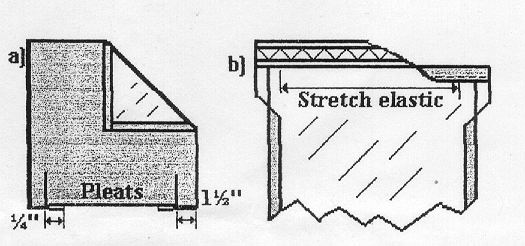 Magazine Holder "I"
It is used
to carry extra note and graph paper and a magazine or 2; it will also carry 1 light book.
It is not quilted. There is an elastic at the upper edge to hold the magazines snug.
From #3 print Cut a 10"xlO" square. On all 4 sides, fold 1/4" seam allowance to the back and press. At the bottom edge create 2 small folds, 1/2" from the sides and 1/4" deep. Have pleat face out. Baste in place (a)
.Apply elastic to upper edge: cut an 8
1/2" length of 1/4" elastic. Place elastic right over the folded seam allowance
on the wrong side of the fabric (b).
.
Stitch
elastic, using a zigzag stitch, match centres. Don't stretch the elastic for the first and
last 1/2". Fold the top edge right over the elastic so that it is completely covered
and, using a straight stitch, stitch close to the lower edge using a straight stitch.
The pocket
is topstitched to the background along the sides and bottom.
Thread
Holder "J"
I
Using print
#3, cut a 3"x7" rectangle. Fold it in half lengthwise with right sides together.
Sew
along the
raw edge, leaving at least 2" unstitched in the middle for turning (a). Press seam
open.
Lay the
"tube" Hat so that the seam is centered, stitch ends(b). Turn to right side.

Cut 4
lengths of 1/8" ribbon, (cut ends on the bias to prevent ravelling). Bar tack the
centre of each of ribbons over the centre of the prepared print rectangle (the seam
underneath provides additional strength and support (c).
.Topstitch
the thread holder in position on the background fabric (panel "A").
Cutting
Background Fabric
Measure the
quilted outershell "sides A and B" - they should measure 26"x21", but
use your own measurements for more accuracy and add a 2" allowance all around:
length
______ + 2"= _________,width ______ + 2"=_________
Use these
measurements to cut the 2 innershell (background) pieces from #1 dark solid colour. (The
extra 2" are added to allow for takeup. Once the pockets are sewn on, the background
pieces are measured again and trimmed.)
POCKET
PLACEMENT
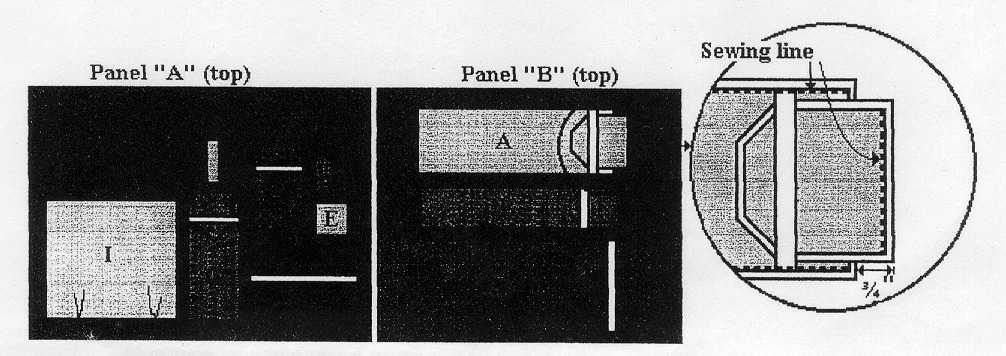
Panel “B”
.Position
"pocket C" first; it has to be placed sideways at the bottom of the tote
(because of the weight of the ruler), about 2" above the lower edge. Also the lower
end of "pocket C" has to be even with the raw edge of the background fabric
because that end will be enclosed by the binding that will placed around the perimeter of
the tote.
Centre the
other pockets above "pocket C". For ease of access, have all flaps open in the
same direction.
Panel "A"
.Before
pockets are sewn to "panel A", the top edge is hemmed to create the opening for
the pocket that is concealed between the inner and outer shells; this pocket stores the
large 18"x24" cutting mat.
To hem top
edge: fold 1" seam allowance to the wrong side, and fold again another inch to
conceal raw edge. Machine stitch.
Notice that
all the pockets on this side open toward the top of the tote, this is to prevent objects
from inadvertently slipping out. Stitch all pockets in position (refer to "Sewing the
Pockets"), leaving at least a 2" margin around the perimeter of the panel.
Sewing
the Pockets
The pockets
arid the pencil case are topstitched to the background. Using a matching thread and a
straight stitch, sew "in the ditch" along the inside edge of the binding. Make
sure that the binding (remember that it was basted to the back) is caught in the seam. A
second line of topstitching can also be sewn along the outside edge of the binding but it
is not necessary.
Don't forget
to leave the one open edge on the pockets!
The flaps
and needle case E are sewn at the top edge only, so that the other 3 sides are hanging
free. The flaps are centred 3/4" above the adjacent pocket.