Identifying
Newly Rescued Chicks
---------------------------------
Nestlings
The following 3
tables are offered to help you roughly identify which species of
nestling you may have. Underlined traits are generally
diagnostic to identifying the listed species. All
other traits are open to interpretation (ex. is it white,
off-white, or cream colored?) Empty fields are unknown by me.
Since I'm not a professional, I have not seen many nestlings
myself. (In fact, I've only ever seen sparrow nestlings) These
descriptions are based on several other sources. I can only hope
this table will help you narrow down the possibilities of which
species you may have found. I hope to add nestling pictures here,
if I ever find any.
| Species |
|
skin
color |
down
color |
gape
color |
flanges |
feeding
call |
special
characteristics |
| |
|
|
|
|
|
|
|
| Mockingbird |
|
grayish |
gray |
bright yellow |
softer yellow |
high-pitched kitten
like miew |
tarsus light gray-blue
at 3-4 days |
| Mourning dove |
|
grayish |
tan-gray, sparse |
|
|
|
|
| Barn swallow |
|
pink |
gray |
bright yellow |
pale yellow, swollen |
|
|
| Chimney swift
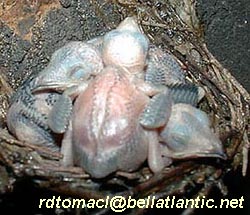
|
|
pinkish |
no down |
pale pink |
no flanges |
|
well developed sharp
claws, no face bristles |
| Starling |
|
pale pink |
off-white, sparse |
bright yellow |
swollen |
loud trilling, deepens
in pitch as they get older |
|
| House sparrow |
|
pale yellowish pink |
no down |
red |
yellow swollen |
drawn-out repeated
squeaks or "peeps" |
|
| Species |
|
skin
color |
down
color |
gape
color |
flanges |
feeding
call |
special
characteristics |
|
| |
|
|
|
|
|
|
|
|
| Robin |
|
pinkish yellow |
off-white, sparse |
bright orange-yellow |
pale yellow |
|
|
|
| Cardinal |
|
dark pink |
gray, sparse |
red |
white |
|
|
|
| Catbird |
|
dark and reddish |
|
|
|
delicate high-pitched
trilling |
tarsusdark gray |
|
| Blue jay |
|
first red, then after
a few days, gray |
no down |
bright red |
white flanges |
|
|
|
| Common crow |
|
dark |
sparse |
red |
|
|
|
|
| Grackle |
|
yellow |
gray |
pale red |
|
|
brown eyes |
|
| Species |
|
skin
color |
down
color |
gape
color |
flanges |
feeding
call |
special
characteristics |
|
| |
|
|
|
|
|
|
|
|
| House finch |
|
|
off-white |
red |
yellow |
|
|
|
| Goldfinch |
|
|
white |
red |
|
|
|
|
| Song sparrow |
|
|
light-gray, sparse |
red |
white |
|
|
|
| Pigeon |
|
|
yellow, straggly |
|
|
|
|
|
| Bluebird |
|
|
dark gray |
yellow |
light yellow? |
|
|
|
| Cowbird |
|
|
light-gray |
bright red |
white |
high-pitched,
"squeak-like" trill |
|
|
Click this box to return to the
"Nestlings" page.
|
---------------------------------
Fledglings
The following
table is offered to help you identify which fledgling you may
have found. Fledglings are far easier to identify than nestlings.
It must be kept in mind that fledglings often do not have the
same coloration as the parents. Underlined passages are
generally diagnostic for the listed species. Some
descriptions, usually those involving color, can be
interpretative. This is for fledgling identification only, and
assumes that you are familiar with or can research adult
appearance yourself. Again, if I ever find any fledgling
pictures, I will eventually add them here.
Once you have
properly identified a fledgling, you must adapt any care you are
giving it as noted on the "Species Info" page.
| Species |
|
Description |
| |
|
|
| Mockingbird
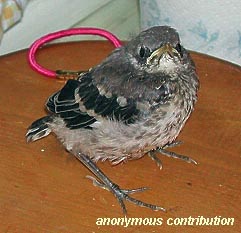
|
|
Grayish with darker
wings and tail, and paler breast. Breast of fledgling
usually has some slight mottling. Tail shorter than
adults for some time after fledging. |
| Mourning dove |
|
Slightly smaller or
thinner than adult, smoother plumage, occasionally some
marbling caused by white-tipped feathers. |
| Barn swallow |
|
Identical to adults. |
| Chimney swift |
|
Identical to parents.
Tiny bill and feet, short
spiny tail, wings extend to or past tail. No
face bristles. |
| Starling |
|
Smooth dark gray
with light gray breast which becomes paler around throat.
Long bill almost black. Darker streaks appear
over time. |
| House sparrow |
|
Same size as parents.
Similar to female house sparrows. Mottled brown with
gray-white breast, no cap or black throat patch. There
may be some variation in markings, particularly for young
males. |
| Robin |
|
Same size as parents,
but much paler. Mostly brown gray on top, ruddy breast
freckled with darker spots or stripes. |
| Cardinal 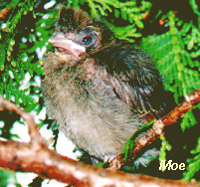
|
|
When first fledged,
fledgling cardinal is brown, lacks
feathers on the face, and is less than 1/2 the size of
the parents. Has a bulge on forehead which
will develop into the crest later. Once fully grown and
feathered, resembles the female cardinal, but has a
blackish beak instead of the adults' colored one. |
| Catbird |
|
Gray plumage, slightly
paler breast, black cap. |
| Blue jay |
|
Virtually identical to
adults. Coloration somewhat more "matte". Crest
somewhat less pronounced. Big, shiny, curious, black
eyes. |
| Common crow |
|
Similar to adults, but
are dull black instead of shiny black. |
| Grackle |
|
Lacks feathers on
the face, plumage is smooth sooty-gray, as
opposed to black body with blue head in adults. Eyes
brown. Generally walk instead of hopping. |
| House finch |
|
Appearance similar to
adults, but coloration of young males is a slightly rosy
version of the adult female coloration. |
| Song sparrow |
|
Slightly duller
coloration than adults, with finer streaks, and sometimes
without the black breast-patch. |
| Pigeon |
|
Slightly smaller and
thinner than adult, variable coloration. Brown eyes. |
| Bluebird |
|
Grayish above, hints
of blue in wings and tail, speckled breast. |
| Cowbird |
|
Light gray all over.
Some very small pale spots or stripes may be present on
wings and around neck to breast. No tail feathers visible
for some time after becoming free flying. No feathers on
face when first fledged. |
Click this box to return to the
"Fledglings" page.
|
-------------------------------------
This website is not intended
to replace the expert care that is only available by professional
rehabilitators. The use of this website is only intended for
those where the option of bringing an orphaned bird to a
rehabilitator is not possible. By raising a wild bird yourself,
you greatly diminish it's chances for survival. Please check this
link for a rehabilitation center in your community:
http://www.tc.umn.edu/~devo0028/contact.htm. If none are listed
near you, call a local animal shelter, veterinarian, or wildlife
office/agent for information on local rescue centers. Thank you.
-------------------------------
Last updated:05/10/2006