117 Interesting and
Influential Family Members
From 1900 to 1945
1016-1840
1840-1900 1900-1945
1945-Present
|
|
|

Chaff -
2
Chafy - 2
Chafe - 25
Chaffe - 4
Chafey - 1
Chafee - 5
Chaffey - 28
Chaffee - 39
Chaif - 1
Shared - 10 |


James
Warren Chafe:
(1900-1984) Born in Springfield, Manitoba. Son of James Warren Chafe
(1862-1922) from Quidi Vidi, Newfoundland, Jim Chafe lived most of his life in
Winnipeg. His accomplishments were numerous, and he was, often at the
same time, an actor, athlete, author, broadcaster
, educator, musician and
playwright. As a young man he learned to play six musical instruments
including the trombone. In the 1920s he acted with traveling theatre
companies in Canada and the USA and, as a left handed pitcher with a
devastating roundhouse curve, set a baseball strikeout record that remained
unsurpassed for over 30 years. In the Depression years he turned his
interests to education and found it to be his calling. Over these years
he taught high school, taught abroad in New Zealand and later in Germany,
became a school principal, and later a prolific broadcaster and playwright
with the CBC and local radio stations. He acted with the Manitoba
Theatre Company. Over 100 stories from Canadian political and social
history were written for radio. And, in his “spare” time in his
words, he wrote seven successful Canadian history books. One book was a high
school textbook for many years in Ontario and the Prairie Provinces.
After taking up jogging at age 65, he produced three (unpublished) novels set
in western Canada. His autobiography “When We Were Young, Winnipeg
and I,” was published as a series of 40 articles in a Winnipeg
seniors’ newspaper in the early 1980's.

Clarence
Church Chaffee:
(1901-1986) Born in Williamstown, Berkshire County,
Massachusetts or New York, NY. He was the son of Jonathan Irwin Chaffee
(b.1861) and Betsy Wright Marvel of Seekonk, Massachusetts. Clarence ("Chafe") Chaffee arrived at Williams College Massachusetts
in 1937 to coach soccer and tennis. He began the squash program in 1938
and coached Williams' first intercollegiate squash team in 1939. He continued
teaching and playing the game until his retirement in 1970, setting a standard
for sportsmanship and excellence of play. In 1973 Chaffee Tennis House
on the campus was built. To honor his contribution to the game of
college squash, Chaffee was inducted into the National Intercollegiate Squash
Racquets Association (NISRA) Hall of Fame in 1990. Colleagues called him
one of the finest
all-around racquets athletes and coaches. He amassed more than 50
national senior titles in singles and doubles. The Clarence
Church C. Memorial Scholarship
was established in 1987 and is given annually to the player who best combines and
displays a high standard of tennis coupled with the highest levels of
sportsmanship. He married Frances Burton and died 13 December 1986, in
North Adams, MA

Edwin
George Chafe:
(1904-?) Born in Petty Harbour Newfoundland, Edwin moved to Montreal and later
to Sherbrooke, Quebec. He was a Sergeant in the 27th Armoured Regiment,
Sherbrooke
Fusilier's. He participated in the landing in Normandy
on June 6, 1944. One the first day he was involved in battles with the 21st
SS Panzer Division who
were stationed in the village of Buron. This formation was made up of teenagers from the Hitler
Jugend and led by
Standartenführer Kurt
Meyer. The SS smashed the Canadian line and took prisoners. On June 7 at L’Ancienne
Abbaye, Ardenne, the Germans shot many Canadian prisoners, six from the 27th Armoured. Both sides believed that the enemy
was executing
prisoners and later evidence against Kurt Meyer lead to his sentencing for
being the senior officer in charge. Kurt Meyer's 12th SS
had been a division of 20,000 men with 150 tanks on D-Day. On August 25th it
had less than 300 men, no tanks or artillery. At the much publicized trial, the verdict
handed out was commuted to life imprisonment, to the outrage of
many Canadians who followed the post war war crimes. Meyer was transferred to a prison in West
Germany. Edwin George Chafe was a
witness to this events whose regiment engaged the
Panzer Division throughout the
battles at Normandy.

Dr.
Eugene
B. Chaffee:
(1905-1992) Attended Boise Junior College,
Idaho from
1923 and 1924. Dr.
Eugene Chaffee's father was Pastor Elmer
Chaffee, grandson of Fernando Henry Chaffee and great grandson of Eber Kize. He did not get a degree at the college but was active in
student affairs, Voorhees Hall and the school newspaper. In 1932, Dr. Eugene
Chaffee and seven other instructors became the first faculty of the newly
created Boise Junior College. In 1936, Chaffee served as the first
president of the college. For 31 years he led the college
and guided it's expansion and evolution into Boise State University.
He became one of Idaho’s best-known educators and brought
national recognition to the college for its exceptional programs. In 1940,
Albertson College awarded him an honorary doctorate of arts and letters.
Nine
professors and President Chaffee joined the military during WWII. The
University of Idaho awarded him an honorary doctorate of law in 1964. In 1976,
he received the Boise State University Silver Medallion, the institution’s
highest award. Chaffee Hall on the university campus was rededicated to him in
1995.


Chaffee,
Missouri and the Chaffee Real Estate
Company:
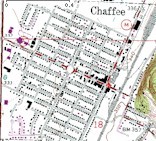
(1906) It is most likely that the town of Chaffee,
Missouri (population 3,044) was
named in honor of General Adna Chaffee who served during the Spanish-American
War. It is also possible that the town was named for a Mr. Chaffee who was
reported to be a
prominent real estate agent located in the Chemical
Building in St. Louis. Regardless, the Chaffee Real Estate
Company was instrumental in founding Chaffee, based on plans Benjamin
Franklin Yoakum, President of the Frisco Railroad in
1900, and spurred on by a bridge competed in 1905 (3959 ft long) across the Mississippi at Thebes.
By 1905,
Yoakum had consolidated the operations of his existing
railroad sufficiently to begin construction of a line to the
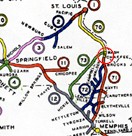
Gulf of Mexico. A line was needed between St. Louis to
Memphis. In this gap was positioned the site of Chaffee. 
The
Chaffee Real Estate Company bought
the land for the city and had it developed for the
railway. The Frisco Railroad was given 150 acres. The most
influential men connected with the development were James W. Black, Mr. Parker,
H.W. Beardsley, Ike Cook and
James Cook of St Louis; and Judge Wright and George Murray of Effingham,
Illinois. The site was developed on land known as the "Old Cox
Farm". The town was incorporated in 1906. A quote from the real
estate firm's brochure stated "When Southeast
Missouri is fully developed there will be no richer nor more
prosperous section on this continent, and Chaffee will be
its commercial metropolis." Railroad construction men moved into
Chaffee in 1905, and by the end of the year the railroad facilities built included an office building for
railroad officials,
a substantial passenger station and a roundhouse that could
accommodate 30 locomotives. In addition, a freight yard,
water works system, car repair shop, powerhouse and a large
machine shop building were in place at Chaffee within little
more than a year of the time tracks were first laid.
By
December, 40 buildings were built or under construction. One of the
cities main streets was named Yoakum. The building boom
continued into 1908-1909; the Astoria Hotel ("one of the most modern hotels in
Southeast Missouri"), a ball park, a planing
mill, five store buildings, a restaurant, an elevator, an
"electric theater" and numerous cottages and boarding houses.
However in 1913 due massive debts, Mississippi river flooding and a recession,
the railroad went into
bankruptcy.
The
Frisco was repurchased many times over the years and as of
1980, merged into the Burlington
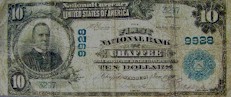
Northern Railroad. The First National Bank of Chaffee was chartered in
1911, issued $392,320 in bank notes and went into receivership in 1931. The
backing for the currency was the amount of the bonds on deposit. In the US, from
1863 to 1935, issuing local bank notes was a common practice - until there was
a common central US currency in 1929. President William McKinley
(1897-1901) is pictured on the $10 First
National Bank of Chaffee note and the signatures are those of the
President and Cashier of the bank.

Albert H. Chafe:
(1909-1941) Born in Newfoundland. At
0030 June 29 1941 a torpedo launched by U-651 sunk the S.S. Grayburn
at position 50.223ºN 41.767ºW,
south of Iceland. Thirty five of the crew
were lost including fireman Albert H. Chafe. The ship master John William
Sygrove and 16 survivors from the Grayburn were picked up by corvette HMS
Violet and transferred to the British rescue ship Zaafaran.
Later that day, the U-boat was sunk by depth charges from the British
destroyers HMS Malcolm and HMS Scimitar, the British corvettes HMS
Arabis and HMS Violet and the British minesweeper HMS Speedwell.
There were 45 survivors and no casualties. The 6,342 ton British
registered steam freighter Grayburn was part of convoy BHX-133, and was
carrying steel and trucks. The ships voyage originated in Balitmore and
then departed Halifax on June 16 and arrived in Liverpool. U-651
(Type V11C) was launched Dec 21 1940 under Commander Peter Lohmeyer.
Earlier on 24th Lohmeyer sank the 5,297 ton British Brockley Hill in
the same convoy.


William
Benjamin Chaffey:
(1914- ) Born in California. Grandson of William Benjamin Chaffey (1856-1926).
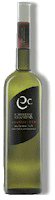
Edwards and Chaffey Wines are
situated 7 km north of the McLaren Vale Township, New South Wales and 8 km
from the coast (35.173ºS 138.555ºE).
Seaview Winery was owned and operated by William Benjamin and
friend Henry Edwards. The valley has been used for wine maturation
for more than 140 years. Its history dates back to 1850 when Englishman,
George Pitches Manning, purchased 65 hectares of land, cleared the property,
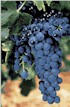
planted wheat and named it “Hope Farm”. Noting the potential for grape
vines, he planted some muscatel and built a small pug cellar. Within
five years, Manning’s wines were gaining recognition in the growing Adelaide
market and, in 1855, he built a larger winery, planted more varieties and
doubled in size of his vineyard. 
The
property changed hands several times and around 1948, was purchased by Chaffey
and Edwards. William Benjamin was a graduate of Adelaide's Roseworthy
Agricultural College. Edwards was an experienced viticulturist. They
changed the name of the property to “Seaview” to reflect the seascapes of
St. Vincent’s Gulf that could be glimpsed from the hills on the
property. They increased the vineyard plantings with additional cabernet
sauvignon and shiraz and planted riesling, malbec, palomino and sauvignon
blanc. In 1954 they began bottling on a large scale and by 1957 had
established a thriving cellar door trade. In 1951, Edwards and Chaffey
introduced Seaview Cabernet Sauvignon which had distinction
of being on of Australia’s first varietally-labelled table wines.
Exemplifying the generous flavours associated with McLaren Vale, Seaview
Cabernet Sauvignon has earned a reputation for quality, consistency and
value. The Section 353 wines are named after the lot number of the
original McLaren Vale vineyard, and includes Cabernet Sauvignon, Shiraz and
Chardonnay varieties. The company is now a subsidiary of Southcorp,
Australia's largest producer of wines contributing approximately 30% of the
domestic market.


Davis
Elliott Chaffee:
(1915-1942) Born in Hartland Township, Ohio and enlisted in the Navy,
January 1941. He was appointed Ensign September 1941, and naval aviator October
1941. While serving with Bomber
Squadron 5 (VB5) based on the Yorktown (CV5), he was killed in action during the
Battle of the Coral Sea May 8, 1942, 600 miles northeast of Australia (16.267ºS
162.333ºE).
This was the first major sea battle between Japanese and United States naval
forces in WWII. It was also the first battle in
history where two naval forces fought using only aircraft and without
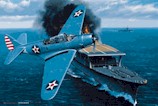
opposing ships ever seeing each other. Davis was flying a TBD Devastator Torpedo Bomber
which required a crew of three and launched one Mk-XIII torpedo. The Douglas TBD
Devastator torpedo-bomber was the first low-wing, all metal monoplane to see
service with the US Navy.
Unfortunately, given the design of the
torpedoes used, attacks had to be made at a maximum speed of only about 110
MPH, and at an altitude of no more than 100 feet. This made the Devastator and
easy target for both enemy fighters or anti-aircraft gunners. Davis participated in the air-sea battles on
May 7th and 8th. At 11:50 on May 7th, the
Japanese light carrier Shoho was attacked and sunk by 22 TBD Devastator
torpedo bombers, 18 F4F Wildcat fighters and
53 SBD Dauntless scout bombers from the Lexington
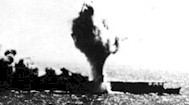
and the Yorktown. The Shoho was sunk by thirteen bombs and
seven torpedoes. This was the first loss of a significant ship by
the Imperial Navy in WWII. At 10:58 on May 8th, 39 planes from the Yorktown
and later 21 planes from the Lexington severely damaged the flight deck, fuel
storage tanks and engine repair shop of the Japanese
carrier Shokaku. The Yorktown scored two bomb hits and the Lexington,
one. The airplanes of Lieutenant John J. (Jo Jo) Powers and Ensign Davis E. Chaffee were
the only ones that did not return from the attack on the Shokaku.
The Shokaku was not sunk.
She eventually sank in the Battle of the Philippine Sea in June 1944. At
20:00 on May 8th, the Lexington
was scuttled by the US destroyer Phelps after being attacked by 69 planes from the Shokaku and Zuikaku. The Yorktown was badly damaged during Battle of Midway in June
1942 and two days later was sunk by a Japanese submarine. Davis was posthumously awarded a Navy Cross
for his courage in participating in attacks on the Japanese carriers (source:
DANFS, Vol. 2, 1963,
reprint 1969, page 65). Two years after Davis' death, the Destroyer Escort USS
Chaffee DE-230, was commissioned. The Chaffee was sponsored by Mrs. L.C. Chaffee.
Don
Chaffey:
(1917-1990) Born in Hastings, East Sussex, England. Beginning in an
assistants post at
Britain's Gainsborough Studios in 1944, Don Chaffey was promoted to head of
the studio's art direction department within two years. Chaffey made his
directorial bow with the award-winning The Mysterious Poacher (1950). On the
strength of this one film, he was tagged as a family and children's director, despite occasionally delving into
much more mature films as A Question of Adultery (1958), The Man Upstairs
(1958), and A
Matter of Who (1961). Hired by Walt Disney to direct 1961's Greyfriars
Bobby (1960), Chaffey remained a Disney regular into the 1970s, helming the
made-for-TV The Prince and the Pauper (1962) and Horse Without a Head
(1962),
and the theatrical features Three Lives of Thomasina (1963) and Pete's Dragon
(1977). Chaffey worked with stop-motion wizard Ray
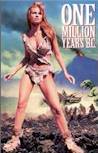
Harryhausen as the director for Jason and the Argonauts (1963) and One
Million Years B.C. (1967). Credited with over 64 movie, TV movies and TV
series including: The Avengers (1961) TV series, The Prisoner (1967),
Charlie's Angels (1976) TV series, Fantasy Island (1978) TV series,
T.J.
Hooker (1982) TV series, Mission: Impossible (1988) TV Series.
Don Chaffey's
last projects included the TV movies Casino (1980) and International Airport
(1985). He was also a the producer for Lies My Father Told Me (1960) and a
writer for The Crooked Road (1965). Don Chaffey died
in Kawau Island, New Zealand. Not related to Don, but heavily involved
in the Hollywood film industry was Mary Chaffee.
She was a script supervisor for 40 TV shows and B-Western movies from 1948 to
1958. These included the TV Series Gunsmoke
(1955) and Have Gun - Will Travel (1957). Joan
Chaffee was a Goldwyn Girl dancer in the 1944
movie Up in Arms staring Dinah Shore and Danny Kaye in his first movie. She was also a WWII Pinup celebrity.

Charles
Donald Chaffey:
(1918-1988) Attended school in Vancouver, BC. Grandson of Charles
Francis Chaffey. Charles left second year
Engineering at University of British Columbia to take a Chartered Accountant's
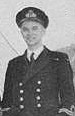
course before joining the RCNVR at HMCS Discovery as an Ordinary Seaman
in October 1940. As an officer candidate, he went overseas to Raleigh
for his first assignment on the Hunt class destroyer HMS
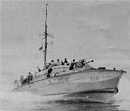
Pytchley. In March 1941 he was assigned to ML-209
operating out of St. Christopher for training as part of the 6th MGB Flotilla
and later assigned to MTB-232 in the 21st MTB
Flotilla. For the attack on Dieppe, he served in ML-309 which did
rescue work off the coast during the action. After Dieppe, he took
command of MTB-232 until January 1943. He was the CO of
MTB-465 in March 1944 as part of the 29th Canadian HMCMTB Flotilla for
operations in the English Channel on D-Day.
The MTB flotillas fought German E-boats (torpedo boats) and flak ships,
disrupted enemy coastal convoys, cleared mines, and landed supplies for agents
on German-occupied islands. On May 16, 1944, along with 5 other MTB's,
his crew participated in a hazardous mine intelligence gathering mission to the coast of
France. They proceeded to the planned D-Day beaches,
and protected soldiers who were assigned to lift sample
mines from the German beach defence. They managed to complete their
mission undetected and return safely. What was learned
from dismantling these mines enabled the Allies to avoid considerable
casualties on D-Day. On D-Day, the MTB's protected the flanks of the
landing beaches and attempted to block enemy harbours. Charles received his MID (Mentioned-in-Despatches, a
military gallantry award for Canadian Volunteers) for his actions in
MTB-465 during the invasion of Normandy. His nickname was "Chuff
Chuff". Charles
later moved to Montreal.

John
Lester Hubbard Chafee:
(1922-1999) Born in Providence, Rhode Island. John came from a family long prominent in
politics. He appears to be related to Zechariah
Chafee or Chaffee
(b.1859) in Providence, RI. Two relatives on his mother’s side had served as governors of
Rhode Island, great grandfather, Henry Lippitt (1875-77) and great uncle,
Charles Warren Lippitt (1895-97). Another great-uncle, Henry Frederick Lippitt
(1911-17), had been a US Senator from Rhode Island. Uncle Zechariah Chafee,
Jr. was a noted Harvard law professor. He obtained his early education
in Providence, and Deerfield Academy, MA. After graduating from Deerfield in
1940, he entered Yale University, but left to enlist in the US Marine
Corps. He
served as a private, landing with the first assault troops at Guadalcanal.
In
1943, he attended Officers Candidate School and was commissioned as second
lieutenant. He went to Guam and served with the 6th Marine Division in the
battle of Okinawa in 1945. Chafee returned to Yale in 1946 and graduated with
a B.A. in 1947. He continued his studies at Harvard Law School and graduated
in 1950. He was a lawyer in Providence when the Korean War broke out.

He
was recalled to active duty in 1951 and served as a Rifle Company commander
with the 1st Marine Division. In 1953 he was released from the Marines and
returned to civilian life. Starting in 1952, Chafee
helped as a campaign manager for the Republican party. In 1956, Chafee
won the endorsement for Rhode Island House of Representatives and went on to
win in the general election. He was re-elected in 1958 and 1960. In 1958, he
was chosen by the Republican members of the House to be the House Minority
leader (1959-62). Chafee was elected for a third term in 1960. In 1962, Chafee
officially declared his candidacy for state governor, and won by only 398
votes.
He was Governor of Rhode Island from 1963 to 1968 and during his
three terms he signed anti-discrimination legislation in housing and
employment, established a health care plan for the state's elderly, supported
the construction of Interstate 95, acquisition of land for state woodlands and
waterfront parks, and the expansion of the state vocational training program.
Chafee met defeat in 1968 and decided to enter federal politics. He was
appointed Secretary of the Navy from 1969 until 1972.
In
May 1969 he succeeded in overruling the court martial of Commander Lloyd Bucher of the
USS Pueblo, who had been captured,
along with his crew, by
the North Koreans in 1968. He oversaw the reduction of Navy personnel in
Vietnam (by 96%). Chafee approved the F-14 carrier-based fighter jet,
the SSN-688 class nuclear submarine, the P-3C anti-submarine aircraft, the
S-3A carrier-based ASW aircraft, and the Spruance Class antisubmarine
destroyers. He appointed the first Black admiral of the US Navy, as well as
permitted women to enrol in Officer Training and a oversaw recruitment of a substantial
number of minority race officers. Chafee resigned in 1972 to run for the U.S. Senate.
He lost and returned to private law practice. In 1976 he won the Senate
seat. He became Rhode Island's first Republican senator in forty-six years.
He
was re-elected in 1982, 1988, and 1994. Considered one of the Senate's most liberal Republicans, Chafee earned
high praise from both the American Civil Liberties Union and the U.S. 

Chamber
of Commerce during his tenure. He assisted passage of numerous
environmental laws, including the Superfund Toxic Waste Cleanup Program
(1980), the Clean Air Act (1986), the Oil Spill Prevention and Response Act
(1990), and the Safe Drinking Water Act (1995). From 1994 he chaired the
Senate Environmental, was a senior member of
the Public Works Committee, served on the Finance and Intelligence committees
and the Joint Committee on Taxation. Chafee's liberal leanings were reflected
in his efforts to expand Medicaid to include maternal care, child health
programs, and community health centers for the uninsured and the
disabled. President Clinton said that Chafee "embodied the decent center which
has carried America from triumph to triumph for over 200 years".
The Chafee
Social Science Building named in his honour is located on the University
of Rhode Island Campus was built in 1972. A statue in his honour is
located in Colt State Park, Bristol RI. At 329 acres, the John
H. Chafee National Wildlife Refuge, near Wakefield, RI provides
habitat for the largest black duck population in Rhode Island. The park
name was changed from the Pettaquamscutt Cove National Wildlife Refuge in
1999. The John
H. Chafee Blackstone River Valley National Heritage Corridor is a region
of 250,000 acres between Worcester, MA and Providence, RI created to promote
the area's cultural, historical, business and environmental assets. In 2000 Chafee was posthumously awarded the
Presidential Medal of Freedom.

Helen
Chaffey Bowring:
(1927- ) Helen grew up in Mildura, Victoria, Australia where she
has lived most of her life. Both the Bowring and Chaffey families were
instrumental in the establishment of Mildura and other Murray River
communities. She was affected by
polio at the age of nine-months, but remarkably, she lives independently and
has a very active career and livelihood, despite being in a wheelchair much of
her life. After attending Mildura High School she went to Melbourne University,
earning a Degree in Art, followed by a Diploma of Education with specialties
in teaching English and Latin. She returned to Mildura to begin a 33-year
teaching career at Mildura High School.
Helen was an enthusiastic Girl Guide when she was young and now belongs
to the Trefoil Guild for ex-Guides. She
assists with Vision Australia, an organization that helps people with vision
impairment, by reading newspapers over a special radio station. She is a
member of the Mildura Historical Society and serves at the society’s
Carnegie Center.

Dr.
John Taft Chaffey: ( 1927- )
Born in Los Angeles and raised in
Palm Springs CA in a house built for his family by George Chaffey (1848-1932).
John was drafted at age 18 and after his WWII military service, he attended college on
the GI Bill, taught science and biology in high school and went on to medical
school at McGill University in Montreal (1964). He later
specialized in radiation oncology at Yale and formed
a new department at Harvard called the Joint
Center for Radiation Therapy (JCRT),
covering five hospitals in the Harvard medical area. Over thirty years
JCRT grew to include six satellite departments and twenty-six physicians,
and had trained over a hundred radiation oncologists. Dr. Chaffey retired to
Bend, Oregon.

Dr.
Wallace L. Chafe:
(1927- ) Born in Cambridge, Massachusetts. Wallace's distant
family was from Newfoundland who moved to Boston sometime before the 1890's.
Wallace received
his BA (1950), his MA in Linguistics (1956) and his PhD (1958) from Yale
University. From 1958 to 1959 he was an Assistant Professor of Modern
Languages at the University of Buffalo. He worked at the Smithsonian
Institution 1959-1962 as a Linguist. He was a Professor of Linguistics
at the University of California, Berkeley from 1962-1986, and at the
University of California, Santa Barbara from 1986-1991, and since then
Professor Emeritus. His major research
is on native languages - especially those of the Iroquoian and Caddoan
families. His research involves understanding language from a functional
and cognitive perspective. He has studied the differences between
speaking and writing, applications of linguistics to literature, and the
functions of prosody. Among his many writings have been the books Meaning
and the Structure of Language (1970) and Discourse, Consciousness, and
Time (1994).


Dr.
Paul Chaffee:
(1928-1990) Born in Port Huron, Michigan. Paul earned a DVM from Michigan State
University School of Veterinary Medicine. He practiced veterinary medicine for
two years in Chicago before establishing his own veterinary hospital in
California. He then became the Veterinarian for Roeding Park Zoo in Fresno and
a few years later became its Director. He oversaw the development of a small
collection of wildlife into a medium-sized facility with significant programs
in education and conservation. In 1985 the zoo changed its name to the Fresno
Zoological Gardens. Chaffee established new
programs of nutrition, quarantine, education, and treatment were established
to meet the growing professional standards of the zoo. He traveled
to acquire giraffes and elephants, and building relationships with other zoos
for animal exchanges and breeding programs. Chaffee raised baby apes and
tigers in their own home and worked so blind people could “see” the
animals. He was President of the American Association of Zoo
Veterinarians. In 1990, Paul was the recipient of American Zoo and Aquarium
Association highest honor, the R. Marlin Perkins Award.
In 1990 the Chaffee Zoological Gardens was
renamed after him.

Nancy
Ann Chaffee:
(1929-2002) Born in Ventura, California. In the late
1940s, she played on the men's tennis team at the University of Southern
California as the school did not have a women's team at the time. Nancy ranked # 4 in world in women's hard court
tennis in 1953-1956 winning 14 national titles. She was a three-time
national indoor champion and two-time winner of the national junior
championship. She was the first
unseeded woman to ever reach the semi-finals of the U.S. Open. She married a professional baseball player,
Ralph Kiner of
the Pittsburgh Pirates. Kiner told broadcasting friend, Lindsey Nelson, about
his wife "When I married Nancy, I vowed
I'd beat her at tennis someday. After six months, she beat me 6-2. After a
year, she beat me 6-4. After we were married a year and a half, I pushed her
to 7-5. Then it happened she had a bad day and I had a good one, and I beat
her 17-15". At this point in the story, Kiner was asked if his wife had been
sick on that day. "Of course not!" he said. Then he added, "Well -
she was eight months pregnant." Chaffee married long-time ABC and CBS
sports caster Jack Whitaker
in 1991.

Dr.
Steven H. Chaffee:
(1935-2001) Born in South Gate, California. Steven was a highly
regarded communication scholar and professor of International Communication.
He earned his bachelor's degree at the University of Redlands and his master's
in journalism at the University of California-Los Angeles. He worked as a
journalist at several Los Angeles-area newspapers before becoming a
communication scholar. After earning his doctorate from Stanford University in
1965, Chaffee worked as a professor at the School of Journalism and Mass
Communication at the University of Wisconsin-Madison until 1981, when he
returned to Stanford to teach in the Department of Communication. He served as
director of the Institute for Communication Research from 1981 to 1985 and
again from 1994 to 1996. His research focused primarily on the role of
politics in mass communication. He was one of the foremost scholars of
political communication, of how people used and responded to mass media for
political information and how the mass media exerted political influence.
Chaffee wrote 13 books and more than 100 articles and book chapters in his
lifetime. He retired from the department in 1999 after having served as
chairman two times. One of Chaffee's projects was a study of Kids
Voting USA, an effort to encourage schoolchildren to participate in
elections. His research indicated that children's civic enthusiasm made their
parents more likely to vote.


Roger Bruce
Chaffee:
(1935-1967) Born in Grand Rapids,
Michigan.
Roger's father, Don Chaffee, was a barnstorming pilot who flew a
Waco 10 biplane. He presented shows at fairgrounds, transported passengers and
parachute jumpers. Later, Don worked for Army Ordnance in Greenville and in
1942 was transferred to the Grand Rapids
where he served as Chief Inspector of Army Ordnance. Roger
enjoyed his first airplane ride at age seven. In 1953 Roger Chaffee graduated from
Central High School in Grand Rapids. Chaffee was offered a Naval ROTC scholarship and in September 1953, he began the
fall semester at the Illinois Institute of Technology in Chicago. He started
flying in 1957 and in that year he completed his Naval training and was awarded a
degree in Aeronautical
Engineering from
Purdue University. He married
Martha Horn in 1957. In 1958 he started aircraft carrier training.
He worked extensively
in photo
reconnaissance. In 1962 Roger started his Master's degree in Reliability
Engineering at the Air Force Institute of
Technology at Wright-Patterson AFB. While doing his studies, Chaffee participated in astronaut candidate testing.
Over this career he logged more than 2,300 hours flying time, including more
than 2,000 hours in jet aircraft. In 1963 Chaffee learned that he was one of 14 candidates for the third wave of astronauts, this time for the NASA
Lunar Program. Training included geography and mineralogy field trips to the Grand Canyon, Alaska,
Iceland and Hawaii; crater studies in Arizona; surveying in New Mexico's and survival training in Panama and Nevada. His training also
included knowledge of spacecraft equipment and systems, spacecraft simulators,
egress procedures, rescue techniques, G forces launch and re-entry conditioning
and Extravehicular Activity techniques. He gained valuable experiences by serving as one of the capsule communicators (Capcom) for the Gemini 4 mission in
June 1965. He flew a chase plane to take pictures of the launch of an unmanned Saturn 1B
rocket. In 1966 Chaffee was named as Pilot, along with Gus Grissom
as Commander and Ed White as Senior Pilot of the Apollo
1. 
The purpose of Apollo I was to test and evaluate all major spacecraft systems as well as the
ground tracking and control facilities. In 1967 he started the final round of
pre-flight Apollo testing. Astronauts Chaffee, Grissom
and White entered the Command Module for the plugs-out test on January 27,
1967 at Pad 34, Kennedy Space Center, Florida.
Chaffee took the pilot's couch on the right side of the spacecraft. His
primary duty was to maintain communications with the Blockhouse as the test
proceeded. The test was extensive and would drag on for hours so that
the spacecraft could be evaluated, system by system and procedure by procedure.
However a fire swept through
the Apollo Command Module. Roger Chaffee chose to remain in his seat,
attempting to transmit emergency messages while the fire raged
throughout the Apollo spacecraft. As a result of the incident, major
modifications were made to Apollo. These included a new hatch design; a change in
the launch pad spacecraft cabin atmosphere from 100% oxygen to a mixture of 60/40%
oxygen/nitrogen mix; better protection for wiring and oxygen tubing; and new materials
to reduce flammability. He was buried in Section 3, Lot 2502-F, Grid
Q-15/16 of Arlington
National Cemetery, Virginia, near the grave of Grissom and other astronauts. The
Apollo/Saturn 204 mission was officially assigned the name "Apollo
1" in honor of Grissom, White, and Chaffee. The first Saturn V launch (un-crewed)
in November 1967 was designated Apollo 4 (no missions were ever designated
Apollo 2 or 3).

Susan
Chaffey: (1935- )
Born
in Los Angeles, CA. Susan grew up in the Pasadena area of Southern
California where she attended local public schools. She graduated from
the University of Redlands with a Degree is Sociology. She later earned a
Master of Arts Degree in Special Education at Sonoma State University. She married right after college in Redlands and worked
for the San Bernardino County in Juvenile Probation. She and her husband
then moved to Santa Rosa in Northern California. Susan became a credentialed
special education teacher and founded an agency that served infants and
preschoolers who have developmental special needs. She also taught
courses at
Santa
Rosa Junior College and Sonoma State University. She and her husband
Martin Powell are authors of A Chaffey
Family, which extensively covers the history of a major branch of the
Chaffey family in England, Canada, United States, Australia and New Zealand.
They have also contributed in making the public aware of the history of Chaffey Garcia House,
owned by Susan's ancestor, George Chaffey
(1848-1932).


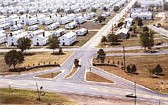
Camp/Fort
Chaffee:
(1941- ) Built in 1941 and located in Arkansas,
south west of Fort Smith. The camp was named after Major General Adna R.
Chaffee Jr. From 1942 to 1946 Camp Chaffee was the training center
for the 6th, 14th and 16th Armored Divisions for World War II. From
1943-1946 3,000 German prisoners of war encamped at Camp Chaffee. From 1948 to
1957 was the home for the 5th Armored Division. In 1956
the camp was re-designated Fort Chaffee. On March 25, 1958 the media
photographed the most famous hair cut in history at building #803 in Fort
Chaffee, as Elvis Presley was inducted into the US Army. He spent
four days at the Fort. In 1975 Fort Chaffee
was home to 50,809 Southeast Asian refugees and later to 25,390 Caribbean
refugees (1980-1982). Movie set for
A Soldier's Story (1983) and Biloxi Blues (1987). It
served as the Joint Readiness Training Center for light combat forces from
1987 to 1993. More than 50,000 Army National Guard and Army Reserve
soldiers train there annually. The Fort Chaffee Military Reservation
(35.3093ºN
94.3236ºW)
is
100 square miles (71,359 acres) in area. In 2004, the U.S. Department of
Defense’s Base Realignment and Closure Program allocated 7,000 acres of the
Fort property for the Chaffee
Crossing residential, commercial and industrial development.


Frederic
H.
Chaffee:
(1941- ) Born to an Army family in West Point, NY. His father,
Frederic Henry Chaffee, was
from Faribault, MN. His great-grandfather was Henry Chaffee born in
1826, Becket, MA. Fred received his
B.A. in Physics
from Dartmouth College (1963) and later his PhD in Astronomy from the
University of Arizona (1968). He worked as an astronomer for the
Smithsonian Astrophysical Observatory at Mt. Hopkins Arizona from
1968-1996. In 1996, he was appointed the first Director of the W.M.
Keck Observatory located on the 13,796 summit of Mauna Kea, Hawaii (19.828ºN
155.478ºW).
The observatory, built in 1993 by Caltech and the University of California,
operates the world's largest optical and infrared telescopes. Each
telescope's primary mirror is four times larger than Hubble's, obtaining
images four times sharper than Hubble in the near infrared. Key research
of the observatory includes the observation of the Shoemaker-Levy comet
crashing into Jupiter, using gravitational lenses to discover galaxies at the
most distant edge of the universe, using supernovaes to determine the
expansion rate of the universe, observation of a supermassive black hole in
the center of the Milky Way, searching for atomic gases in the regions of
space between galaxies, helping to solve the riddle of gamma ray bursts, and
discovering planets outside the solar system and close observations of our
planets and their moons.

Winnie
Chafe:
From Glace Bay, Cape Breton, Nova Scotia. Winnie Chafe is a highly
respected figure within Cape Breton Island’s musical culture. Winnie
has successfully played in the international fiddling stage since the 1950's.
The first woman to become an International Fiddling Champion. She has been
featured on numerous national radio and television programs including her lead
role in the CBC television program Ceilidh in the 1970's. She has
toured the world and teaches her unique style of
Scottish violin to up and coming prodigies in Cape Breton. She has
performed for royalty and has received two honorary doctorates in recognition
of her contribution to the legacy of Cape Breton’s music. Her daughter
Patricia Chafe is a classically trained pianist, composer and music arranger who
also specializes in Scottish music.

Dr.
William
Henry Chafe:
(1942- ) Born in Boston, Massachusetts. He was raised in
Cambridge and then went to Harvard College, graduating in 1962. In 1965, he
was a student in the graduate program in American history at Columbia
University where he received his Ph.D. in 1971. He taught for one year at
Vassar College, and then began his career at Duke University, Durham, North
Carolina. Dr. Chafe has written two books on the history of post-World War II
America, and a biography of the liberal crusader Allard Lowenstein. The author
of eight books overall, he has received the Robert F. Kennedy Book Award
(1981) for Civilities and Civil Rights: Greensboro, North Carolina and the
Black Struggle for Freedom (1980); the Sidney Hillman book award (1994) for
Never Stop Running; Allard Lowenstein and the Struggle to Save American
Liberalism (1993). Co-director of the Duke Oral History Program, and its
Center for the Study of Civil Rights and Race Relations. His other books
include: Unfinished Journey: America since World War II; History of Our
Time: Readings on Postwar America; Achievement of American Liberalism:
The New Deal and Its Legacies; Paradox of Change: American Women in the
20th Century; Remembering Jim Crow: African Americans Tell about Life in
the Segregated South; The Road to Equality: American Women Since 1962,
Vol. 10; Women and Equality: Changing Patterns in American
Culture; America since 1945; American Woman: Her Changing Social,
Economic and Political Roles, 1920-1970. From 1990 to 1995
Chafe chaired the Duke University Department of History. In 1995 he became Dean of the Faculty of Arts and Sciences and in 1997 as Dean of Trinity
College.

USS George Chaffey:
(1942-1972) A WWII
Liberty Ship (EC2-S-C1 Type) hull 671, one
of a fleet of 2,751 similar cargo ships and
named after George Chaffey of California. She was built in two months
and launched in October by the
California Shipbuilding Corp., Terminal Island. The design for Liberty Ships
was originally from Britain; all welded, 440 feet long, and oil burning.
Britain
provided the design to the US as part of the "Lend-Lease" plan
allowing the USA to build ships to counteract the U-boat losses in the
Atlantic. Early on, each ship took about 230 days to build, but the
average eventually dropped to 42 days, with the record being set by the USS
Robert E. Peary, which was launched 4 days and 15 1/2 hours after the keel
was laid. The ships were 441 feet long and 56
feet wide, with a speed of 11 knots. Her five holds could carry over 9,000
tons of cargo, plus airplanes, tanks, and locomotives lashed to its deck.
A
Liberty ship could carry 2,840 jeeps, 440 tanks, or 230 million rounds of
rifle ammunition. The US deployed ships were named after prominent
deceased Americans. Sixty ships were built by the US for Britain, while
Canada built 354 more. Their anticipated life span was only five years,
and so great was the expected casualty rate that the U.S. Navy considered one
safe voyage per ship a full quota. By the end of the war, Liberty Ships
had carried about 75% of all the cargo that went to support the American war
effort. In 1955 the Chaffey was converted to a US Navy Auxiliary
and then laid up Mobile AL. It has been estimated that as late as 1960
Liberty Ships made up around 40% of the world general cargo fleet. In 1972 she was scrapped in Panama City.

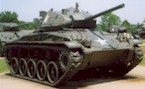
US M24 Chaffee Light Tank:
(1943-1960) Christened in honor of General Adna R
Chaffee Jr. Design of the M24 was begun in
mid-1943 in order to replace the M5A1 light tank, which suffered from
insufficient armament, lack of room in the turret and over-heating of the
engine. A small number entered service in time to be used in Europe, seeing
action at the crossing of the Rhine and the later stages of the campaign
against Germany. The tank was used in the Battle of the Bulge in January
1945.
The M24 Chaffee,
arguably the best light tank of World War II, was a fast light armoured
vehicle with the ability to deliver relatively large calibre direct fire with
the excellent 75 mm M6 gun. 4415 tanks were produced by Cadillac and
Massey-Harris during 1943-45. The first reached Europe in late 1944, where
they proved very effective and highly reliable. However,
at the outset of the Korean War American forces equipped with the with M24
Chaffee's performed poorly against the enemy's T-34/85s, and these US units
were soon augmented with M26 Pershing's and M46 Patton's, along with M4A3E8
Sherman's with the long 76mm gun. However in spite of these deficiencies,
the M24 fought in a number of significant delaying actions, often as dug-in
artillery, allowing many of the beleaguered ground forces to withdraw during
the retreat down the Korean peninsula to Pusan. It remained in American service until 1953,
by which time it was totally replaced by the M41 Bulldog. After
1945 the M24 Chaffee was used by many American allies.
The French army used
them in Indo-China, including at the battle of Dien Bien Phu. Though obsolete
by the mid-1960's, it remains in service in some countries. In Taiwan the
platform has been re-equipped with a 90mm gun. Crew of 5, weight 30,500
lb, max speed 35 mph, range 175 miles. About 5,000 were built for WWII.


Kenneth
C. Chafe:
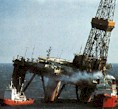
(1943-1982) Kenneth perished onboard the Ocean Ranger,
166 miles
east of St. John's, Newfoundland, Feb. 15, 1982. All 84 crew members,
including 56 Newfoundland residents, were
lost. It was built by Mitsubishi Heavy Industries, Japan and
first operated in the Bering Sea off Alaska in 1976. From there the rig
was moved to
New Jersey, then Ireland and in November 1980 arrived on the Grand
Banks. The Ocean Ranger was then the world's largest semi-submersible oil
rig. It was touted to be unsinkable and designed to drill in
seas too treacherous for others. It was built to withstand 110-foot waves and
100 mile-an-hour winds. Like the Titanic, the Ocean Ranger
challenged the sea in one of the most dangerous areas on earth – the North
Atlantic. The crew lived on the rig for two months at a time, pumping oil from
the seabed, 220 feet down. Tragically, as in the case of the Titanic (which
sank 400 miles to the north),
the Ocean Ranger succumbed to a combination of design problems, lack of
safety equipment, a human error, and the awesome might of the
ocean. Weather that night was hurricane force winds up to 90 knots and high
seas up to 75-100 feet At 6:45PM a large wave broke a porthole
in the ballast control room. The seawater short-circuited the control panel
and caused several sea valves to open, allowing seawater to enter the forward
tanks. This created a list in the Ocean Ranger. The crew left the rig
by 1:30AM but were lost in the cold stormy seas after numerous rescue
attempts. The rig began to list and sank by 3:55AM. The
disaster could been prevented by having a better design, the crew
having proper safety training and the rig equipped with better survival equipment.
A plaque was placed in St. George's Anglican Church in Petty Harbour that
reads "The hanging cross in this Chancel is placed to the glory of God
in the loving remembrance of Kenneth George Chafe, age 39 years, who lost his
life in the Ocean Ranger Disaster, Feb.16.1982, by his parents Victor &
Ivy & Family."


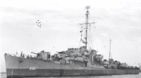
USS
Chaffee DE-230:
(1944-1948) Rudderow
Class, Destroyer Escort, was commissioned May 1944 in Charleston Navy Yard,
two years after the date of Ensign David E. Chaffee's death as a result of enemy action in the
Battle of the Coral Sea. The other pilot who died that day along with Davis, Lieutenant John J.
(Jo Jo) Powers, had the USS
John J. Powers (DE-528) commissioned after him as well. The Chaffee was sponsored by Mrs. L.C. Chaffee. Destroyer
Escorts were named to honor US Naval heroes. She was 306
feet long with a speed 24 knots. The Chaffee began her major role in the liberation of the Philippines
when she sailed from Hollandia 17 December 1944 to escort landing craft to
Leyte. Assigned to patrol in Lingayen Gulf, Chaffee underwent a unique
experience 23 January, when a Japanese aerial torpedo passed through her bow
without exploding, or causing any injuries to her crew. The Japanese
Betty bomber had launched the torpedo so close to the Chaffee that it
did not have a chance to arm. The Chaffee continued to
escort convoys in the Philippines, as well as conduct patrols, in support of
the Mindanao operation until April 1945. Chaffee escorted convoys
between Morotai and Hollandia and the Philippines and aided in the
establishment of the base in Subic Bay. She escorted a troop ship to
Okinawa in September, then returned to Philippine operation until January
1946. She arrived at San Francisco in February, where she was
decommissioned in April 1946. She was sold in 1948 to the California
Maritime Academy as a training vessel.

Dr.
Ellen-Earle Chaffee:
(1944- ) Born in Detroit, Michigan. Ellen was a High School English Teacher in Moorhead, Minnesota
and Hinsdale, Illinois, 1966-70. She was Associate Dean of Students,
Assistant Professor, North Dakota State University, 1971-77. She earned
a Ph.D. in higher education administration and policy analysis at Stanford
University. She is presently President of Valley City State University, North
Dakota. From 1993 until 2002, she was also president of Mayville State
University, a unique dual arrangement that won the administrative leadership
award from the American Association of University Administrators. The universities
were among the first in the nation to integrate information technologies into
the teaching and learning processes, in part by providing notebook
computers to all students and faculty with network access to everyone in class
and throughout the campus. During her presidency, the university has
been featured in three national studies of instructional innovation and
national feature stories (New York Times and Computerworld), won five national
awards, and received a number of highly competitive federal and foundation
grants. Computerworld named Ellen one of its Premier 100 IT
Leaders. Dr. Chaffee has been national president of two major higher
education associations and served nine years on the national accrediting board
for pharmacy education. Her previous positions were in research, state
system academic affairs, student affairs, and equal opportunity. She has
written five books and many articles on strategic management, quality,
innovation, and leadership.
1016-1840 1840-1900 1900-1945
1945-Present