117 Interesting and Influential Family Members
From 1840 to 1900
1016-1840 1840-1900 1900-1945 1945-Present
Chaff - 2
Chafy - 2
Chafe - 25
Chaffe - 4
Chafey - 1
Chafee - 5
Chaffey - 28
Chaffee - 39
Chaif - 1
Shared - 10
Hon. Sir Richard Chaffey Baker:
(1841-1911) Born in North Adelaide. In 1838 his father, John Baker (1812-1872) from Somerset, England emigrated to Tasmania, and married Miss Isabella Allan. John Baker's father was Richard Chaffey Baker (1784-1821). Richard was the son of John Baker and Mary Chaffey (1751-1788). Mary was the daughter of Richard Chaffey (1707/10-1795). John Baker gained his fortune in sheep farming, mining and banking. Richard, was educated at Eton and Cambridge, where he graduated B.A. in 1864 and M.A. in 1870. He was called to the bar in June 1864 and returned to Adelaide in the same year. There he practised successfully as a barrister and in 1868 he was elected for the poll for Barossa. In 1870 he was a government attorney general, but resigned in July 1871 so that he could take over the management of the affairs of his father. In 1875, Prime Minister Sir Arthur Blyth offered him a position in his cabinet which was declined. He stood for Barossa Electoral Division in that year and was defeated, but in 1877 he was elected to the legislative council and held his seat until federation. In June 1884 he joined the Colton ministry and was Minister of Education for 12 months.
In 1885 he was appointed special envoy for Australia to England to negotiate a postal union, and for his services he was awarded a C.M.G. in 1886. He was elected president of the legislative council in 1893. Baker had given much study to the federation question and prepared A Manual of Reference to Authorities for the Use of the Members of the Sydney Constitutional Convention, which was published early in 1891 and must have been extremely useful to the delegates to the 1891 convention. It influenced to some extent the first draft of the constitution which was then drawn up. He was elected a representative of South Australia at the 1897 convention and was a member of the constitutional committee and chairman of committees. He was elected a senator for South Australia at the 1901 election and, when parliament met, was elected first President of the Senate. He was re-elected in 1904 and retired from politics in 1906. He married Miss Katherine E. Colley who predeceased him and was survived by two sons and a daughter. He was made K.C.M.G. (Knight Commander of the Order of St. Michael and St. George) in 1895. Baker was an oarsman in his youth and was always much interested in cricket and racing; he was for many years chairman of the jockey Club at Morphetville. He had large pastoral interests and helped to develop copper mining. In politics, as president of the legislative council of South Australia and president of the federal senate, he refused to be a party man and carried out his duties with ability, justice and decision.
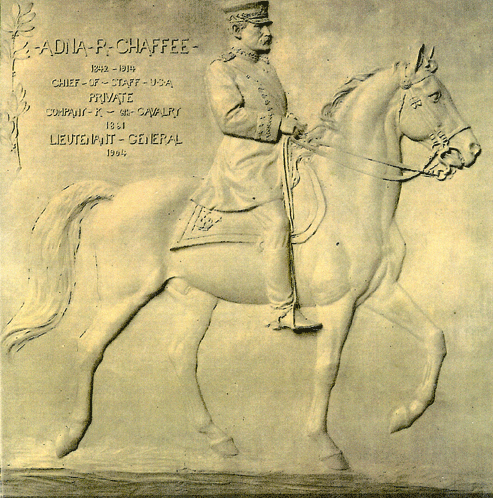
(1842-1914) Born in Orwell, Ohio. He was on his way to join a volunteer regiment in July 1861 when he came across a recruiting party for the 6th Cavalry regiment and enlisted. He saw action in the Peninsular campaign, the
battle of Antietam, the battle of Fredericksburg, and the Stoneman Raid. He was commissioned Second Lieutenant at the personal behest of Secretary of War Stanton in 1863 and was for the rest of the war mainly with the Army of the Potomac. He was twice wounded in 1863, the first time in the Gettysburg campaign, refusing parole as a prisoner and being abandoned by the enemy. Throughout 1864 he took part in General Philip Sheridan's Virginia campaigns and was promoted to first lieutenant in February 1865. After the Sixth Cavalry's reorganization in the summer of 1865, Chaffee was transferred to Austin, Texas, where he was appointed depot quartermaster in 1866. After the war he contemplated leaving military service, resigned while his commanding officer was on leave, but was persuaded to return after only a week as a civilian. He married Kate Haynie Reynolds in 1868, however she died a year later. In 1868 he successfully pursued a band of Quahadi Comanche warriors who had attacked a wagon train hauling lumber from the Mill Creek sawmill. Chaffee and his men found the Quahadis taking refuge near Paint Creek, encircled the camp, charged, and defeated them. Chaffee was brevetted a major for his actions. With his reputation as an Indian fighter established, he spent the next three years at various army camps in Texas chasing down outlaws and hostile Indians. The persistence of Chaffee and his men on the Texas frontier soon gained them the name Chaffee's Guerrillas. When the Red River War broke out in 1874, Chaffee led his troops in a charge against a superior number of Cheyenne warriors. In 1875, he married Annie Frances Rockwell; they had three daughters and a son. He commanded Fort Verde, Arizona in 1878. In 1888 he was promoted to Major and assigned to the 9th U.S. Cavalry, one of two regiments in the Regular Army composed of black men. That year he supervised the construction of Fort Duchesne in southern Utah. Chaffee then moved to Fort Robinson, Nebraska, and in 1895 conducted the restoration of the Bannock Indians to the Fort Hall reservation in Idaho. He served as an instructor at the
Infantry and Cavalry School at Fort Leavenworth, Kansas (1896-1897), when he was appointed lieutenant colonel of the Third Cavalry. With the outbreak of the Spanish-American War (1898), Chaffee was made brigadier general (1898) and commanded the Third Brigade in Cuba. As a result of his performance in the capture of El Caney, he was promoted to major general. In 1900 he was given command of the 2,500-man United States contingent in the joint relief expedition sent to put down the Boxer Rebellion in China. His troops took the gates of Peking in August 1900, and relieved the city's besieged embassies. The success of that mission made Chaffee a celebrity among the troops and commanders as well as the Chinese. Chaffee was appointed military governor and commander of the United States forces in the Philippines, where he remained until 1902. He commanded the Department of the East until 1903. In 1904 was named United States Army Chief of Staff, with the rank of Lieutenant General. It had taken him 43 years to bridge the chasm between Private to Chief of Staff of the entire Army, the widest space and most difficult task which an Army soldier can attempt. He served as grand marshal for President Theodore Roosevelt's inaugural parade in March 1905, in which former Indian adversaries like Geronimo and Quanah Parker also participated.
Afterward, he went on a good-will tour of Europe on behalf of the president. Chaffee stepped down from his position in 1906, and retired from the army. He was subsequently named a member of the Board of Visitors of West Point. Later he and his wife moved to Los Angeles, CA, where he served as chairman of that city's Board of Public Works in 1906 and as first president of the Southwest Museum. It is quite likely that he knew George Chaffey Jr. (1848-1932) who, in 1905, was starting to establish an irrigation project in Manzanar, 180 miles to the north. Founded in 1910, the town was abandoned when the city of Los Angeles purchased the land in the late 1920's for its water rights. Adna died in Los Angeles in 1914 and was buried in Section 3, lot 1945 map grid S/T 15.5 in Arlington National Cemetery, Virginia beside his son and Apollo astronaut Lt. Cmdr. Roger B. Chaffee. Chaffee Parade Field at the US Army Intelligence Centre at Fort Huachuca, AZ was named in his honor in 1960. The Springfield Armory, MA, manufactured 753 Model 1882 Chaffee-Reese Rifles in 1884 (0.45-70 caliber, 27-7/8 inch barrel). The rifle industry was evolving from muzzle loading to breech loading systems. This rifle was one in a series of bolt-action (trap door type) experimental rifle models that lead up to the selection of the Model 1888 used by guard units in the Spanish-American War (60,000 were produced from 1890-1893). This rifle was a favourite of William F. "Buffalo Bill" Cody. This rifle may not have been named after Adna but he was high in the military command at the time of the introduction of the model.

(1844-1915) Born in Stoke-under-Ham, Somerset. Robert Chaffey and George Chaffey Jr. likely shared the same
common great-grandfather;
Benjamin Robert Chaffey(1749-1806) whose son was Richard Chaffey (1773-1828) father of Robert Chaffey (1817-?) who married Eliza Maudlin. In 1870 at age of 26, Robert moved from Somerset to the Welland, Ontario area. After marrying Juliana McClelland in 1878, Robert farmed their acreage of 80 acres in Crowland Township, Welland and worked as a railroad station switchman at Allanburg until his death. The Chaffey land bounded the present day Maple Leaf Park area (Dain Ave, Ontario Road, Commercial & Devon Streets). Robert and Julianna had five children: Beatrice Margaret, George (Mac), Charles, James Hugh Trenchard (Hugh) and Robert (Jr). Robert Chaffey Jr. (1879-1953) served with the 4th Canadian Mounted Rifles during World War I and was a road foreman for Crowland Township. The Chaffey-Fennessy House at 52 Chaffey Street was built in 1913. It was constructed in the Edwardian Classical style of the early twentieth century and displays features typical of that period including a smooth brick exterior with stone accents, large paned front window with stained glass and a veranda with short colonettes set on brick piers. The house remained in the Chaffey family until 1990, when James Hugh Chaffey's grandson Robert Charles had it sold. It now is designated an historical landmark in Welland.
manufacture of silk. The company’s silk braid and fishing lines gained a nationwide reputation. In 1872 with the partnership of his son, a factory was started at Willimantic, under the title of O.S. Chaffee & Son. In politics he was a Republican, and was for the success of the party. He held many of the town offices, representing the town in the State Legislature for two terms. O.S. Chaffee & Sons continually expanded during the 1880s. Joseph Chaffee went into partnership with Willimantic’s Morrison Machine Company, manufacturers of silk spinning and weaving machinery. Chaffee represented the town of Mansfield in the General Assembly, 1871-72, and was state senator from the then 24th district, which included Mansfield from 1885 to 1886. In 1885, he became famous for installing Willimantic’s first telephone, a line connecting the Chaffeeville and his silk mills. He acquired the rank of Colonel when he served on Connecticut Governor Phineas Lounsbury's staff from 1887 until 1889. His Victorian style home built in 1889 in Willimantic is located on 183 Summit Street. Chaffee’s Company was a phenomenal success. Its fine, black dress silks were in demand across the United States, and Colonel Chaffee opened sales offices in New York City and Chicago.
The Natchaug Company’s fame was at its height in 1893. All this came crashing down in 1895 following the suicide of a Willimantic bank official. An investigation into his death led to an investigation of his bank’s finances. It was revealed that the Natchaug Silk Company had been capitalized by highly creative means, in an attempt to survive the deep economic recession of 1893/94. The company was liquidated and Joseph Chaffee, and other officers of the company were arrested and subsequently put on trial for fraud. After the collapse of his company, he went into business with his son and manufactured the highly successful “Natchaug Silk Fish Lines”. The Chaffee Manufacturing Company operated from 1900 until 1927. Joseph Chaffee lived in the basement of the silk mill when the business closed down. He died in Willimantic in 1938, aged 92. Chaffeeville is now a road and village in Mansfield. Olon S. Chaffee, born in 1855, was the second son of Orwell Chaffee. He worked in his father’s factory, eventually employed in all the various departments to secure a thorough knowledge of the business. In 1888, after the death of his father, he assumed full charge of the factory. In 1902 he moved all his business to Montville CT. Olon was Republican, and represented Mansfield in the State Legislature in 1882. He served on the committee on State’s Prisons. In 1903 he represented the 24th District in the State Senate.
George Chaffey Jr.:
In 1879 George returned to Toronto at the bank of his brother-in-law Andrew McCord. Later that year he went to British Columbia and was an engineer on various boats on the Fraser River. His life and accomplishments were closely associated with this two of this brothers, Charles Francis and William Benjamin (1856-1926). In 1881 George visited his parents in California and stayed, at first becoming the chief engineer of the new Los Angeles Electric Company. The Chaffey brothers constructed the first hydroelectric power plant and electric house lighting west of the Rocky Mountains at Etiwanda in 1881. In 1881, George Chaffey Jr. and William purchased a 560-acre sheep ranch house at the foot of the San Gabriel Mountains from Captain Joseph Garcia for $30,000 (34.124ºN 117.525ºW). He bought water rights, built irrigation systems for vast portions of worthless desert land, advertised the land in the East and Canada and then sold the serviced properties for a profit.
In 1882, after being impressed by a meeting with Alexander Graham Bell six years earlier, he installed and extended a six mile long telephone line - the first in California. He founded Etiwanda (1882), Ontario (1882) and North Ontario (Upland 1906) in California. The City of Ontario California (population: 160,000), was incorporated in 1891. They installed all the basic municipal infrastructure including laying out a model community, streets and the creation of a mutual water company. Their methods became enormously successful and soon settlers began the process that would transform Ontario into a prosperous community. Chaffey selected the name Euclid for the main street in 1882, in honour of the father of geometry. George laid the cornerstone for the Chaffey College of Agriculture in 1882.
The school later became the Ontario High School (1901). In January 1885 the Victorian Irrigation Mission to America, headed by Alfred Deakin (who went on the become Prime Minister of Australia three times), arrived in San Francisco. They solicited ideas on how to irrigate their dry land. They asked George and William to go to Australia to scout possible sites for irrigation projects. In 1886 the Chaffey's went to work building two irrigated farm communities in now Mildura and Renmark along the Murray River (near Adelaide) in 1887. An Act was passed in 1887 for the agricultural development of the Murray River. The pump and engine at were built by Tangye’s in Birmingham, England to George Chaffey’s specifications. They converted an old steamboat, the Jane Eliza, into a pumping barge. By 1893 the Chaffey's had 8,000 acres under irrigation, and 3,500
pioneer fruit growers residing in Mildura. At first they used steamboat engines to drive the irrigation pumps. Then they designed a complex system with a triple expansion steam engine. The Chaffey engine is on display in Mildura. In 1894 he received the hall-mark M.I. Mech. E. of the British Institute of Mechanical Engineers during a visit to London. However by 1894 it became evident that it was difficult to deliver the products without a rail link. Settlers could not pay their water tax and fruit rotted. They planned the town on their Californian models. At 12.1 km the Mildura's main avenue (named after Deakin) is the longest straight avenue in the country. The original town plan was to incorporate tram lines so it is also notable for its great width. The central plantations contain a fine band rotunda (1915), an attractive fountain and many gum and palm trees, personally planted by brother William Chaffey. The company, Chaffey Brothers Ltd, went into liquidation in 1895. Bankrupt, George returned to California in 1897. He became interested in irrigating the lower Colorado Desert. On April 3, 1900, George Chaffey signed a contract with the California Development Company to construct canals capable of diverting 400,000 acre-feet of water a year from the Colorado River to the arid Imperial Valley in California. In 1902 he arranged for water to service La Habra, Brea and Whitter. That year he became founding president of First National Bank of Ontario and from then until 1920, George and son Andrew McCord (1874-1941), opened more than 25 banks.
In 1910 he founded the town of Manzanar, California to produce apples. In 1930 George helped found the City of Imperial Beach. In 1942 Manzanar became a Japanese war relocation centre. It is now deserted - its water now diverted to service Los Angles. Andrew brought the idea of branch banking from Australia to California. The idea later spread across America. George's son Benjamin (1877-1937) became owner of a horse farm in Woodlands, Australia. He has developed and worked large tracts of the West Darling River. He was responsible for the further development of the moorna sheep stud, and the establishment of champion thoroughbred horse studs. He was the author of a plan to settle Australian and British soldiers on grazing areas after WWI. He had an elegant estate home with stables called Woodlands, which is now a museum. Another son of George was Colonel John Burton Chaffey (1883-1940). He was VP of the California Bank and an army colonel during WWI. He was in charge of the building of Camp Fremont in Northern California in 1917 that comprised of 1124 structures, 23,000 men and 10,000 horses over 7,203 acres. The camp was abandoned in 1919. After the war he became manager of the Whittier Water Company and served on the city council of Whittier.
Mary Elizabeth Kilborn, daughter of Lieutenant Colonel John Kilborn, in 1849 at Newboro. George arrived in Superior, Wisconsin in 1886 from Port Huron, Michigan. He served for a number of years as foreman at the George L. Brooks Brickyard and later was a foreman at the steel plant brickyards in Billings Park. In later years he and his brother John (1851-1937) took up a homestead in the Wisconsin community that became known as Chaffey (Black River area). George's house was made out of sod, the doorways were short, there was no electricity nor running water. At one time the settlement numbered over 300 residents, but now this is a rural, cottage community. Chaffey received its official name at the time the Post Office was established (circa 1900). John was a farmer, a surveyor, and for 10 years served as the first postmaster of Chaffey. There used to be a Forestry School in Chaffey and a Chaffey School. Chaffey is located at the crossroad of Garrison and Anderson Roads and Highway, 35 miles south of Superior, Wisconsin. On the NW corner is the Drydock Tavern/gas station. 0.3 miles north is a large AT&T communication tower (#87987). One mile north on the right is Chaffey Road. The old farm, where the family once resided, (still) stands about 10 miles south of Manitou Falls on the highway.
William Benjamin Chaffey:
Charles Francis Chaffey:
George Thrall Chaffee:
Levi George Chafe:
Frank Newton Chaffee:
Herbert Fuller Chaffee:
Hubert and Carrie were on a European trip and on their way home to Amenia, Cass Co., North Dakota. They boarded the Titanic as 1st Class passengers at Southampton on Wednesday 10th April 1912, ticket No. 5734, £61 3s 3d, Cabin No. E31. Lifeboat #4 was lowered at 1:55 AM. from the Titanic's port side. The Titanic sank at 2:20 AM, 400 miles southeast of Cape Race, Newfoundland. There was a popular myth written in 1912 of Rigel, a black Newfoundland dog who saved Lifeboat #4. According to the story in The New York Herald, the passengers were drifting in front of the oncoming Carpathia and to weak to call out. The dog had swam in the icy water for three hours, probably looking for his master and was in front of the life boat, alerting the Carpathia crew by barking. Herbert's father Eben Whitney Chaffee (1824-1892) came from Litchfield Co., CT and moved later to North Dakota in 1875 where he founded a bonanza-farming business; the Amenia-Sharon Land Co. Eben was the delegate from Cass County to the North Dakota state constitutional convention in 1889. The company was comprised of bondholders from the Union Pacific Railroad and had its headquarters in Amenia, ND. Herbert Chaffee became the chief executive officer of the
business. At its greatest extent the company controlled 42,000 acres of prime farmland, 34 grain elevators, a grain-trading firm, and three company towns with dozens of smaller company-owned businesses. Its holdings were worth perhaps $150 million in today's dollars. Carrie was born on August 28, 1864 Manchester IA. She trained in music, she gave voice lessons to the children of prairie farmers while managing a complex household and giving birth to six children: Eben Whitney Chaffee, Dorothy Chaffee Stroud, Herbert Lawrence Chaffee, Florence Adele Chaffee, and Lester Fuller Chaffee (one other child died in childhood). Mrs. Chaffee was renowned for her decisive mind and her willingness to confront any situation. After Hubert's death Carrie took an active role in managing the Land Company's assets, and was also a leader in charitable work in North Dakota and in Minneapolis MN, she was a charter member of the American-Chinese Education Committee, Canton, China. After Chaffee's death, remaining family members ran the firm jointly but continually disagreed on business strategy. In 1922 the company was dissolved and its assets distributed. Very little of the company holdings remain in family hands today. Carrie died in Amenia, ND.
(1868-1951) Born in Keinton, Mandeville, Somerset, England. Henry's father was Major Ebenezer Chaffey (1822-1883), a successful farmer and cheese monger who began his military career in his father’s 25th Somerset Rifle Volunteers. Henry emigrated with half brother Ralph Anderson Chaffey (b.1856) and sisters Emily Fox (Millie) Chaffey (b.1867) and Mabel Trenchard Chaffey (b.1871). Henry was thought to have been in New Zealand by the age of 17. He started first as a sheep shearer. He later had a fleet of trucks, a traction engine, and by around 1906, a threshing mill at Timaru. In 1908, after an unhappy first marriage, he retreated to the Cobb Mountains in remote northwest Nelson
region to prospect and mine asbestos. Annie Selina Best (1877-1953), also leaving a bad marriage and her two sons, joined him in 1913. At their home, Asbestos Cottage , the couple lived a ruggedly self-sufficient and interdependent life. Annie cooked with a billy-pot and camp oven over an open fire, cured goat and deer skins for rugs, lined the walls with pictures cut from magazines, and worked to keep the cottage spotlessly clean. Dressed always in the long Edwardian-style clothing she had taken into seclusion with her, and wearing a feather boa and brooch and hat, she was tall, proud, stoic and reserved, but nevertheless could be kindly and hospitable. Henry was an advocate for the development of the region's asbestos deposits. He prospected over large areas, mined and cleaned asbestos, and in later years acted as caretaker for the nearby asbestos quarry. For 28 years, from 1923, he kept meticulous rainfall records and also measured Cobb River le
vels. These records were later to prove invaluable to the planners and developers of the big Cobb hydroelectric power scheme, and a plaque at the Cobb hydro station records their appreciation of his work. He corresponded widely, gardened extensively, made home brew and was a prodigious whisky drinker. A renowned packman, he was wiry but strong, and even in old age regularly walked the miles to Motueka or Upper Takaka, carrying in on his back extremely heavy loads of food and other necessities. Asbestos Cottage, is now preserved and maintained as a tribute to their life there. The hut is believed to have been built in 1897 by a Christchurch company prospecting asbestos in the nearby ultramafic rocks. Jim Henderson's romantic book about their lives is chronicled in The Exiles of Asbestos Cottage. The cottage (41.0895ºS 172.5408ºE) is now part of Kahurangi National Park and is 2.25 km south of Cobb Reservoir near Gabbro Creek. Chaffey Hut (2 hours from the Cobb Reservoir) was built in 1953 by ranger Jack McBurney in his spare time, and takes its name from the nearby Chaffey Stream.
The blaze began about 9 p.m. on Sunday, October 8, 1871. By midnight the fire had jumped the river's south branch and by 1:30 a.m., the business district was in flames. Shortly thereafter the fire raced northward across the main river. Captain Gilson, of the Tugboat Magnolia was in bed when the fire broke out and when he saw the reflection in the sky he went to his boat, which was lying in the Illinois Central slip, to see if his men were there. He found them, and started up the stream, with the intention of going to the foot of Illinois street, and saving his household goods. The fire soon made its appearance on the wharves west of Rush Street Bridge, and observing that it was eating its way east, he passed out his hawser to several vessels and towed them into the lake. Upon returning he found that the propellers Ira Chaffee, Skylark, and side wheel steamer Manitowoc were crowded with men, women and children who had been driven on board by the fire, there was no other place for them to seek shelter. The captains of these vessels had steam up, and were ready to leave their moorings, but their engines were powerless to move the boats, as the strong wind forced them against the wharf. Captain Gilson towed the vessels one by one into the lake, and thereby saved the lives of all on board. Had not this tug been there, everyone on board would have perished, as there was no available avenue of escape. In 1869 the Ira Chaffee had the following incidents: damaged by a collision with schooner Campbell, at Chicago (May), broke her wheel at Chicago (June), Sagatuck, Lake Michigan (July), Kalamazoo (September) and run aground (November). The Ira Chaffee burned and sank at Sault Ste. Marie in 1891.
allowed to see her children for a limited time during the year. This resulted in angry protests by the women of South Carolina. Eulalie joined the South Carolina Equal Suffrage League and helped organize the Aiken chapter. In 1919, she was elected president of the South Carolina Equal Suffrage League and that same year Congress passed the 19th Amendment allowing women to vote. Eulalie attended national conventions and political events, lobbying hard for 36 states to ratify the 19th Amendment. When South Carolina finally enacted the Amendment in 1969, Eulalie addressed the legislature. Eulalie also a very successful realtor and owner of Eulalie Salley & Co. She often had houses moved; shrubs and trees transplanted to new locations, and redecorated entire homes. Eulalie purchased the Edgewood Plantation after attending a dinner party held by the lawyer for the Tillman estate. She decided to move the 100 year old house to Kalmia Hill in Aiken in 1929, on 15 acres of land near her grandfather's home. The Pickens-Salley House was moved again to USC in Aikens in 1987 (33.573ºN 81.7715ºW).
Fort Riley, Kansas from 1907-1911, where he commanded the mounted detachment serving the students and staff of the Army War College. He was also a member of American Equestrian Teams that competed world-wide. Chaffee then attended the French Cavalry School at Saumur for a year, returning to teach again at Fort Riley. Chaffee’s next posting was with the 7th Cavalry in the Philippines (1914-1915). He was then reassigned to the Staff and Faculty at West Point as the Senior Cavalry Instructor in the Tactical Department (1916-1917). Now a Captain, Chaffee next served as the adjutant for the 81st Division as it prepared to depart for France in WW I. During WW1, he advanced rapidly and served with distinction in the St. Mihiel and the Meuse-Argonne offensives. Promoted to the temporary rank of Colonel, he became the G3, III Corps for the duration of the war and remained with the corps for occupation duty in 1919. Chaffee returned to the United States in 1919 as an instructor at the Command and General Staff School at Fort Leavenworth. He became the G3 for the 1st Cavalry Division in 1921 and remained at Fort Bliss through 1924. After attending the Army War College, he assumed command of a squadron of the 3rd Cavalry from 1925 to 1927. By 1928, as a member of the war dept general staff, he was the foremost advocate of an armoured force of all arms and initiated planning for such a force. Following this command, he moved to the War Department's General Staff (1927-1931), was promoted to Lieutenant Colonel and worked on developing mechanized and armoured forces for the Army.
Chaffee left the General Staff in 1931 to serve as the Executive Officer of the newly formed 1st Cavalry (Mechanized) at Fort Knox. Returning to Washington, D.C. and the War Department in 1934, Chaffee served as the Chief of the Budget and Legislative Planning Branch (1934-1938) and returned to Fort Knox in 1938 to assume command of the 1st Cavalry which became the nucleus of the force that eventually included 16 armoured divisions and 139 separate battalions. He was promoted to Brigadier General in November 1938 and given the command of the 7th Mechanized Brigade. He led the embryonic unit through crucial manoeuvres conducted in Plattsburgh and Louisiana (1939-1940). The Louisiana Manoeuvres in particular are noteworthy for the impact they had on developing U.S. mechanized doctrine. In June 1940, Brigadier General Chaffee was appointed the Commander of the Armoured Force, responsible for integrating all branches of the Army into mechanized warfare As such he played a major role in the development and fielding of the 1st and 2nd Armoured Divisions. Promoted to Major General in October 1940, he was given command of the I Armoured Corps, unfortunately before many of the major armoured battles of World War II that changed the face of modern warfare forever. Major General Chaffee died of cancer on 22 August 1941 in Boston, Massachusetts. Nonetheless, General Chaffee is still considered the father of the US Armour branch. He is buried next to his father in Section 3, lot 1944 map grid S/T 15.5 in Arlington National Cemetery, Virginia. There is a Chaffee Room located in Patton Hall, Fort Myers, Virginia. A main entrance to the Patton Museum of Cavalry & Armor in Fort Knox, KY, is on Chaffey Avenue.
Born in Somerville, Massachusetts. Physicist with a particular interest in communication devices. He received the BS Degree in Electrical Engineering in 1907 from the MIT and his MS and PhD Degrees in Physics at Harvard University (1908-1911). In 1910, during his doctoral research, Chaffee discovered a method of producing the first coherent continuous electrical oscillations from 1 to 100 or more megacycles and applied them to radiotelephony. For this work he was awarded the Bowdoin Prize at Harvard and the Longstretch Medal of Merit at the Franklin Institute. He was appointed instructor in electrical engineering in 1911 and progressed to Assistant Professor of Physics in 1917, Associate Professor in 1923, and Professor in 1926. He was appointed Rumford Professor of Physics in 1940, and Gordon McKay Professor of Applied
Physics in 1946. Chaffee served as Director of Cruft Laboratory in 1940, Co-director of the Lyman Laboratory of Physics from 1947, Chairman of the Department of Engineering Sciences and Applied Physics 1949-52, and head of wartime Pre-Radar Training Course for Officers of the three services. Dr. Chaffee served as Vice-President of the IRE in 1922. He was awarded the IEEE Medal of Honor in 1959, "For his outstanding research contributions and his dedication to training for leadership in radio engineering." He is best known for his work on thermionic vacuum tubes. In 1911 he introduced the concept of the Chaffee Gap which was a way of producing continuous oscillations for long-distance telephone transmissions. In 1924 he pioneered work on controlling weather, using aircraft to break up clouds with electrically charged grains of sands. This was one of the first known attempts at seeding rain clouds. His later work concerned vacuum tubes, electric oscillations, optics, and radio. During WWII he concentrated on improving radar. He was the author of two books and co-author of another. He died in Waltham, MA.
:
businesses, livestock, fishing gear as well as the catch of salt cod. Following the tsunami a gale blew up, dropping temperatures and adding sleet and snow to the survivors' misery. Many houses were lifted off their foundations and floated away. George's house was tipped over and pushed back a half mile from where it stood. The Tsunami at Taylor's Bay claimed the lives of Mrs. Robert Bonnell (who was Noel father's sister-in law) and her child Alice. Noel has a hand written note about her that said "Bridgett lost her glass eye in Tidel Wave 1929, eye was found on the beach but no Bridgett." One of George's son, Walter Chesley (1920-1981) served in the Newfoundland Overseas Forestry Unit #3271, Home Guard and Merchant Navy in WW2. Another son Thomas Leo (1921-1941) served in the 59th Newfoundland Royal Heavy Artillery Regiment and son Lewis (1917-?) joined the Newfoundland Royal Heavy Regiment.
801 Newfoundlanders among them, commenced the largest infantry offensive to-date along a 40-kilometre stretch of No Mans Land. Thinking advance troops needed help, the Regiment's orders were to capture the lines of enemy trenches at Beaumont-Hamel, some 900 metres away. At 0915, weighed down by 30 kilograms of equipment each, and without artillery support, they advanced slowly from the reserve trenches of St John's Road towards the waiting German guns. A murderous cross-fire by the experienced and dug-in Germans cut across the advancing soldiers. Within thirty minutes the 1st Newfoundland Regiment was virtually annihilated. An isolated tree called the
Danger Tree was the Regiment's rally point but also marked a target for the enemy's deadly fire. It was the bloodiest day of the war for British Army. Of the 801 Newfoundland soldiers who went into battle, 255 were killed, 386 wounded and 91 went missing, decimating the colony’s premier contribution to the imperial war effort. When the roll call of the unwounded was taken next day, only 68 answered their names. The British suffered 57,470 casualties (19,240 deaths), while German dead or wounded totalled 8,000. Little ground had been gained and months of deadlocked fighting followed. Some historians see the Somme as the beginning of the end for British control over her empire. The commanding British General de Lisle remarked that the battle was "a magnificent display of trained and disciplined valour" but failed "because dead men can advance no farther". Ernest Chafe was buried in the Y Ravine Cemetery, Somme, the memorial marked by a bronze statue of a caribou - the symbol of the Regiment. July 1st remains an important day of remembrance in Newfoundland.
years with the National Bank of Ventura and later with the Bank of America. He also was the President of the W.S. Chaffee Estate Co. along with V.P. W.S. Chaffee and Secretary A.L. Chaffee. Hyde died during his term as Chief County Auditor. Wallace joined the Marines in 1917 and arrived in France with the 23rd Company, 6th Machine Gun Battalion, 6th Marine Corps Regiment, 2nd Marine Division. The 2d Infantry (Indianhead) Division was born in October 1917, at Beaumont, France. The division spent the winter training with French Army veterans. Though judged unprepared by French tacticians, they were committed to combat in the spring of 1918 in a desperate attempt to halt a German advance toward Paris. The 2d Division drew its first blood in the nightmare landscape of the Battle of Belleau Wood, and contributed to shattering the four year old stalemate on the battlefield during the Château-Thierry campaign that followed. Wallace saw action in the Marbache Sector of France from August 7-17, served in the St. Mihiel Sector from September 12-17 and in open warfare in the Champagne Sector October 2-10, 1918, taking part in the capture of Blanc Mont and St. Etienne. The Meuse-Argonne Offensive was the biggest operation and victory of the American Expeditionary Force (AEF) in WWI. Wallace was serving in action east and west of the Meuse River in the Argonne Sector, Beaumont Valley area (50.078ºN 2.6554ºE), on November 10 when he was killed in action from shell fire, one day before the Armistice was signed. He received the Purple Heart and other medals for his sacrifice. He was buried in France but in 1921 his parents had him brought home and he was interred at Ivy Lawn Cemetery, Ventura, CA.
Ernest "Charley" Chafe:
However open water separated the island from their position, and they had a harrowing return back to the base camp. Bartlett successfully lead the crew safely to Wrangel Island based on Chafe's observations. On March 18th, Bartlett and an Inuit named Kataktovik left the camp to notify a rescue party. They crossed the treacherous ice to the Siberian coast and travelled east. On April 8th Chafe went with two others to gather up the remaining provisions at the site of the ship's sinking. However the ice flows were constantly colliding, flowing and opening up. He became separated from the team, and half blind, frostbitten and lead on by a husky named Molly, he returned home to camp on April 13th. Bartlett and Kataktovik were picked up by Captain Pedersen and the Herman on May 21st, and taken back to Alaska. There he arranged for the rescue of the Wrangel Island survivors. The US walrus trader King and Winge found the 6 crew members, 1 scientist, 1 passenger, 4 Inuit (including an 8 and 3 year old), Molly and one cat on September 6th. Two days later they transferred over to Bartlett's boat, the Bear, and had a heartfelt reunion. One half of the Karluk crew and scientists died on the expedition. Chafe eventually lost most of one foot due to frostbite. In 1915 he wrote is own account of the Karluk story.
The bombardment of the enemy positions lasted for about half an hour, bombarding a line 50 yards in front of the troops and creeping towards the enemy line. The infantry was supposed to keep pace with the barrage, but a problem occurred. The 4th Worcester Regiment who were supposed to have bridged the Broembeek and then taken the first two objectives, had difficulties in the fog. The Newfoundlanders found themselves leading the assault. They crossed the Broembeek, which normally would have presented no problems, but was swollen to a small river. After his company commander was killed, Eric Chafe took charge, and by his personal energy and courage forced the attack. At many points during the advance, the Regiment was held up by enemy machine gun fire and sniping from pill-boxes. These were taken out and the advance continued. By 1100, all the objectives were taken, and the position was fortified. The Germans continued sniping heavily during the remainder of the morning, and large numbers of enemy troops collected for a counter-attack. The first attack took place at 1200, but it was beaten off with severe losses to the enemy. The Germans collected a larger force and made a stronger attack. At 1830 they opened heavy machine gun fire on the position and began to advance. The Battalion on the left was driven back, and after a stubborn fight, the Regiment fell back. This position was held until it was relieved during the night. Captain Chafe left the service in 1919. In 1920, he along with 92 men of all ranks took part in the first Blue Puttee Reunion. To be a descendant of a Blue Puttee is a very great honour. Sergeant Edward Bartlett Chafe of the 73rd Bn., Canadian Infantry (Royal Highlander Quebec Regt.) lost his life on Tuesday, 6 November 1917, the last day of fighting at Passchendaele. On 6 November 1917 Canadians took Passchendaele on the crest of the ridge dominating the Flanders Plain. Canadians held Passchendaele against a strong enemy attack on 7 November 1917, advanced 600 yards on a 300 yard front and took 140 prisoners on 7 November 1917, held Passchendaele again on 14 November 1917, and captured a farm at Passchendaele on 17 November, 1917.


December 29, 2005