
|
|
 The
rooftop of the world and the land of snow. Tibet is probably the
number 1 place on my most-eager-to-visit itinerary. I have seen
much of their way of life in the bordering province of Yunnan and
Sichuan, and wanted to see whether there is any difference in their
homeland. I wanted also to experience the remoteness which Western
Tibet offers, I wanted to see the Chinese/Tibetan relationship and
their influence on each culture. And finally I wanted to see the
stark Tibetan landscape, the snowy Himalayas and it's greatest crown
- Mt Everest.
The
rooftop of the world and the land of snow. Tibet is probably the
number 1 place on my most-eager-to-visit itinerary. I have seen
much of their way of life in the bordering province of Yunnan and
Sichuan, and wanted to see whether there is any difference in their
homeland. I wanted also to experience the remoteness which Western
Tibet offers, I wanted to see the Chinese/Tibetan relationship and
their influence on each culture. And finally I wanted to see the
stark Tibetan landscape, the snowy Himalayas and it's greatest crown
- Mt Everest.|
Welcome to Gongkar International Airport. The
flight into Lhasa from Chengdu was beautiful. We flew beside the
Himalayas, with it's snowy white tip peeping out above the clouds,
past a tapestry of rolling hills, I remember those colours, all
a different shades of green, I was so excited! Arriving in at
Gongkar airport
- 95km from Lhasa, it was a 1 1/2 hours bus ride to town. I was
feeling a little queasy upon setting foot in Lhasa, I guess from
the altitude (3700m). It wasn't pleasant but after 2 day's rest
I was ready to get going. I checked out first and foremost the
Bakhor, this is where the Tibetan part of Lhasa is located. And
within it is the Jokhang, the most revered religious structure
in Tibet. This temple is full of history and atmosphere. From
pilgrims prostrating in front of the building, walking around
the interior in a clockwise direction (also known as a kora) while
chanting 'om mani padme hum' - this mantra literally means 'hail
to the jewel in the lotus'. It is dark inside, and the smell of
yak butter is strong. I climb to the rooftop for a sweeping view
over Bakhor place and one of the wonders of the Eastern world
- the Potala Palace. |
|||
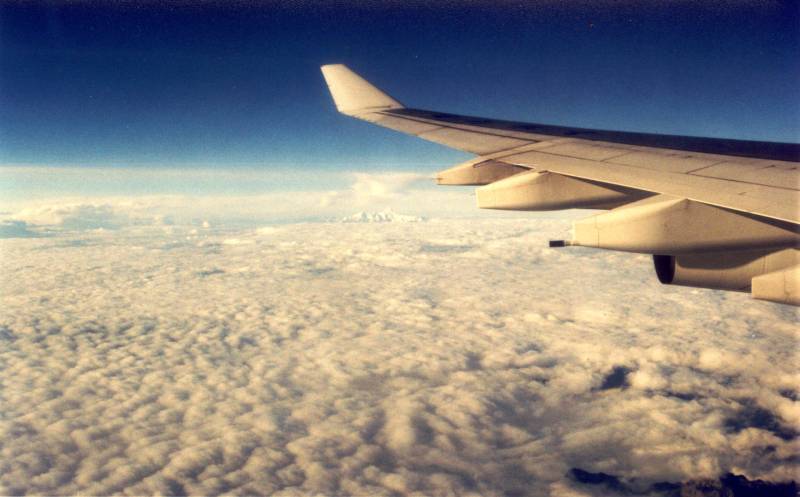 You could just see the white tip through the clouds on my flight from Chengdu to Lhasa. |
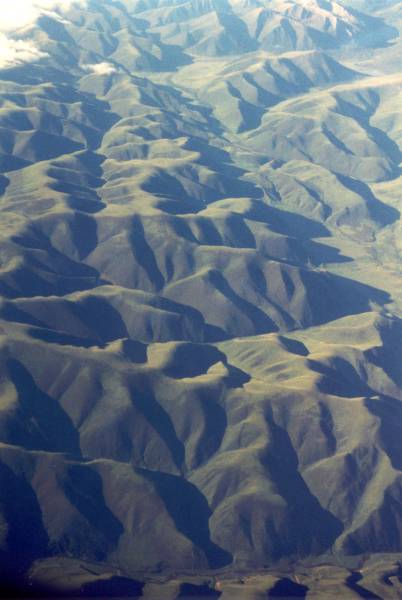 The Tibetan landscape... |
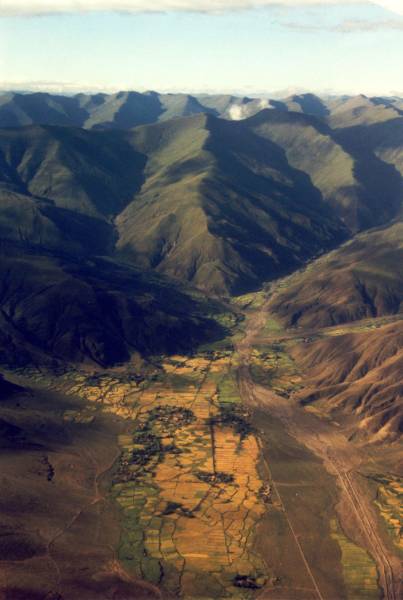 ... From the air. |
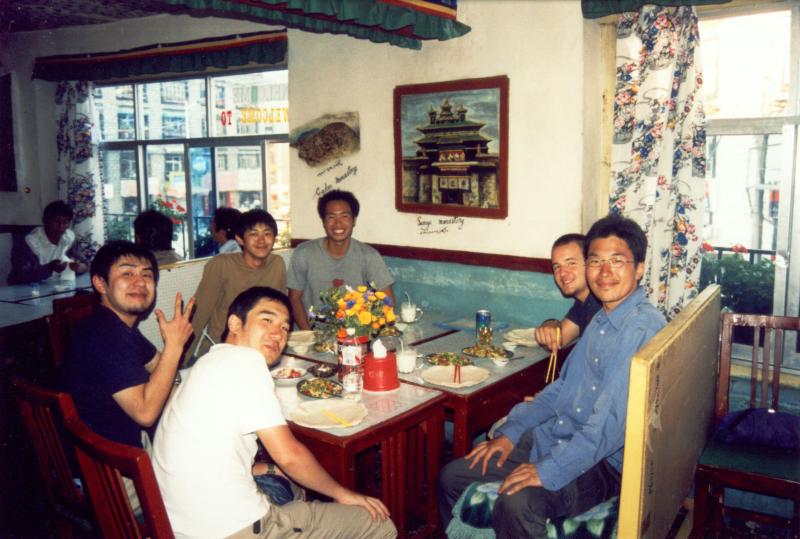 The crew - Me, Keisuke, DJ Haru, poor dude who got sick at Nam Tso, Yusuke, 'speedo' Ben! |
|
The Potala Palace, is a most impressive piece of architecture. I was mesmerized by it's size!!! Painted in white and red with tiny windows dotting it like decoration. This was where Tibet use to be govern from and home to successive Dalai Lamas until the Chinese invasion. Now it is a museum serving tourist and lacks the atmosphere which is seen in the Jokhang. Still it's been wonderful to finally get to visit this amazing structure as there was a time, a few months back when I thought my only view of this Palace would be from a sad little postcard I bought! I
also visited the Norbulingka, the summer palace of the Dalai Lamas.
It has been left to a pretty run-down state, but the park is peaceful
to wonder around, and the zoo (despite Lonelyplanet's disapproval)
was funny to watch. Like when the game keeper tried hosing down
the bears... ok so not quite funny haha then. |
|||
 Here is when I thought Lonelyplanet got a bit one sided, it seem
like everything the Chinese did was frown upon by the guidebook.
I visited the excellent Tibetan museum which Lonelyplanet dismissed
as propaganda. And this applies to many aspect of my trip and the
sentiment was share by my fellow travelers. I can understand their
disgust at the action of the government, but honestly Tibet under
Chinese occupation is not as bad as they make it!
Here is when I thought Lonelyplanet got a bit one sided, it seem
like everything the Chinese did was frown upon by the guidebook.
I visited the excellent Tibetan museum which Lonelyplanet dismissed
as propaganda. And this applies to many aspect of my trip and the
sentiment was share by my fellow travelers. I can understand their
disgust at the action of the government, but honestly Tibet under
Chinese occupation is not as bad as they make it!|
Tibetan
food! One
good thing the Han Chinese and Hui Muslim bought here are their
cuisine as Tibetan food is... well, the less said about it the better.
But since I am a huge fan of eating I have to delve into it. Tibetans
daily food is a kind of dough made with roasted-barley flour and
yak butter, mixed with tea to become.... Tsampa! Tsampa taste a
bit like dry milk powder at best, and I can only eat it with lots
and lots of sugar. Then there is momo, small dumplings filled with
meat or vegetable, steam or fried. These are slightly better but
my favorite is thugpa, a noodle soup with meat and vegetable. Pretty
stock standard but very eatable. My favorite is dried yak meat,
it is delicious with fried rice. As for sweets the Tibetans have
dried yak cheese. |
|||
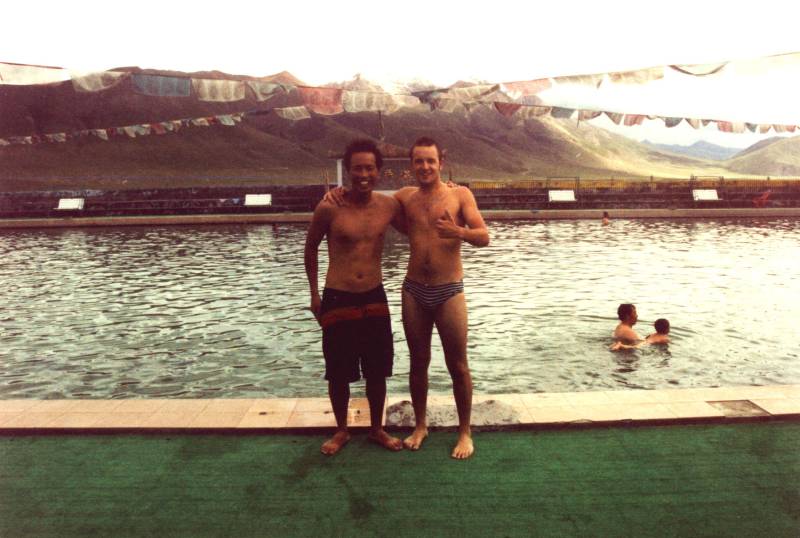 Check out Ben's sexy speedos!!!  |
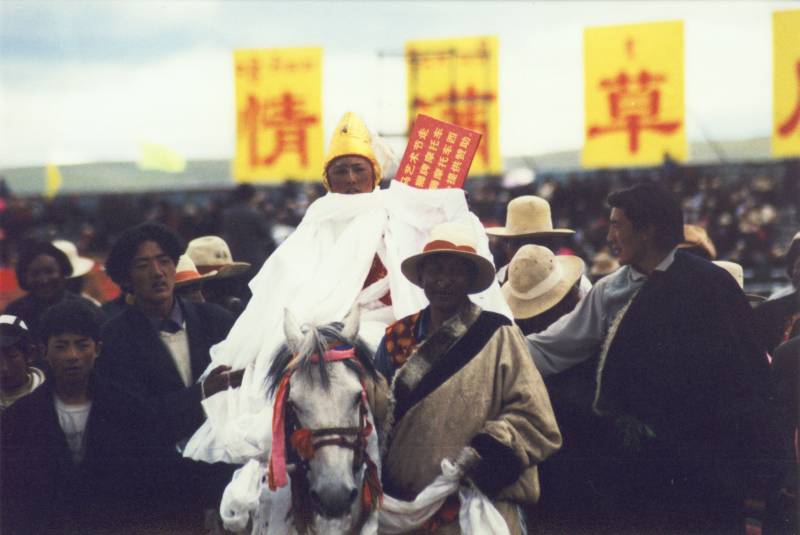 The winning jockey at the Naqu Horse race. |
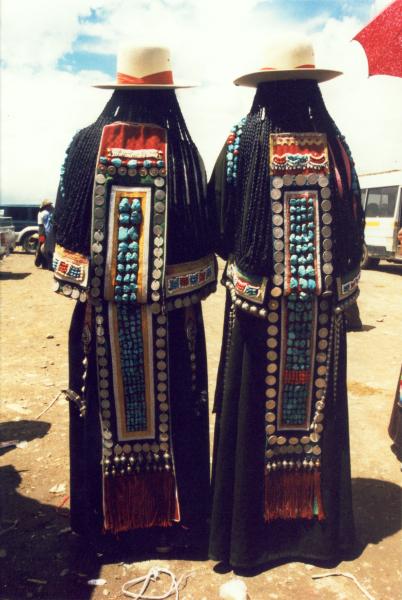 Beautiful Tibetan outfit at Naqu. |
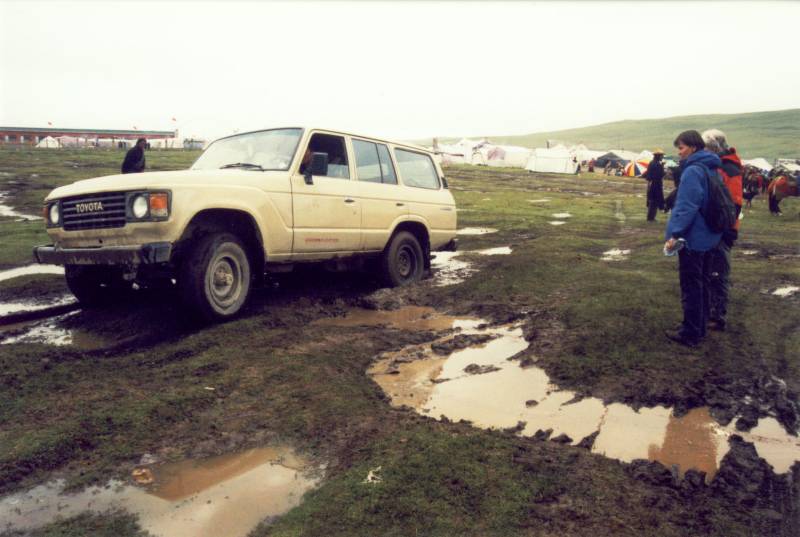 Bill and Medi watches on as our driver dig our 4WD out. |


|
Ganden and Nam-Tso I left Lhasa one early morning to visit Ganden Monastery for a Thanka (religious painting) festival. The monastery is situated at 4500m and was full of pilgrims. It was interesting to mingle with the Tibetans, and to follow them on their kora around the hill top, while watching the unveiling of the huge Thanka over the monastery. |
|
After
Ganden it was up to Nam-Tso lake at 4718m. This lake is huge, at
over 70km long and 30km wide. The Nyenchen Tanglha (Tangula) range
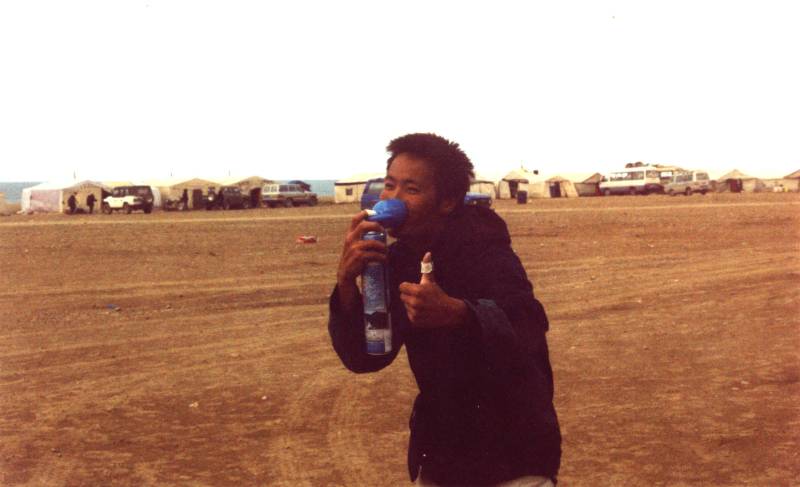
and it's 7000m snowy peaks provides a backdrop. It was here when
most of the crew suffered from altitude sickness, especially this
Japanese whom spent most of the time in bed breathing with the help
of oxygen containers. The poor guy only arrived to Tibet 2 days
ago before agreeing to coming with us! But it was good to see him
out and about on the second day! Along the way back from Nam-Tso
Ben and I went swimming at, what must be one of the highest hot
water pool in the world - at about 4200m. Ben forgot his togs though
so had to purchase some sexy looking speedos. hahahaha From
Nam-Tso, I headed north with Ben, Bill and Medi to see the horse
race at Naqu. This famous race held in August, and Tibetan nomads
from all over the northern plateau Changtang come to participate.
It was a great time to obeserve the Tibetans. All are dressed in
their finary, especially the women-folk. The race days were cold
and wet, and slightly un-organized, but then we weren't particularly
concern with the race, we were more interested in the people around
us! Whilst there officers from the local Chinese PSB (Public Secuirty
Bureau) manange to find us and made us pay extra as foreigners to
watch the race. Crap! I enjoyed the race overrall, and enjoyed the
singing and dancing which went and most of all, beating Bill at
outdoor pool! heheh |
|



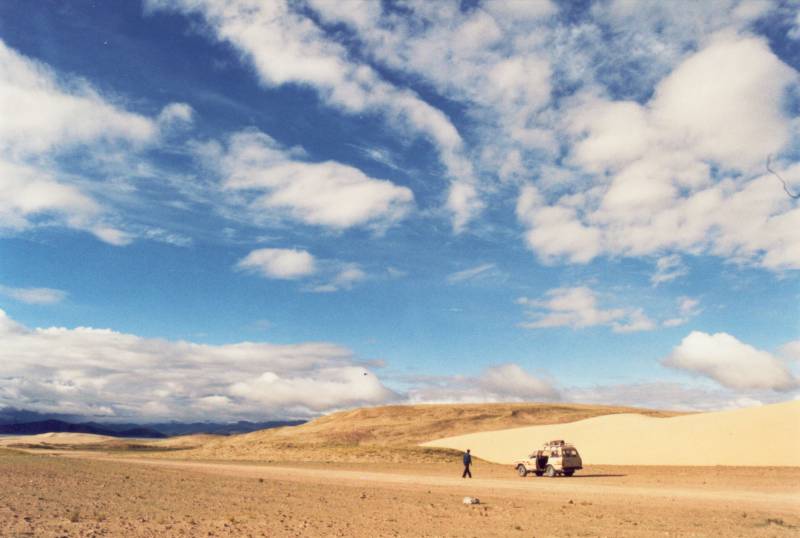 Our 4WD parked by massive sanddunes in Western Tibet. |
4WD trip to Western Tibet. After Naqu I return to Lhasa to organize my trip out to Western Tibet. I wanted to see the sights and the only ways to do this was either hitch my way around, or organize a group and hire a 4WD to show us around. I opt for the later as it is technically illigal to hitch as you cannot organize a permit, and that with a 4WD we can travel far and fast. I found 3 willing companions, Seiko and Yuko from Japan and Kristin from Australia. So it was a quick stop at the supermarket to stock up on food, for us that includes boxes of instant noodles <shivers>, can vegetable, can meat, sweets and bottled water. Our driver and guide are both Tibetan. Our excellent driver is Noodle. A tall, athletic and a serious kind'a guy. Our guide is Tashi. He is Mr Smiley and is a bit of a clown, always trying to crack jokes - in Tibetan and Mandarin! They, like the rest of the Tibetans love their ciggys, which they puff away at each rest stop. |
|
The trip began with a visit to Yamdrok-Tso lake, a beautiful turqoise lake. Before stopping over at the the town of Gyantse. This town is home of the Kumbum, the biggest chorten in Tibet. It rises up to 35m with 4 main symmetrical floors surmounted by a gold dome. What impress me most are the 4 sets of eyes gazing out in 4 directions, watching... The best view was up on Gyantse fort, built on a hill overlooking the old Tibetan town and the new Chinese town. Some Chinese propaganda was seen on this hill as they depict the Tibetan's struggle against the British troops back in 1904. The troops advance through Gyantse into Lhasa from Sikkim. After lunch we drove on to Tibet's second largest city, Shigatse. Shigatse is also home of the Tashilhunpo Monastery, which contains the seat of the Panchen Lama. The Panchen Lama's lineage are very important as it is second only to the Dalai Lamas themselves. We got to visit the tombs of past Panchan lamas, some encrusted in gold plated chorten studed with precious jewels. |
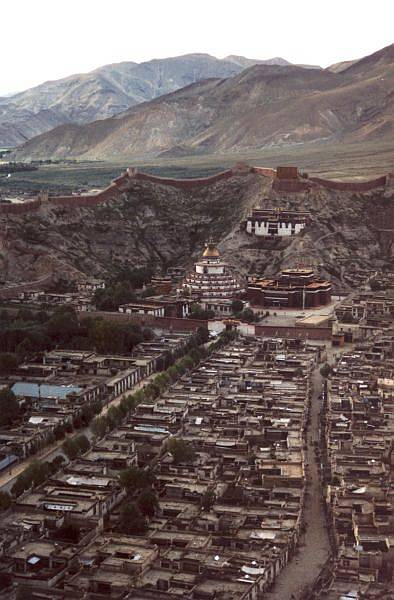 The Kumbum of Gyantse. |
|
|
The Land of Temples and Monasteries... After
that, it was more Monastery visits (I must confess by now all
the monasteries are merging into one! Our accomodation each night are pretty basic, usually a room with a few wooden beds, and a bucket for us to wash up. Dinner consist mainly of instant noodles and cans of meat/veg we bought back in Lhasa. As you can guess by the end of our 16 days trip we were all pretty nausiated by it's smell and taste! One
of my favorite stop overs on the journey would have been the village
of Paryang. This tiny village consist mostly of Tibetans and a
smittering of Chinese shop keepers. The houses are built of mud
bricks painted white, and at 4750m the treeless landscape is bare
except for the backdrop of the snow covered Himalaya Range. As
everning wears on it got bitterly cold but I still took a moment
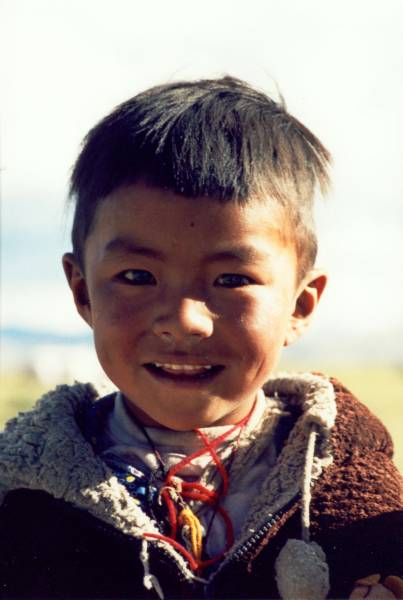
to get out to see the bright bright stars. I love the kids in
the village too, they follow us around, watching our every moves
with their shy eyes, laughing easily and smiling for our cameras.
One thing about these kids thou, and that is they need to start
wiping those snorty dribbles off their nose. |
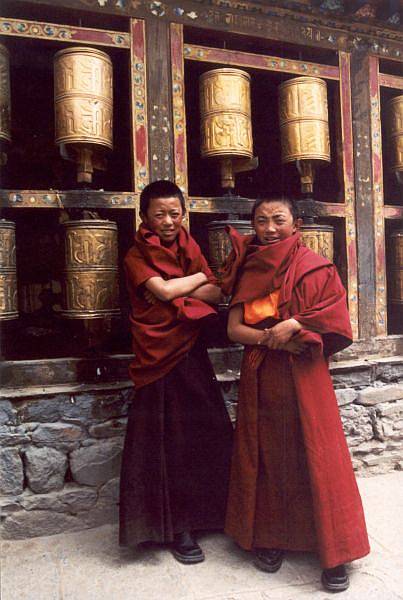
 ).
This time it was the Sakya Monastery in Lhaze. This Monastery
is built like a fort, with watch towers and high walls to protect
it from intruders. One thing which I am finding at all these monastery
is that a lot of restoration work and construction is going on,
returning them to their former glory.
).
This time it was the Sakya Monastery in Lhaze. This Monastery
is built like a fort, with watch towers and high walls to protect
it from intruders. One thing which I am finding at all these monastery
is that a lot of restoration work and construction is going on,
returning them to their former glory.|
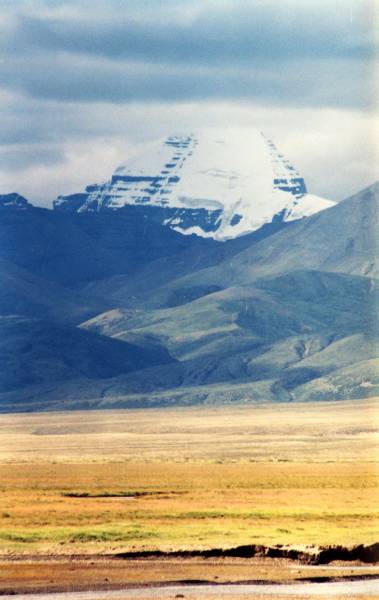
Mt Kailash! After
lots more driving over bumpy ground we finally arrive at the base
of Mt Kailash. The most revered mountain to the Tibetans, at 6714m,
is not the tallest mountain in this region, but with it's hulking
shape (some describe it as an ancient axe) and it's permanent snow
capped peak, it is the most dominating mountain here. Besides the
Buddhist faithful, MT Kailash is also worshiped by other religions.
They include the Hindus, Jains of India and the ancient Bön
religion. Many worshipers visit MT Kailash to perform a kora - to
walk the circuit around the mountain, all 52km of it. For me this
was a 2 days walk, and it is the highlight of my trip in Tibet.
The walk took us up alpine valleys linked by a lofty pass, the Dröma-la
(5630m), before dropping into the green turf and many streams on
the other side. Along the trek we met other pilgrims too, from Tibetans
nomads and their yak herds to the faithful of both religion. The
more devoted pilgrims prostrate the entire way. They do this by
lying down at full length with their arms stretched over their heads,
then standing up, placing their feet where their hands ended up
and repeat the process... Unbelievable! |
|||
|
|
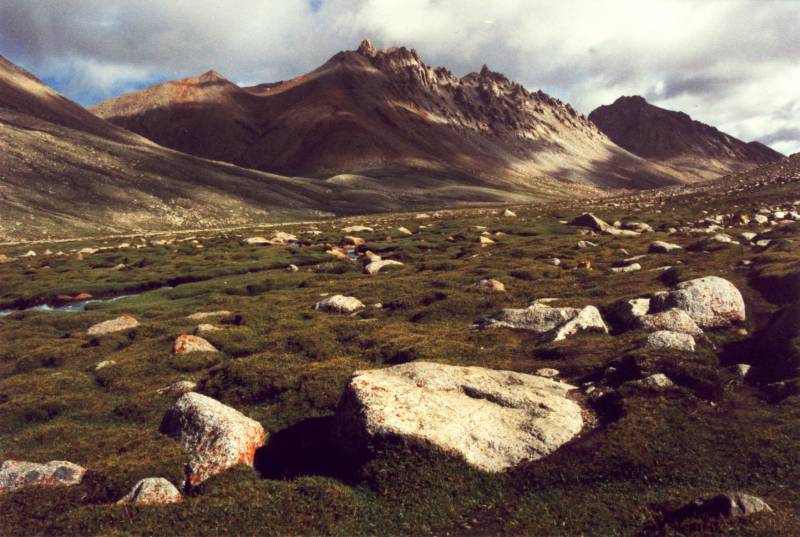 The plains surrounding Mt Kailash. |
 Devoted pilgrims prostrating on their 52km kora. |
|

|
After
the exhausting kora at Kailash we visited Lake Manasarova, to soak
up at the hot spring of Ganga-chu. It was a well deserved break,
and a chance to scrub out the dirt which had accumulated from the
last week! We also visit the nearby Chiu Monastery for a magical
view of this holy lake. Chiu Monastery is well known as it enshrines
a cave said to have been used by Guru Rinpoche at the end of his
life. Mt Everest!!! After
Western Tibet, it was time to head south, into the midst of the
Himalayas. Our destination: Mt Everest! At 8848m it is the highest
mountain in the world. We visited Everest Base Camp, at 5200m I
was surprised to find the facilities up here to be proper and organized.
With tea tents set up along the road, and various expedition camps
setup in their little corners. We heard of an expedition of two
crazy Americans who's plan was to scale the Mountain, and snowboard
their way down! I wonder whether they made it. |
|||
|
|
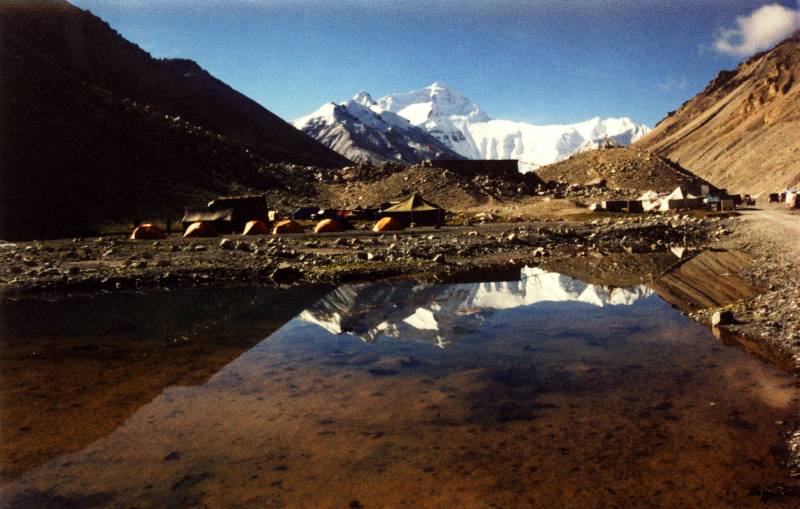 Everest Base Camp |
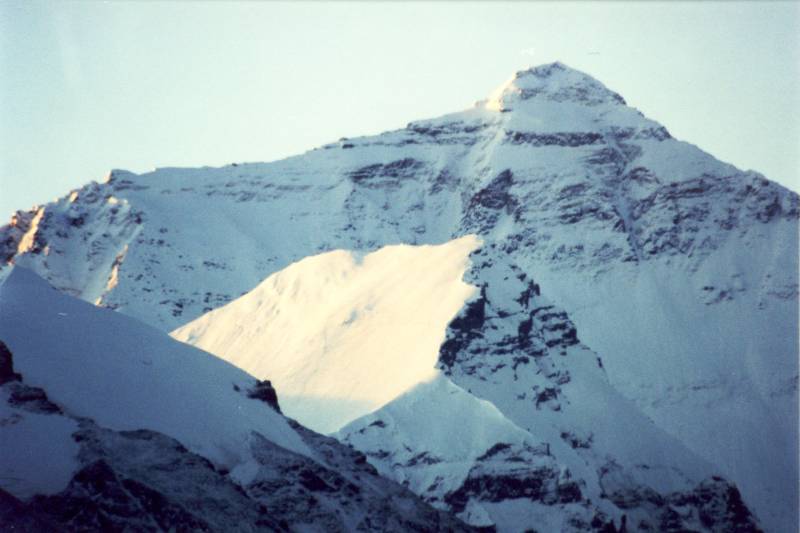 Everest at dawn... |
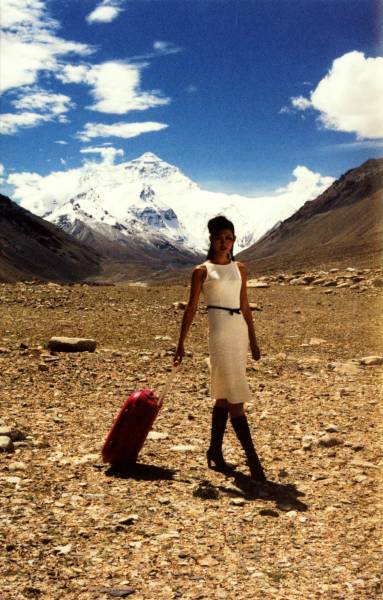 Surreal Chinese fashion shoot by Mt Everest. |
 We had a clear view on the drive up to the camp, but the cloud cover
came over by the afternoon. We spent the night keeping warm in the
tea tents, chilling with other travelers and playing cards. I got
up early the next morning to watch the sunrise. It was truely a
sensational morning, without a cloud in sight I
watch the first rays of light setting upon MT Everest. It wasn't
long before the whole of it's Eastern side was uncovered. This was
followed later by whispers of snow drifting of it's peak no doubt
from the strong wind. Word cannot describe the peaceful scene as
I was up on a little hill all alone, digesting this magnificent
sight all to myself.
We had a clear view on the drive up to the camp, but the cloud cover
came over by the afternoon. We spent the night keeping warm in the
tea tents, chilling with other travelers and playing cards. I got
up early the next morning to watch the sunrise. It was truely a
sensational morning, without a cloud in sight I
watch the first rays of light setting upon MT Everest. It wasn't
long before the whole of it's Eastern side was uncovered. This was
followed later by whispers of snow drifting of it's peak no doubt
from the strong wind. Word cannot describe the peaceful scene as
I was up on a little hill all alone, digesting this magnificent
sight all to myself.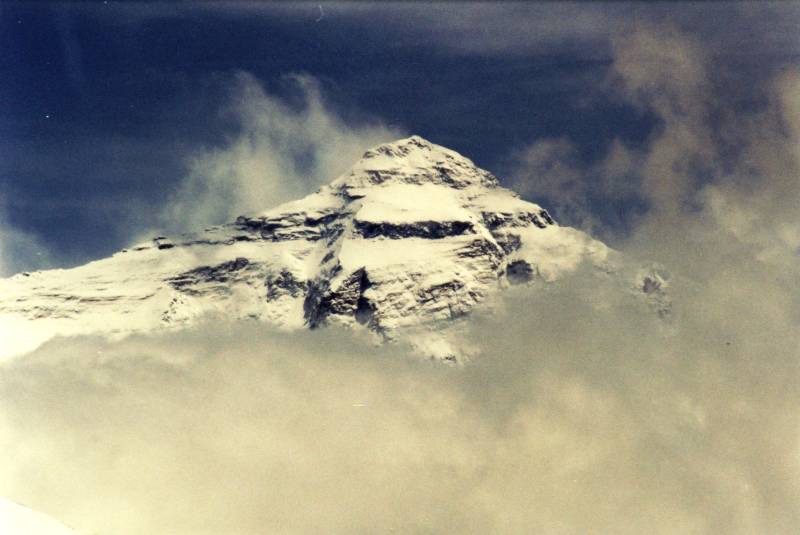
|
After Mt Everest, we began our decent into Nepal. And after passing the Tong-la pass at 5120m, we left the snow covered mountains of Tibet behind. The decend into the border town of Zhangmu was dramatic, as we enter a sea of clouds into Nyalam, (known to the Tibetans as the "gateway to hell"). These clouds are the monsoon clouds from the south, being blocked by the mountains we came from. Once past the clouds it was wet and wet and... full of green green trees! The first trees I have seen since leaving Lhasa! Zhangmu,
at 2300m is the border town into Nepal. The town hugs the rim
of a seemingly never-ending sucession of hairpin bends with houses
and shops hugging onto the side of the road. It is a town mix
with ethnic Chinese, Tibetans, Nepalis and Indian as they trade
their wares. It is also here that we bid kale shoo |
 (goodbye!) and thoo jaychay
  I am sad to leave the snowy white mountain and to say goodbye
to one of the friendliest people on Earth. May Buddha bless all
your souls my lovely Tibetans!
I am sad to leave the snowy white mountain and to say goodbye
to one of the friendliest people on Earth. May Buddha bless all
your souls my lovely Tibetans! |
"Tashi dele" to... Konichiwa
to Yuko and Seiko (Jap)! G'day to Kirstin (Aus), Ben Weller (England),
Bill Connors (USA) and Mechtild 'Medi' Hartmann(Ger), Harunori 'DJ
Haru' Nakamura (Jap), Randy Quan (Can), Yan Zheng (Hangzhou), Wang
Yum Feng (Beijing), Yusuke Nakamura (Jap), Adelaide Chen (USA),
Keisuke 'Sony' Yamaguchi (Jap), and finally Tashi and Noodle - my
driver and guide to Western Tibet! |

 ©
1998 - 2005
©
1998 - 2005