|
 ____________________________________________________________ |
 A
Smart Antenna A
Smart Antenna..................................................................................................
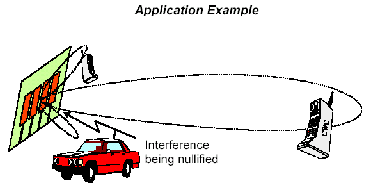 The antenna works by steering a beam to each mobile user when it is needed; the antenna also forms nulls in directions of strong interference.Both the beams on the wanted user and the nulls on interference sources track moving sources. Smart Antennas in CDMA .............................................................................. 1. Channel Modelling Considerations - Modelling the Received Signal
2.
The Spatial Processing Rake Receiver A
Space-time RAKE receiver
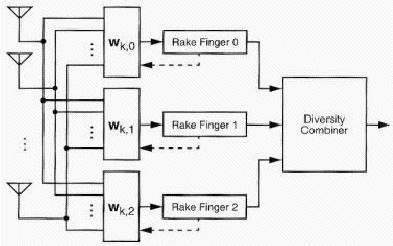
In
this structure each RAKE finger used the adaptive antenna to reject
multipath components that are uncorrelated with the component to which
the finger is locked. At the same time, the weight vector for each finger
is adjusted to take advantage of all correlated components which arrive
with path delays of within one chip period of the path delay of the
component to which the finger is locked. 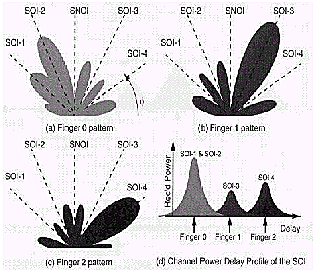 Antenna patterns using a three finger spatial filtering rake receiver receiving four components.The SOI's and interfering signals are shown as a function of Direction of Arrival (a-c), and time delay (d). This approach has been called the "2D RAKE filter" or a space-time RAKE receiver, because the receiver operates two separate sets of combiners in time and space. The receiver picks up the largest channel taps and selects the appropriate spatial filters in each case. The outputs from the spatial filter banks are then combined in a conventional RAKE filter. |
|
__________________________________________________________________________
Copyright © 2001, Michigan Technological University 1400 Townsend Drive, Houghton MI 49931-1295.Web Master |