|
 ____________________________________________________________ |
 Diversity Diversity
It is a powerful receiver technique that provides link improvement at relatively low cost. It exploits a random nature of the radio propagation by finding the independent signal paths for communication. If one radio path undergoes a deep fade, another independent path may have a strong signal. By having more than one path to select from, both the instantaneous and average SNR at the receiver can be improved by around 20 to 30dB. The two categories ..............................................................................
Depending upon the type of fading the diversity
techniques have been categorized as 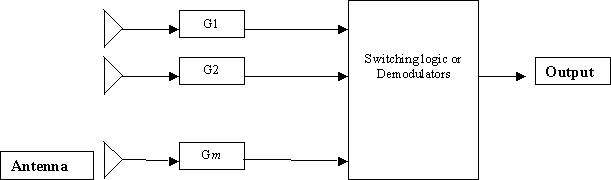
b.Feedback
or Scanning diversity 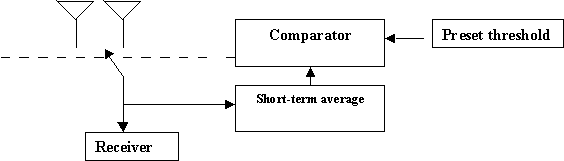
c.Maximal Ratio combining Here all the incoming signals from all the M branches are weighted according to their individual signal voltage to noise power ratios and then summed. All the individual signals must be co-phased before being summed. This requires sn individual receiver circuitry and phasing circuit for each antennas element. Pros: It produces an acceptable SNR compared to othe rtechniques Cons: It has a complicated circuitry 
d.Equal gain combining Here the branch weights are all set to unity, but the signals from each branch arae co-phased to provide equal gain combining.this allows the receiver to exploit signals that are simultaneously received on each branch. Pros: Simpler circuitry compred to Maximal Ratio Combining Cons: Provides inferior results compared to Maximal Ratio Combining. Time diversity ........................................................... Here we repeatedly transmit information at time spacings that exceed the coherence time of the channel, so that multiple repetetions of the signal will be received with independent fading conditions, thereby providing for diversity. Frequency diversity .......................................................... Here information is transmitted on more than one carrier frequency.The reson being that the frequencies separated by more than the coherence bandwidth of the channel will not experience the same fading . This is often employed in microwave line of sight links which carry sevral channels in a FDM mode. In practice a 1:N protection switching is provided by a radio liensee, wherein one frequency is is nominally idle but is available on a stand by basis to provide the frequency diversity switching for any one of the N other carriers. When diversity is needed the appropriate traffic is simply switched to the backup frequency. |
|
__________________________________________________________________________
Copyright © 2001, Michigan Technological University 1400 Townsend Drive, Houghton MI 49931-1295.Web Master |