|
| |
Deborah Ring Born July 10, 1698 in Plymouth Colony Married John Fuller before 1729 |

Eleazar Ring Born about 1655 in Plymouth Colony Married Mary Shaw about 1687 |
|
| Eleazer, a yeoman, and Mary lived in Plymouth, where their first nine children were born. He was appointed constable there for 1692. They later moved to Plympton, and then, toward the end of his life, to Kingston. Mary died there in 1730, as did Eleazer in 1749, aged about 94. | |
Deborah Hopkins Born about 1626 in Plymouth Colony Married Andrew Ring on April 23, 1646 in Plymouth Colony |
||
| Deborah married Andrew Ring, son of William and Mary Ring, at Plymouth. They had six children before she died in about 1666. | Andrew may have come to New England on the Second Mayflower in 1629. He was a proprietor at Plymouth by 1640 and had lands at Middleboro. He was made a Freeman of Plymouth in 1646, a constable in 1647, and served as surveyor of highways in 1654, 1668, and 1673. He died in 1693. | |
 |
Stephen Hopkins Born October 28, 1581 in Wortley, Wotton Under Edge, Gloucestershire, England Married Elizabeth Fisher on February 19, 1618 in Middlesex, England |
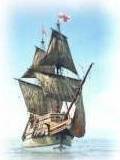
| Stephen Hopkins was from Hampshire, England. He married his first wife, Mary, and in the parish of Hursley, Hampshire. He and wife Mary had their children Elizabeth, Constance, and Giles all baptized there. Stephen Hopkins went with the ship Sea Venture on a voyage to Jamestown, Virginia in 1609 as a minister's clerk, but the ship wrecked in the "Isle of Devils" in the Bermudas. Stranded on an island for ten months, the passengers and crew survived on turtles, birds, and wild pigs. Six months into the castaway, Stephen Hopkins and several others organized a mutiny against the current governor. The mutiny was discovered and Stephen was sentenced to death. However, he pleaded with sorrow and tears. "So penitent he was, and made so much moan, alleging the ruin of his wife and children in this his trespass, as it wrought in the hearts of all the better sorts of the company". He managed to get his sentence commuted. Eventually the castaways built a small ship and sailed themselves to Jamestown. How long Stephen remained in Jamestown is not known. However, while he was gone, his wife Mary died. She was buried in Hursley on 9 May 1613, and left behind a probate estate which mentions her children Elizabeth, Constance and Giles. Stephen was back in England by 1617, when he married Elizabeth Fisher, but apparently had every intention of bringing his family back to Virginia. Their first child, Damaris, was born about 1618. In 1620, Stephen Hopkins brought his wife, and children Constance, Giles, and Damaris on the Mayflower (child Elizabeth apparently had died). Stephen was a fairly active member of the Pilgrims shortly after arrival, perhaps a result of his being one of the few individuals who had been to Virginia previously. He was a part of all the early exploring missions, and was used almost as an "expert" on Native Americans for the first few contacts. While out exploring, Stephen recognized and identified an Indian deer trap. And when Samoset walked into Plymouth and welcomed the English, he was housed in Stephen Hopkins' house for the night. Stephen was also sent on several of the ambassadorial missions to meet with the various Indian groups in the region. Stephen was an assistant to the governor through 1636, and volunteered for the Pequot War of 1637 but was never called to serve. By the late 1630s, however, Stephen began to occasionally run afoul of the Plymouth authorities, as he apparently opened up a shop and served alcohol. In 1636 he got into a fight with John Tisdale and seriously wounded him. In 1637, he was fined for allowing drinking and shuffleboard playing on Sunday. Early the next year he was fined for allowing people to drink excessively in his house: guest William Reynolds was fined, but the others were acquitted. In 1638 he was twice fined for selling beer at twice the actual value, and in 1639 he was fined for selling a looking glass for twice what it would cost if bought in the Bay Colony. Stephen died in 1644, and made out a will, asking to be buried near his wife, and naming his surviving children. Information courtesy of www.mayflowerhistory.com | |
Mayflower Main Page
    
|
||||
Loh. |
||||