|
 Home
Page Home
Page
Photo
Album
More
Photos
Favourite
things
Smiths
U2
Radiohead
McAlmont
and Butler
Nirvana
R.E.M.
Blur
kd
lang
Frasier
Favourite
Links
"street
s like a jungle
so
call the police
following
the herd
down
the greece
on
holiday."
"so
far you havn't
stayed
i n touch
well I
knew as much
it's
no surprise
that
today
I'll
get up around two
with
nothing to do
except
get a
touch
of flu."
|
|
|
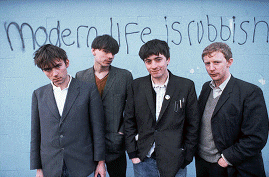
Blur
were the 'Big Thing' in the UK a few years back,
but have since been overshadowed by Oasis. Their
music fortunately has not suffered and their recent
material has shown that they have maintained their
freshness and vitality, making their contemporaries
(esp Oasis) lack of such all too
apparent.
|
'When
our third album comes out our position as the quintessential
English band of the '90s will be assured.' A typical bullish
statement which could have been made by any number of UK
indie bands in 1990—but from the mouth of Damon Albarn
of Blur it amounts to prophecy.
Blur were
formed in London while Albarn (b. 23 March 1968,
Whitechapel, London, England; vocals), Alex James (b. 21
November 1968, Bournemouth, Dorset, England; bass) and
Graham Coxon (b. 12 March 1969, Rinteln, Hannover, West
Germany; guitar) were studying at Goldsmith's College. Coxon
had first seen Albarn when he played a debut solo gig at
Colchester Arts Centre in 1988. Also in that audience was
future Blur drummer Dave Rowntree (b. 8 May 1964,
Colchester, Essex, England). Albarn's desire to make music
was encouraged by his father, who moved in circles that
exposed his son to artists such as Soft Machine and Cat
Stevens, while his mother was a stage designer for Joan
Littlewood's theatre company at Stratford. Rowntree's father
was sound engineer for the Beatles at the BBC, and had taken
lessons on the bagpipes. When the four members convened in
London (the first person James saw in halls of residence at
Guildhall was Coxon) they formed a band—initially
entitled Seymour—and started out on the lower rungs of
the gig circuit by playing bottom of the bill to New Fast
Automatic Daffodils and Too Much Texas at Camden's Dingwalls
venue.
A year
and a dozen gigs later, the quartet had signed to Food
Records, run by ex-Teardrop Explodes keyboard player David
Balfe and Sounds journalist Andy Ross, whose suggestion it
was that they change their name to Blur. They earned a
reputation with venue promoters for haphazardly implemented
onstage stunts. Vibrant '90s-friendly pop with a sharp
cutting edge, Blur's debut release, "She's So High," which
had initially got Seymour signed when included on their
first demo tape, sneaked into the Top 50 of the UK chart.
With the band displaying a justifiably breezy confidence in
their abilities, there was little surprise when the
infectious "There's No Other Way" reached number 8 in the UK
charts in the spring of 1991. This success continued when
Leisure entered the UK charts at number 2—a mere two
years after formation. However, a relatively fallow period
followed when "Popscene" failed to rise above number 34 in
the UK charts.
As the
'baggy' and 'Madchester' movements died, the band were
viewed with the same hostility that now greeted bands like
Rain or the Mock Turtles, as audiences looked away from the
Byrds-fixated guitar pop of the period. Blur seemed set to
disappear with the same alacrity with which they had
conjured themselves, though their names were kept alive in
press columns by their 'expert liggers' status.
MODERN
LIFE IS RUBBISH was presented to their record company at the
end of 1992 but rejected, Balfe insisting that Albarn go
away and write at least two more tracks. The resultant
songs, "For Tomorrow" and "Chemical World," were the album's
singles. When it finally emerged in 1993 its sales profile
of 50,000 copies failed to match that of its predecessor or
expectations, but touring and a strong headlining appearance
at the Reading Festival rebuilt confidence.
The 'new'
model Blur was waiting in the wings, and saw fruition in
March 1994 with the release of "Girls & Boys," the first
single from what was to prove the epoch-making PARKLIFE
album. This set wantonly upturned musical expectations,
borrowing liberally from every great British institution
from the Beatles, the Small Faces and the Kinks to the Jam
and Madness, topped off by Albarn's knowing Cockney
delivery. At last there seemed to be genuine substance to
the band's more excessive claims. With the entire music
media their friends again, Blur consolidated with a live
spectacular in front of 8,000 fans at London's Alexandra
Palace, while the album gained a Mercury Prize nomination.
THE GREAT
ESCAPE followed in its predecessor's lofty footsteps, and
Blur went on to secure four trophies, including Best Band
and Album, at the 1995 BRIT Awards.
|