|
 Home
Page Home
Page
Photo
Album
More
Photos
Favourite
things
Smiths
U2
Radiohead
McAlmont
and Butler
Nirvana
REM
Blur
kd
lang
Frasier
Favourite
Links
|
|
|
Well
my favourite REM album is Out of Time. My favourite
track is "Half a World Away". I enjoy the folk like
quality to the music, and the instrumental work is
truly inspiring. Check out my Out
of Time,
which is part of my CD
Collection
|
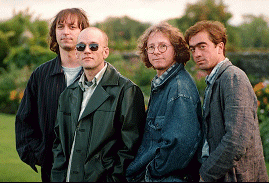
R.E.M.
played
their first concert in Athens, Georgia, USA on 19 April
1980. Their line-up, then as now, consisted of four
drop-outs from the University of Georgia; Michael Stipe (b.
4 January 1960, Decatur, Georgia, USA; vocals), Peter Buck
(b. 6 December 1956, Los Angeles, California, USA; guitar),
Mike Mills (b. 17 December 1958, Orange County, California,
USA; bass) and Bill Berry (b. 31 July 1958, Duluth,
Minnesota, USA; drums). Without the charisma of Stipe and
his eccentric onstage behaviour, hurling himself about with
abandon in between mumbling into the microphone, they could
easily have been overlooked as just another bar band,
relying on the harmonious guitar sound of the Byrds for
their inspiration. Acquiring a healthy following among the
college fraternity in their hometown, they entered the
studio before long to record their debut single, "Radio Free
Europe," to be released independently on Hibtone Records.
This was greeted with considerable praise by critics, who
conceded that the band amounted to more than the sum of
their influences. Their country/folk sound was contradicted
by a driving bassline and an urgency that put the listener
more in mind of the Who in their early mod phase. Add to
this the distinctive voice of Stipe and his, on the whole,
inaudible, perhaps even non-existent, lyrics, and R.E.M.
sounded quite unlike any other band in the USA in the
post-punk era of the early '80s. They gained further
favourable notices for the CHRONIC TOWN mini-LP, and their
debut full-length album was now eagerly anticipated; when it
arrived in 1983 it surpassed all expectations, and was
eventually made Album Of The Year by Rolling Stone magazine.
As in the USA, the band earned a devoted cult following in
Europe, largely composed of college students, as a result of
MURMUR.
RECKONING
appeared the following year and was permeated by a reckless
spontaneity that had been missing from their earlier work.
Recorded in only 12 days, the tracks varied in mood from
frustration, as on "So. Central Rain," to the
tongue-in-cheek singalong "(Don't Go Back To) Rockville."
The songs were accessible enough but, as would be the case
for most of the '80s, the singles culled from R.E.M.’s
albums were generally deemed uncommercial by mainstream
radio programmers. However, their cult reputation benefited
from a series of flop singles on both sides of the Atlantic.
Although received enthusiastically by critics, FABLES OF THE
RECONSTRUCTION was a stark, morose album that mirrored a
period of despondency within the band. Peter Buck summed it
up in the '90s—‘If we were to record those songs
again, they would be very different’. LIFE'S RICH
PAGEANT, in 1986, showed the first signs of a politicization
within the band that would come to a head, and coincide with
their commercial breakthrough, in the late '80s. Stipe's
lyrics began to dwell increasingly on the prevailing
amorality in the USA and question its inherited ethics,
whilst still retaining their much-vaunted obliqueness.
Tracks like "These Days" and "Cuyahoga" were rallying cries
to the young and disaffected; although the lyrics were
reflective and almost bitter, the music was the most joyous
and uplifting the band had recorded to date. This ironic
approach to songwriting was typified by "It's The End Of The
World As We Know It (And I Feel Fine)," from the equally
impressive DOCUMENT. Released also as a single, it
intentionally trivialized its subject matter with a witty
and up-tempo infectiousness, more characteristic of the
Housemartins.
GREEN
arrived in 1988 and sold slowly but steadily in the USA, the
attendant single "Stand" reaching number 6 there, while
"Orange Crush" entered the UK Top 30. Apart from
demonstrating their environmental awareness, particularly in
"You Are The Everything," the album laid more emphasis than
previously on Stipe's vocals and lyrics. This, to the
singer's dismay, led to his elevation as ‘spokesman for
a generation’. Already hero-worshiped by adoring
long-term fans, Stipe insists, ‘Rock ‘n’ roll
is a joke; people who take it seriously are the butt of the
joke’. The world tour that coincided with the album's
release saw R.E.M. making a smooth transition from
medium-size venues to the stadium circuit, due as much to
Stipe's individual choreography as to the elaborate,
projected backdrops. After a break of two years the band
re-emerged in 1991 with OUT OF TIME. Their previous use of
horns and mandolins to embroider songs did not prepare their
audience for the deployment of an entire string section, nor
were the contributions from B-52s singer Kate Pierson and
Boogie Down Productions' KRS-One expected. Ostensibly all
love songs, the album was unanimously hailed as a
masterpiece and entered the UK Top 5 on its release, topping
both US and UK album charts shortly afterwards. The
accompanying singles from that album, "Losing My Religion,"
"Shiny Happy People," and "Near Wild Heaven," gave them
further hits. After picking up countless awards during the
early '90s the band has maintained the high standard set by
OUT OF TIME. AUTOMATIC FOR THE PEOPLE was released in
October 1992, to universal favour. It reached the top of the
charts in the UK and USA. Michael Stipe was seen both as
pin-up and creative genius. The album produced a number of
memorable singles, including the moody "Drive" and the
joyous "Man In The Moon," with its classic Elvis Presley
vocal inflections from Stipe and an accompanying
award-winning monochrome video. MONSTER showed the band in
grungelike mode, not letting any accusations of selling out
bother them, and certainly letting fans and critics alike
know that they had not gone soft. "What's The Frequency
Kenneth?" started a run of further hit singles taken from
the album and further awards were heaped upon them.
Following the collapse of Bill Berry in Switzerland while on
a major tour in 1995 the band were forced to rest. Berry was
operated on for a ruptured aneurysm and he made a full
recovery. The critical praise heaped upon the band has been
monumental, but through all the attention the band appear
united, reasonably unaffected and painfully modest. They are
one of the most important and popular groups to appear over
the past three decades, and still retain massive credibility
together with fresh ideas.
|