|
 Home
Page Home
Page
Photo
Album
More
Photos
Favourite
things
Smiths
U2
Radiohead
McAlmont
and Butler
Nirvana
R.E.M.
Blur
kd
lang
Frasier
Favourite
Links
"you
wanted to
get
somewhere so
badly,
you had to
lose
youself along
the
way, you change
your
name but that's
ok,
it's necessary
and
what you leave
behind
you don't
miss
anyway"
"there
will be no time
of
sorrow, there will
be no
time time for
shame.
And though I
can't
say why, I
know
I've got
to
believe"
"weather
'round here
choppin'
and changin'
surgery
in the air
print
shirts and southern
accents
cigars and
big
hair"
|
|
|
Well
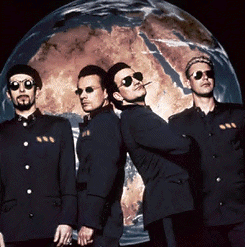
I was lucky enough to see the Popmart tour when it
stopped at Wembley. It was an increadible show, and
the music from the Pop album worked fantastic with
the big production. Pop was probably my favourite
album of last year. Well that's what I think, do
you think I care what the critics say
?
|
Indisputably,
the most popular group of the '80s in Britain, Irish unit U2
began their musical career at school in Dublin back in 1977.
Bono (b. Paul Hewson, 10 May 1960, Dublin, Eire; vocals),
The Edge (b. David Evans, 8 August 1961, Barking, Essex;
guitar), Adam Clayton (b. 13 March 1960, Chinnor,
Oxfordshire, England; bass) and Larry Mullen (b. Laurence
Mullen, 1 October 1960, Dublin, Eire; drums) initially
played Rolling Stones and Beach Boys cover versions in a
group named Feedback. They then changed their name to the
Hype before finally settling on U2 in 1978.
After
winning a talent contest in Limerick that year, they came
under the wing of manager Paul McGuinness and were
subsequently signed to CBS Ireland. Their debut EP, U2:3,
featured "Out Of Control" (1979), which propelled them to
number 1 in the Irish charts. They repeated that feat with
"Another Day" (1980), but having been passed on by CBS UK,
they were free to sign a deal outside of Ireland with Island
Records. Their UK debut, "11 O'Clock Tick Tock," produced by
Martin Hannett, was well received but failed to chart. Two
further singles, "A Day Without Me" and "I Will Follow,"
passed with little sales while the group prepared their
first album, produced by Steve Lillywhite.
BOY, a
moving and inspired document of adolescence, received
critical approbation, which was reinforced by the live shows
that U2 were undertaking throughout the country. Bono's
impassioned vocals and the group's rhythmic tightness
revealed them as the most promising live unit of 1981. After
touring America, the group returned to Britain where "Fire"
was bubbling under the Top 30.
Another
minor hit with the impassioned "Gloria" was followed by the
strident OCTOBER. The album had an anthemic thrust
reinforced by a religious verve that was almost evangelical
in its force. In February 1983 the group reached the UK Top
10 with "New Year's Day," a song of hope inspired by the
Polish Solidarity Movement. WAR followed soon after to
critical plaudits. The album's theme covered both religious
and political conflicts, especially in the key track "Sunday
Bloody Sunday," which had already emerged as one of the
group's most startling and moving live songs. Given their
power in concert, it was inevitable that U2 would attempt to
capture their essence on a live album. UNDER A BLOOD RED SKY
did not disappoint and as well as climbing to number 2 in
the UK brought them their first significant chart placing in
the US at number 28.
By the
summer of 1984, U2 were about to enter the vanguard of the
rock elite. Bono duetted with Bob Dylan at the latter's
concert at Slane Castle and U2 established their own company
Mother Records, with the intention of unearthing fresh
musical talent in Eire. THE UNFORGETTABLE FIRE, produced by
Brian Eno and Daniel Lanois, revealed a new maturity and
improved their commercial and critical standing in the US
charts. The attendant single, "Pride (In The Name Of Love),"
displayed the passion and humanity that were by now familiar
ingredients in U2's music and lyrics.
The
group's commitment to their ideals was further underlined by
their appearances at Live Aid, Ireland's Self Aid, and their
involvement with Amnesty International and guest spot on
Little Steven's anti-Apartheid single, "Sun City." During
this same period, U2 embarked on a world tour and completed
work on their next album. THE JOSHUA TREE emerged in March
1987 and confirmed U2's standing as one of the most popular
groups in the world. The album topped both the US and UK
charts and revealed a new, more expansive sound, which
complemented their soul-searching lyrics. The familiar
themes of spiritual salvation permeated the work and the
quest motif was particularly evident on both "With Or
Without You" and "I Still Haven't Found What I'm Looking
For," which both reached number 1 in the US charts. After
such a milestone album, 1988 proved a relatively quiet year
for the group. Bono and The Edge appeared on Roy Orbison's
MYSTERY GIRL and the year ended with the double-live album
and film, RATTLE AND HUM. The group also belatedly scored
their first UK number 1 single with the R&B-influenced
Desire.
The
challenge to complete a suitable follow-up to THE JOSHUA
TREE took considerable time, with sessions completed in
Germany with Lanois and Eno. Meanwhile, the group appeared
on the Cole Porter tribute album RED HOT + BLUE, performing
a radical reading of "Night And Day." In late 1991, "The
Fly" entered the UK charts at number 1, emulating the
success of "Desire." ACHTUNG BABY was an impressive work,
which captured the majesty of its predecessor yet also
stripped down the sound to provide a greater sense of
spontaneity.
The work
emphasized U2's standing as an international group, whose
achievements since the late '70s have been extraordinarily
cohesive and consistent, and although the critics were less
than generous with ZOOROPA the band remain one of the most
popular 'stadium' attractions of the '90s. In the mid-'90s
Bono devoted much of his time writing song for others. With
Edge he wrote the theme "Goldeneye" for Tina Turner and
became involved in the Passengers project.
His
verbal lashing of the French president Jacques Chirac at the
MTV awards in Paris created the biggest news, however.
Obviously upset by the recent continuing nuclear tests, Bono
came onstage smiling to accept an award. The audience were
brilliantly fooled by his perfectly delivered sarcasm: 'What
a city' (cheers and applause), 'what a night' (cheers and
applause), 'what a bomb' (confused laughter and applause),
'what a mistake' (mixed response), 'what a wanker you have
for a President' (sporadic boos).
|