|
|
| |
|
|
. | ||
 |
| |
|
............................................... |
............................................................................................................. |
|
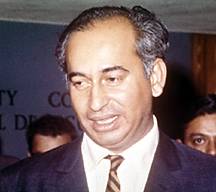
ZULFIQAR ALI BHUTTOTwenty three years before this day (April 4, 1979) the elected Prime Minister and Chairman Pakistan Peoples Party (Founded by him in 1967) was hanged to death by the court order for his role in a murder case. Thereafter his death the international and National Politics in Pakistan took various ups and down. Those celebrating his death anniversary must be wondering today what the political scenario would have been had had Bhutto was not hanged and left to rule the country. Since he was a democrat, educated and rose in the west and had served for a decade of time under the dictatorial regime of Field Marshal Mohammad Ayub Khan against he had a better approach of world politics. Before initiating his mass movement in 1968 to overthrow the very regime that raised him to exalted fame Bhutto had closely studied and analyzed the consequence of the bi-poplar world Order and as such being an active admirer of the Cento and CEATO during the late fifties he was adored by the West. However still being a politician and political tactician he would dare to take advantage of the Indo China downing relations during the late fifties while India had indulged itself with the Non alliance movement. And that is how Button could initiate a bargaining amid the diplomatic stalemated relationship between the West and the East. The history of the cold war would if so facto recognize this role as it finally contributed to the US- China understanding and Chinese inclusion into the world community. Probably the over indulgence into the International Relations and Public International Law helped him to device his own utopia of the National Politics. And that is how when he left Ayub Khan regime in 1967, he came with a unique formula for the future governance in Pakistan. Accordingly launching his PPP with the motive to introduce democracy in the country he could unleash the vision of Socialist economy with the Leninist slogan " All powers to the people". This new philosophy created a huge storm in the country as the uneducated orthodoxy condemned him to be a Chinese agent while the rulers termed him a social menace. Sooner the entire country was indulged into a unique historical agitation, which was no doubt part of the world politics as London, Paris, Bonn, Rome and other big cities around the world had students’ protests. The result of such a manor in Pakistan paved way to the emergence of yet a new dictatorship as Gen. Yahya Khan took over in 1969 lamenting poor law and order. Gen. Yahya honestly placing all the political cards before the masses declared that the recipe to solve the socio-economic and administrative problems was to introduce rule of law in the country and thus he decided to hold free, fair and impartial elections in the country on the basis of one man one vote so that peoples' elected representative would constitute the source of law. The first ever free and fair election resulted into the emergence of Bhutto against Shaikh Mujib as both were overwhelmingly followed in their respective provinces. And soon the polarization resulted into a tussle that gave rise to the emergence of Bangladesh. This made possible for Bhutto to take over in the ramp Pakistan under a very shabby scenario.
During his brief rule for about five years Z. A. Bhutto
emerged as a unique historical figure. He was no doubt not Gen. Degaul but
without a military uniform he succeeded in founding a new Republic of Pakistan.
The difficult task of constitution making was completed and a unanimously agreed
democratic constitution was enforced that even to this day is alive.
The policies of nationalization of heavy industries and introduction of ceiling
of land holding were the issue that angered the country's rich class and as such
all opposition against Bhutto regime was now channelized through the religious
circles. Yet to mention was the formidable challenge from the nationalists
elements that were having a say in the two provinces that border Afghanistan.
And as such Afghanistan could come with a fresh slogan of Pukhtoonistan, which
meant that people in both the bordering provinces should be given freedom from
Pakistan. This created a big problem for the existence of the Federation because
through Kabul, the Soviets were perusing by all means the Breshnieve's Asian
Security Plan.
Again the lawlessness and unrest made the armed forces to take over and thus
emerged the eleven years ruthless rule of Gen. Zia ul Haq who soon liquidated
Bhutto.
Today remembering Z.A. Bhutto, one wonders while watching the development in the
post cold world scenario if his philosophy would tolerate what the world is
going through. In Palestine, Afghanistan, and rest of the Muslim world the
continued warfare against terrorism and its imercusions with respect to the very
existence of peaceful co-existence and peaceful intercourse of relationship
between the sovereign states? No doubt the cold war era witnessed a unique history in making and atop this effect the contributions from the sub continent and particularly Pakistan could not be denied. However, presently after the fall of soviet Empire, and emergence of new world order, called the global village, it is worth considering if Bhuttoism has any place left over in the present day political scenario? The new world order called uni-polar would be needing a lot more vigilant leadership particularly in the third world where the neo-colonialism has erupted through the open and international market strategy. However to coup with such basic question no one can dare to think about means other that those devised through years of hard work via the Public International Law. The very law in its founding chapters has defined the state entity to be an artificial person who likes a real person has its own rights and duties. The current era is to one that we got to ensure and strengthened such rights and obligations and that is what teachings of present day Bhuttoism would emphasize. The post Bhutto era has shown that his successor not only failed to follow his policies but on the international scenario right from the days when the Argentinean iron man Gen. Peron tossed for the first time the rights of the third rated states and which could led the world toward the concept of peaceful co-existence during the bi-polar era, one would find the approaches of Z.A. Bhutto repeatedly praised. Be it Degaul or Bertrand Russell, Chou En laie, or Gromyko his vision and tactics regarding peaceful co-existence was time and again praised. However during the present era when the bi-polar world has come to its logical end and the village world has taken shape Bhutto's approaches are found stretching to the frontiers of the global world order. |
|
.......................................................... ..................................................................................................... ...... |
 .
.