
Click here if you don't hear music
In the early 1930’s, Japan launched a war against mainland China. The League of Nations, including the United States and Great Britain, were outraged and demanded that Japan cease the fighting. Yet, furious as they were, neither country was capable of stopping the Japanese-Chinese war due to the world-wide great depression, and they didn’t wish to go to war over it, Japan was able to continue it’s war against China. However, on December 12, 1937, Japanese aircraft sent shockwaves around the world when they bombed and sank the 450 ton American gunboat USS Panay on the Yangtze River in China. One American sailor, Charles L. Ensminger was killed. Japan apologized profusely and paid a significant amount of money to the U.S. Meanwhile, the Japanese war department ordered Admiral Isoruku Yamamoto [Commander in Chief, Combined Fleet. The Admiral in charge of Japan’s Navy] to begin plans for war with the United States. Yamamoto vigorously argued, saying that the United States’ industrial strength was many times greater than Japan’s, and that in a war of attrition, "The American’s will, repeat, will win". After coming up with Operation Z, [the code name for the attack on Pearl Harbor] his superiors agreed to the plan, which had six Japanese aircraft carriers to strike Pearl Harbor. But Yamamoto warned them, saying " I shall run wild for six months to a year, but after that, I can not say." He meant that once war began, the Navy and Army would have about six to twelve months of victory, but after that time period, the victories would probably be replaced by defeats. On November 26, 1941, Kido Butai [Japanese for "Strike Force] sailed from Tankan Bay in Northern Japan. Under the command of Vice Admiral Chuichi Nagumo sailed six aircraft carriers: Akagi, Kaga, Hiryu, Soryu, Shokaku, and Zuikaku, two battleships: Hiei and Kirishima, heavy cruisers Tone and Chikuma, light cruiser Abukuma and nine destroyers. The fleet sailed undetected on a northern Pacific route. On December 2nd, due North of Midway Island, Nagumo received a radio message from Yamamoto: "Climb Mount Niitaka". That meant that the attack was to go forward. Japan was at war. At dawn on December 7th, 350 Japanese strike aircraft launched from their carriers 250 miles North of Oahu, the island on which Pearl Harbor is located. They arrived over the peaceful harbor just as many sailors and soldiers were eating breakfast or on their way to the Sunday Church services. The time was 7:55 a.m. A Japanese dive bomber swooped down over Ford Island and dropped a bomb that missed the runway and landed on the beach, near battleship USS California. Aboard minelayer Oglala, Rear Admiral William Rhea Furlong, SOPA, at first thought an Army Airforce pilot had messed up. Then he saw the red disks on the wings on the plane. He realized what was happening immediately. He shouted "Japanese! Man your stations!" and sent out an order: "All ships in harbor sortie" Then the Japanese torpedo planes came in and began to fly their deadly runs toward their targets. In seconds, torpedoes had ripped into battleships Nevada, Arizona, West Virginia, Oklahoma, and California. Oklahoma was hit by five torpedoes almost simultaneously and her damage control efforts failed. She soon capsized and sank. West Virginia was hit by seven torpedoes, two of which are believed to have detonated inside her hull. However, quick thinking on her bridge saved her from capsizing, and she sank upright into the shallow harbor, as did California, hit by two torpedoes and two or three bombs. Next came the high level bombers. They mostly concentrated on three ships: Tennessee and Maryland, which were tied up between West Virginia and Oklahoma, respectively, and because of this, no torpedoes could reach them, and Arizona. Bombs rained down on Tennessee and Maryland. Fragments from the bombs targeted on Tennessee flew across and struck West Virginia, one of which fatally injured her captain, Captain Mervyn S. Bennion, who died soon after. But the worst damage happened when, high above the harbor, Petty Officer Noboru Kanai, of IJN carrier Soryu, released his bomb at exactly 8:05 and 35 seconds. It crashed down through the deck of USS Arizona and detonated in the magazine, setting off close to a million pounds of gunpowder. The resulting explosion threw smoke, flames, men, and debris as high as 1,000 feet in the air. Of a crew of 1,400, 1,103 were casualties, including Captain Franklin von Falkenburgh and Rear Admiral Isaac Cassin Kidd. At about 10:30, Commander Fuqua finally ordered abandon ship. Less than 300 men were able to obey the command. By 9:00 am, the Japanese were gone, leaving behind over 2,000 dead, dying or wounded Americans, 4 sunken battleships, one heavily damaged battleship, and three lightly-medium damaged battleships, 3 destroyers sunk, and several other ships. Japan lost 25 planes and 50 men.
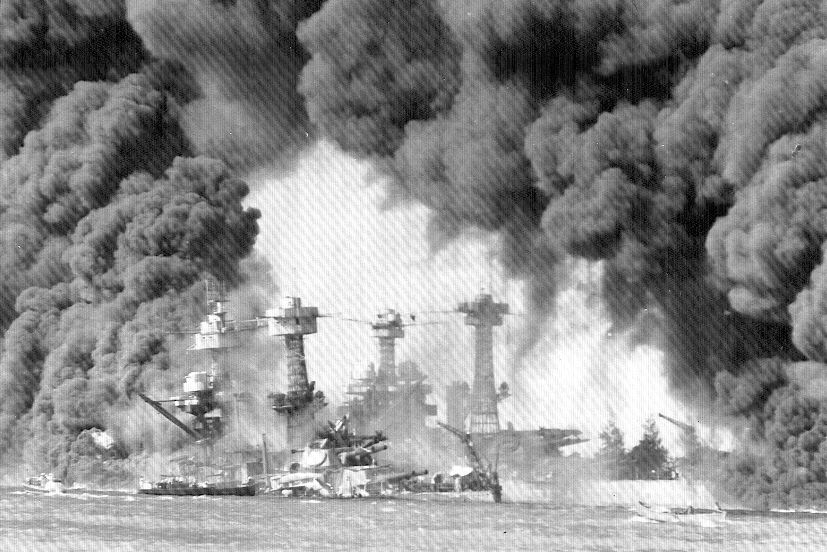 (Above: USS West Virgina, sunk, but upright, burning after the attack. USS Tennesse is inboard, with only moderate damage. Tennessee was one of the first ships to rejoin the fleet.)
Forces
 Links to other sites on the Web
 HOME
HOME
My Midway Site
BATTLESHIP ROW: The USN at Pearl Harbor
click here for info on me
View Deck Log
United States Navy Today
© 1997 Colt1911_45@yahoo.com
 Get your own Free Home Page