|
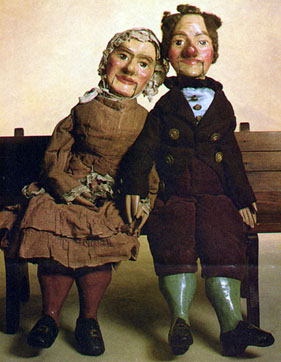
Woman and man are from
England in the 1890s. Vents gave them life with the "near voice" and lip control. The art of ventriloquism is booming, and so is puppet making the best figures can cost $3,000 to create. |
A knife-wielding dummy run amok
Paradoxically, it's this ability to talk in different voices that brings a vent not only
his success but his bad rap, too. The more real the character, the more the audience will
presume that the vent must also believe the illusion in its entirety. You can't blame an
audience for imagining that conversations go on between the vent and figure long after the
end of the show-secret powwows in the cluttered quarters of the dressing room beneath the
glare of a naked light bulb. And it doesn't take the imagination of Stephen King to push a
little beyond this scenario and visualize the malevolent figure run amok, the terrifying
theme of the 1978 film Magic, with its sinister, knife-wielding dummy Fats. It's as if
that evil little voice inside us that urges us to do outrageous things is suddenly given
form and an outward expression-free to do all that good manners, guilt and civilization
forbid. Working vents, who spend a great deal of energy creating the illusion of reality
in their figures, groan when the subject of Magic comes up, believing that it has
given ventriloquism a bad name.
No myth about ventriloquism is more popular, however, than the one about the vent gone berserk, convinced that his figure is real. Erich von Stroheim immortalized it earlier this century in the The Great Gabbo, a 1929 film adaptation of the Ben Hecht short story. In the tale, a vent goes mad, attacking and destroying his dummy, and then spends the rest of his life on the run, under the delusion that he is on the lam for committing murder.
Real-life instances have also contributed to the strange public perceptions of ventriloquists; for example, the case of the vent's wife who sued her husband, Herbert Dexter, for divorce in the 1930s and named his figure Charlie as corespondent. Court proceedings unraveled a sordid tale of an unhappy threesome, in which Dexter spent more time with Charlie than with his wife and used him to taunt her with cruel barbs. She began to have "homicidal" thoughts about Charlie, fearing that "I would have thrown him out of the window, had I been able to unlock the coffin-like trunk in which he was kept." The judge granted a divorce. Other stories are legion-vents who are buried with their figures or who leave them money in their wills.