When you're really good, then comes the precision work: the breathing
and synchronizing with the figure. Only then can you try the difficult stuff, forcing air
with the diaphragm over the vocal chords at a frenzied pace, doing a speeded-up
auctioneer's voice, while keeping your lips from trembling or while blowing up a balloon
or drinking water. All the while the vent must keep in mind, and be responsive to, the
audience. Try balancing all that on your knee.
It's an act that goes back to ancient times. (And even to other species-little mountain rodents called pikas "throw" their squeaks to confuse predators.) The term ,'ventriloquism" comes from the Latin words venter and loquor which mean "belly" and "to speak." The earliest roots of ventriloquism are difficult to determine but are probably tied to early religious spiritism, where socalled necromancers professed to communicate with the dead, using their own bodies as the vessel. Some believe that the witch of Endor in the Old Testament used ventriloquism, while others are convinced that the Oracle at Delphi availed herself of ventriloquial skills in Grecian times. Contemporary English vent and author Valentine Vox (who adopted the name of a celebrated fictional vent) believes that the world's oldest ventriloquist oquism joke-"Hey, stop putting words into my mouth"was coined by the Greek playwright Aristophanes in his comedy of 422 B.C. entitled Wasps.
A dead fish belies a salesman's spiel
Along with the art of mimicking sounds other than voices, ventriloquism really got going
in the late 18th and early 19th centuries, especially after the French Revolution, which
opened up the way for music halls and entertainment for the masses. While many
entertainers were successful both in Europe and America, one in particular catapulted the
art to new heights.
Born at the end of the 18th century, Frenchman Nicholas Marie Alexandre Vattermare performed for Napoleon Bonaparte at the age of 11. In his show at London's Adelphi Theatre in 1822, he played 13 characters in an astounding flurry of rapid costume changes and "thrown" voices. His onstage character would converse with the others, who appeared to be in a room offstage, behind a door or in a cellar, chimney or trunk. During his rapid costume changes offstage he would maintain constant chatter among multiple characters. He once landed in jail after challenging a fishmonger's claim that his product was fresh. To everyone's surprise, the dead fish in his hands retorted, "It's a damned lie-I haven't seen water in a week."
Vattermare's escapades inspired a highly successful romantic novel, Henry Cockton's The Life and Adventures of Valentine Vox the Ventriloquist, a frolicking tale that came out in 1840 and introduced vast audiences to the magic of throwing one's voice.
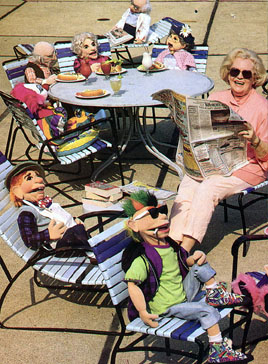 |
Verna Finly, the grande dame of "soft figures," enjoys a picnic lunch with her creations at summer vent meet. |