 |
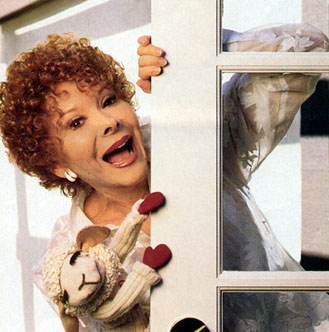
The puppets get top billing: seeing Shari Lewis, one fan said, "Look, Mom, the lady who works for Lamb Chop." |
Ventriloquism-a lot more than lip
control
Nearly 500 historical vent figures will
be on display at a museum opening early next year in Las Vegas. Called the Magic and Movie
Hall of Fame, it will be the second ventriloquism museum in the United States-the first is
the 31-year-old Vent Haven museum in Fort Mitchell, Kentucky. Valentine Vox has designed
the exhibits for the Las Vegas museum, which will include film clips of many famous live
performances and a figure that a visitor can manipulate with buttons and levers.
Elsewhere, following a clip from the film Magic, a chair spins around and the
figure Fats chillingly intones, "Abracadabra! " There is also a booth with
special mirrors to help teach visitors secrets of the ventriloquial art.
The mild resurgence ventriloquism enjoys today is due in large part to the genius of puppeteer Jim Henson. His Muppet creations on Sesame Street, beginning with Kermit the Frog (on periodic display at the Smithsonian), revolutionized the art of puppetry. The Henson touch translated as well into ventriloquism: no longer were figures the province of carved wood with intricate workings and stiff movements; they were soft and fluid, less expensive, and could become almost any creature or object.
The grande dame of "soft figure" makers is Verna Finly. Distinctive and universally admired, her figures are known simply as Verna puppets among fellow vents. A white-haired woman presenting the comfortable figure of a happy grandmother, with disarming modesty she characterizes what she does as sculpting with foam and scissors. She carries around a book of her work, Polaroids stuffed into a family picture album, with visages of King Tut, Michael Jackson, Rodin's Thinker, a sumo wrestler and a past-her-prime stage actress. Occasionally, Finly gives a course to would-be puppet makers, working slowly through the stages of constructing the head (carpet foam) and body (a plastic bottle). Her hands move deftly, like a chef's, over a table laden with glue, scissors, cloth and paint.

Today the top vents, such as Ronn Lucas, Jeff Dunham, Dan Horn, Brad Cummings, Peggy Miller and Shari Lewis, use soft figures. Lewis' soft figures predate the rest of the pack. In 1960 she brought a show to television with Lamb Chop, a sock converted into a lamb, and her friends Charlie Horse and Hush Puppy. Her PBS show, in its third season, has three Emmys to its credit and some I I million viewers each week. I remember her from my childhood, and now I watch my children enjoying her fast-paced energy and saccharine humor. Don't think, however, that the show hasn't changed over three decades. "I have winds of MTV blowing through my show," says Lewis, "complete with rock, country, hip-hop and hand jive."
The television age has put pressures on vents to create more acts and update their material quickly. With few spots at the topone estimate is that only about 100 vents make their living completely from performancesthey are extremely competitive and sensitive about their material, and there are times when the informal code of professional ethics breaks down.
At the convention, in the all-night coffeeshop, two of the top American vents exchange heated words at a table of embarrassed onlookers. It seems that one believes he originated a piece on emotions that entails asking someone in the audience for an emotion, then performing it. Such a simple yet ingenious routine is in the acts of both vents. No one knows who came up with the idea first or to whom it belongs. The conflict lies unresolved, hanging in the air like a bad odor.
When it comes down to it, the best material is not the straight jokes but the situations a vent can create-ones in which the punch line is not necessary. Take Ronn Lucas' signature act. It involves a sock, which he strips off his foot and draws over his hand. Bent at the wrist, the lime green sock suddenly becomes a creature, alive and talkative. It's as believable as any figure that costs thousands of dollars.
After I return home from the convention and play with the home vent course, I find myself with my 3-yearold daughter, Grace, one night in the front yard, watching the moon. I casually pull off a sock and put it on my hand. There in the moonlight, my sock character, Grace and I talk about going to preschool, a big concern of hers. Her attention is rapt; the conversation among the three of us is real.
And though my mouth moves quite a lot, I have learned the most important lesson in ventriloquism: that the secret is to create the illusion of reality, possible with a puppet, a sock-or just about anything.
The End
Article by: John
Ross, who is based in Chevy Chase, Maryland, writes for print and television media.
Photographs by: Theo Westenberger