 |
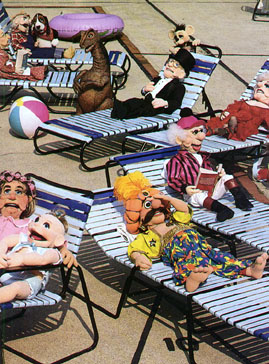
Verna Finly says that her woman in hair curlers (at center) tops all of the others as a cantankerous smart aleck. |
With the vaudeville period-an era reaching its height between the 1880s and 1920s-many ventriloquists started using single characters, hastening development of what we know as the modern figure, with an exaggerated mouth and a great range of movement. The best of the wooden figures are a curious fusion of engineering feats and sculpture. Underneath the wig, the back of the head opens, revealing tangled innards of metal and wire, screws and levers. The most mechanically complex figures, including Reggie Trickpus, were made by the McElroy brothers, who created perhaps only 100 of them in the ten years prior to World War 11. They assembled some 300 different springs, pieces of metal, typewriter keys and bicycle spokes into a mechanical brain, a synergistic effort not unlike that of another pair of brothers-the Wrights. Bob Neller and Rudy Vallee were among the vents who used McElroy figures.
"N-E-S-T-L-E-S, Nestle's makes the very best...
Another pair of skilled carvers, Theodore and Charles Mack, created Charlie McCarthy, the figure that would help to make Edgar Bergen one of the greatest performance stars of this century. The original Charlie can be seen at the Smithsonian's National Museum of American History. Steeped in the traditions of the vaudevillian stage, Bergen almost single-handedly changed the art of ventriloquism, which had found little audience after vaudeville's demise. In 1936 he appeared on the Fleischmann Hour, a radio show starring Rudy Vallee. Performing on radio, where no one could see his technical skills, was a risk for a ventriloquist, but it paid off. His gift was the ability to bring Charlie to life-so much so that First Lady Eleanor Roosevelt, upon meeting the duo, stuck her hand out to shake Charlie's first.
When television came along, Bergen-inspired vents, such as Jimmy Nelson and Paul Winchell, adapted to the new medium. One of the most recognizable television icons of the 1950s was the Nestles commercial, featuring Jimmy Nelson and his figures Danny O'Day and the floppy-eared dog Farfel. Trying out for the commercial in 1955, young Nelson was nervous. First, Danny O'Day sang "N-E-S-T-L-E-S, Nestles makes the very best. . ."; then Farfel answered, "Chawwwwclat." Andbecause of Nelson's sweaty hands, which caused his finger to slip-the dog's jaw snapped, a no-no in the world of ventriloquism. But the Nestles folks liked it, and for a decade Farfel was the country's mostquoted dog-at least among children.
After the network variety shows of the 1950s and '60s died out, ventriloquists were less visible, with notable exceptions including Jay Johnson and his figure Bob on the television show Soap or Willie Tyler's appearances with Lester. Top vents such as Lucas and Jeff Dunham appeared on the last remaining television network venue, the Tonight Show with Johnny Carson, perhaps because Carson himself started out as a vent. The best hard figures-by such carvers as Tim Selberg and Alan Semok-now sell for thousands of dollars each.