No Frames
Spiders,
like many other invertebrates, have generally been forgotten by the conservation
community. This site will serve to promote awareness of the issues related
to spider conservation including threats to spider diversity, current conservation
actions, and challenges in protecting spiders and their habitats.
 Nine
Texas Invertebrates Listed under the U.S. Endangered Species Act:
Nine
Texas Invertebrates Listed under the U.S. Endangered Species Act:
The U.S. Fish and Wildife Service has finally listed nine Texas cave
invertebrates, including 5 spiders, as
endangered on the U.S. Endangered Species Act. You can read more about
it in the USFWS
press
release and the Federal
Register notice.
U.S. Endangered Species Act News
from GREENLines:
The GrassRoots
Environmental Effectiveness Network (GREEN), a project of
Defenders
of Wildlife publishes a daily electronic newsletter called GREENLines.
Some news on ESA spider listings:
NINE
BLIND CAVE-DWELLING INVERTEBRATES LISTED: The USFWS has listed "five
species of spiders, three beetles and one harvestman" known to live in
the Edward's Aquifer underground ecosystem, "predominantly in northern
Bexar County," Texas says the San Antonio Express-News 12/22. While the
listing is not expected to affect use of the aquifer it could aid efforts
to protect some 100,000
acres of the Edwards Aquifer recharge zone from development. The listing
culminates an eight year battle to have the non-charismatic micro-fauna
protected under the Act. (GREENLines - December 28, 2000)
USFWS
MISSES LISTING DEADLINE: The USFWS has failed to meet a commitment
to make a decision on the listing of "nine blind cave dwelling invertebrates"
that live in Bexar County, Texas says the San Antonio Express-News 10/12.
The local office says it is waiting on Washington, but the Center for Biological
Diversity says that despite the broken promise it will only continue to
hold off on filing a lawsuit until November 1. (GREENLines - October
25, 2000)
DON'T
MESS WITH THE ESA: The fate of the Bexar County 9, "five species of
spiders, three beetles and a harvestman," is now in the hands of the courts
after the USFWS failed to meet yet another deadline for listing the so-called
Texas "water cave bugs" says the San Antonio Express-News 10/31. Eight
years and repeated broken promises later, the Center for Biological Diversity
has now moved to force listing of the species in order to protect their
habitat from residential and commercial development. Although ranchers
and developers are "extremely upset" over possible listing, their representative
warns that the ESA is "not something you want to mess with." (GREENLines
- November 13, 2000)
NatureServe® Database Online:
NatureServe®
is a source for authoritative conservation information on more than 50,000
plants, animals, and ecological communities of the United States and Canada.
NatureServe is provided by the Association
for Biodiversity Information (ABI) a non-profit organization dedicated
to developing and providing knowledge about the world's natural diversity.
While
compiled data on spiders is admittedly sparse, 343 spider species are tracked
in these databases, including 108 at risk species. Decent ecological
and conservation status reports are available for USESA-listed species
or candidates and rarer species. Note that ABI works in partnership
with the Natural Heritage
Network-a group of 75 independent Natural Heritage programs and Conservation
Data Centers that collect data on rare species and ecosystems in the United
States, Canada, and Latin America - to provide the scientific information
that is essential for effective conservation action.
2000
IUCN Red List Available:
The new 2000
IUCN Red List is available online as a searchable database. No clear
changes in the status of spiders since the
1996 Red List have been made.
 Why
conserve spiders? What threats do spiders face?
Why
conserve spiders? What threats do spiders face?
What legal
protection is provided to threatened spiders?
What's
New on these pages....
Conservation Case
Studies
Spider
Conservation Links
Spider Conservation Bibliography
Page Author
Information
Pages administered by Kevin
L. Skerl
.
[Spider Conservation Home] [What's
New?] [Why conserve spiders?][Legal
Protection] [Case Studies] [Links]
[Bibliography] [Author]
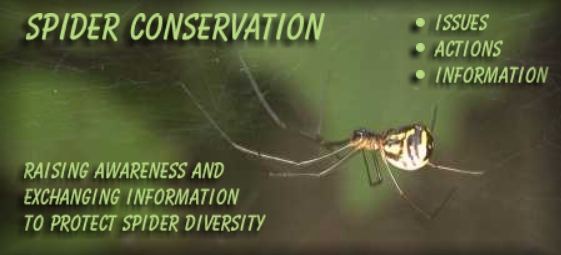
Header image of Frontinella frutetorum provided
by Ed Nieuwenhuys. Visit his Spider
Photo Gallery.
This page last updated on March 26, 2004.
Copyright © 1997-2004 Kevin L. Skerl.
All rights reserved.
