|
|


Music
Editing,
Recording and
Publishing
|
|
|


Introduction
- Music
Links - Wagner
- Music
Scores


Updated February,
2005
Music
has been called both the most mathematical and the most
abstract of the arts. Unlike words, pictorial images, and
bodily movements, however, musical tones in themselves
have no concrete associations, and only gain meaning when
they are combined into musical patterns.
Edelweiss
Media™
is amply aware that music is a key element of our Western
cultural roots, it serves as a celebration of folkish
ethic, a tool of engagement, a propaganda weapon and a
call for mobilization, this was as true yesterday is is
for today.
Nowhere
is the cult of frenzied feeling, the delirium of the
senses and the dream of a 'total work of art' more
evident than in the music of Richard Wagner, becoming a
cultural hero for the masses. Many of our current ideals
still draw heavily on the intoxicating effects of the
Wagnerian imagery and on his ideal of the Volk community.
The true populist as a political 'artist', in the
neo-romantic mould, is one who can translate this
Wagnerian vision with meticulous literalness into the
realm of the mass spectacle. In a similar manner, the far
right movements of the past were able to strengthen the
traditions of classical antiquity, revive Hellenic
aesthetic taste of pure form and admire the bodily
perfection to the 'Aryan' legend in the Nordic
ideal.
Even
though most European countries now officially forbid the
dissemination of far-right merchandise, music proves
difficult to totally censure and ban. Old party songs
recorded on tape cassettes, compact discs or record
albums are of course available through mail-order houses,
but there are also new types of music that inspire a
whole new generation of younger audiences. Music has been
successfully used to initiate younger members in the
patriot circles, into ideology and cultural
awareness.
Many
songs, played by modern bands, for example, lament
Germany's defeat in the Second Word War, or openly pay
tribute to renowned 'martyrs'. This type of music,
whether in Germany, Italy, France, Britain or the USA,
has an unmistakably nationalist message and has the power
to arouse raw emotions. Recognizable emblems of banners
decorate the bandstands, the crowd gathering at these
concerts share the same ideals and dream of a country
that has regained her honor, and is not bogged down in
lying, cowardly and petty politics. They honor past
patriots who are real men, clever and brave and not
riddled with selfishness or perversion; and of women who
can embody the spirit of the nation, are mothers not
symbols of easy virtues. These songs and words are
reserved to citizens who love their fatherland
fanatically, who call for leaders that will fashion once
again the populace into a salvational force. Singers,
thus, engage the audience in many a patriotic revivalism
that digs deeper in time and consciousness.
 Back To Top
 Music
Links Music
Links
***NOTE***
Edelweiss Media™ will regularly
update this link section so that fans may find the type
of music most inspiring to them. Though we have tested
these links, we provide them without any warranty of any
kind. We are not affiliated with any other sites selling
goods via internet and cannot be held responsible for
loss of merchandise or funds. We will, upon request, try
to answer questions regarding merchandizing and will look
into the feasibility of setting up our own distribution
network in the States and Europe in the near
future.
Military
recordings, in this section, produced from original
recordings of the period 1922-1945 include war songs,
marches, military music, speeches, and film sound tracks.
These audio records are invaluable reference and
background material for collectors, militaria
enthusiasts, musicians, scholars, historians, war-gamers,
and all those who enjoy the sounds of martial
music.
Listen to original
recordings:

http://www.oocities.org/schwalbennester/
Back To Top
 Tribute
To Great Composers: Tribute
To Great Composers:
WAGNER,
Richard (1813-1883)
The
greatest composer of German opera, Richard
Wagner, b. Leipzig, May 22, 1813, was the
youngest of nine children of Friedrich and
Johanna Wagner. His father, a police
registrar, died 6 months after Wagner was
born, and his mother was remarried the
following year to Ludwig Geyer, an actor and
portrait painter, who moved the family to
Dresden. Geyer died in 1821, and in 1827 the
family returned to Leipzig.
Life
Wagner
was attracted to the theater at an early age.
His first creative effort was a spoken
tragedy, Leubald and Adelaide (1828), which
was heavily influenced by Shakespeare and
Goethe. He decided at once, however, that he
must also write music, and he proceeded to
teach himself the rudiments of composition,
supplementing them with the study of scores.
His formal training was brief--about 6 months
in 1831-32 with the Leipzig cantor C. T.
Weinlig. During the 1830s, Wagner held a
series of conducting posts with small
theatrical companies, and he wrote two
operas, Die Feen (The Fairies, 1834) and Das
Liebesverbot (Forbidden Love; after
Shakespeare's Measure for Measure); the
latter was performed without much success in
1836 in Magdeburg. His third opera, Rienzi,
was conceived on a larger scale, and Wagner
traveled to Paris in 1839 with the futile
hope of having it performed there.
Rienzi
was finally accepted for performance in
Dresden in 1842. Its success, coupled with
that of Der fliegende Hollander (The Flying
Dutchman) the following year, led to Wagner's
appointment to an official conducting post in
Dresden. There he completed Tannhauser (1845)
and Lohengrin (1848). This period of success
ended in 1849, however, when his
participation in revolutionary political
activities forced him to flee to
Switzerland.
Wagner's
exile from Germany, which lasted until 1860,
marks the start of a new period in his
career. For a few years he devoted himself
almost entirely to speculation about the
nature of opera. This took the form of
several treatises, the most important of
which (The Artwork of the Future and Opera
and Drama) laid the foundation for his most
ambitious work, Der Ring des Nibelungen (The
Ring of the Nibelung), a cycle of four
operas--Das Rheingold (The Rhinegold), Die
Walkure (The Valkyrie), Siegfried, and
Gotterdammerung (Twilight of the Gods)--that
he began to compose in 1853 and did not
finish until 1874. Halfway through Siegfried,
work on the project was interrupted for 12
years while Wagner composed (1857-59) Tristan
and Isolde and Die Meistersinger
(1862-67).
Wagner
and Bayreuth
The
last great turning point in Wagner's fortunes
occurred in 1864 when he was called to Munich
by the eccentric young king of Bavaria,
Ludwig II, an ardent admirer of his works and
theories. Ludwig's patronage continued for
the last 20 years of Wagner's life, making
possible the performance of all his mature
works and eventually the construction in
Bayreuth of a theater of Wagner's own design.
It was opened in 1876 with the first complete
production of the Ring. Bayreuth soon became
the center for the promotion of Wagner's
works and ideology (Bayreuth Wagner
Festival). His last opera, Parsifal, was
performed in 1882, with the ceremony normally
accorded only to a religious event. Following
Wagner's death on Feb. 13, 1883, control of
the Bayreuth festival passed to his second
wife, Cosima (a daughter of Franz Liszt), and
later to their children and grandchildren, a
succession that has continued to the
present.
Works
and Influence
Although
Wagner's early training was slight by the
standards of most major composers, he had an
uncanny ability to copy the various styles he
encountered in the music of his time. The
basic gestures and the orchestral sound
(although not the large-scale architecture)
of Beethoven are reflected in early
instrumental works such as the Symphony in C,
which Wagner completed in 1832. When he
turned to opera he moved easily from the
German romantic style of Weber and Marschner
(in Die Feen) to the Italian style of Rossini
and Bellini (in Das Liebesverbot) to the
grand opera style of Spontini and Meyerbeer
(in Rienzi). In the three works of the 1840s,
however--The Flying Dutchman, Tannhauser, and
Lohengrin--a more distinctive personal style
emerged.
The
use of legendary sources and the gradual
reduction in contrast between aria and
recitative in these operas anticipate the new
music drama that Wagner was to propose in the
treatises written about 1850. The guiding
principles of his theory were naturalism and
dramatic truth, which he felt had been
compromised by the musical conventions of
contemporary opera. He advocated a new
synthesis of music, verse, and staging--what
he called a Gesamtkunstwerk. The verse, which
Wagner always wrote himself, was to be
compressed, metrically free, and
alliterative, dispensing with the end-rhyme
that led to closed musical structures. The
open-ended melody of the vocal line was to be
supported by a symphonic accompaniment,
continuously fluctuating with the sense of
the text and unified by a web of motifs
associated more or less directly with
characters, things, ideas, or events. Wagner
called these motifs Grundthemen, but they
have become better known as leitmotifs
("leading motifs"). Ensemble singing was to
be avoided. This theoretical music drama was
exemplified in its purest form in Der Ring
des Nibelungen, the text of which took shape
as Wagner was writing the treatises. Later
works adhered less strictly to the theories:
ensemble singing returns in Tristan und
Isolde, and Die Meistersinger makes use of
end-rhyme, closed musical forms, and a plot
set in historical rather than mythological
times. Even the later portions of the Ring
include scenes in which naturalism is
sacrificed for musical effect.
In
turning to myth and legend for his dramatic
materials, Wagner was seeking themes of
lasting symbolic value. In this respect he
was pursuing a direction already established
by Carl Maria von Weber and Heinrich
Marschner, both of whom had treated themes
involving supernatural forces. Particularly
Wagnerian was the theme of fall and
redemption, which recurs in all of the mature
works except the comic Die Meistersinger.
Although Wagner varied his treatment in each
opera, the means of redemption is typically
some combination of increased awareness on
the part of the flawed male protagonist and
the love and instinctive vision of his female
counterpart. Death is celebrated as a step to
transfiguration. An equally important theme
is the futility of opposing social (or
artistic) change. Influenced in part by the
philosophy of Schopenhauer, which sought
renunciation of worldly desires, Wagner
repeatedly portrayed noble older characters
in the process of accepting their own
displacement by a new generation. The
philosophical overtones of such themes,
together with the symbolic nature of much of
the dialogue and action, have made Wagner's
operas a favorite subject for modern
psychological analysis and experimental
productions.
The
extreme position formulated by Wagner made
him the center of controversy even in his own
lifetime. Such contemporaries as Berlioz,
Brahms, and Verdi were impressed by his works
but did not fully understand them. The next
generation reacted in various ways: some
followed, some sought alternatives, and
others adapted aspects of Wagner's musical
style to traditional methods. His influence
on the mainstream of musical development was
above all through Tristan und Isolde and
Parsifal. Extreme chromaticism, irregular
resolution of dissonance, and continuously
shifting key centers make Tristan a pivotal
work in a progression leading ultimately to
the atonality of Arnold Schoenberg and his
followers. Although the impressionists, led
by Debussy, favored other expressive goals
and found other ways of weakening tonality,
they, too, were influenced by Wagner's
treatment of orchestral color (especially in
Parsifal), his rich chords, and his subtle
relation of motif to large-scale
structure.
Copyright ©
1992 by Douglas Johnson
Bibliography:
DiGaetani, John L., ed., Penetrating Wagner's
"Ring": An Anthology (1978); Donington,
Robert, Wagner's "Ring" and Its Symbols, 3d
ed. (1974); Goldman, Albert, and Sprinchorn,
Evert, eds., Wagner on Music and Drama
(1964); Gutman, Robert W., Richard Wagner:
The Man, His Mind and His Music (1968);
Newman, Ernest, The Life of Richard Wagner, 4
vols. (1933-46; repr. 1976), and The Wagner
Operas (1949; repr. 1959); Spencer, Stewart,
and Millington, Barry, ed. and trans.,
Selected Letters of Richard Wagner (1988);
Stein, Jack, Richard Wagner and the Synthesis
of the Arts (1960); Taylor, Ronald, Richard
Wagner: His Life, Art, and Thought (1979);
Wagner, Richard, My Life (1911; repr. 1974);
Watson, Derek, Richard Wagner: A Biography
(1981); Westernhagen, Curt von, Wagner: A
Biography, 2 vols. (1978).
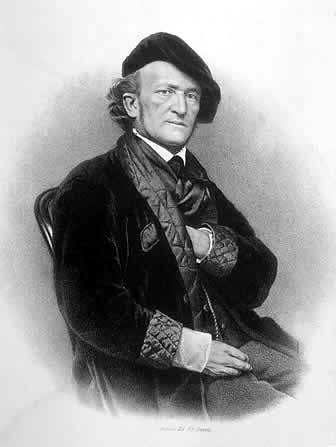
Richard
Wagner, regarded as the greatest
composer of German opera, used German
myths and legends as a basis for his
librettos. Tannhauser, Lohengrin, and
the tetralogy Der Ring des Nibelungen
are among his most admired operas. (The
Bettmann Archive)
Back To
Top
|

Original Music
Scores:
As
a token of our appreciation for our members' support and
loyalty we offer a selection of unusual sheet music of
know patriotic songs that marked important periods of
history.

|
 Die
Fahne Hoch (p.
1) Die
Fahne Hoch (p.
1)
|
The Horst Wessel
song "Die Fahne Hoch" (Raise high the flag!) was
the official hymn of the Nazi party--between 1933
and 1945. It was heard in Germany more frequently
than "Deutschland Uber Alles," the national anthem.
This song has lyrics describing martyred comrades
still marching forward, in spirit, toward the day
when party banners shall wave
unchecked.
|

|
Youth
Hymn
N/A
|
The lyrics of the
official German Youth hymn vouch to continue the
fight even if the nation vanishes. Long after other
soldiers cease to fight or hope, it is the younger
generation that will follow the banners without
failing.
|
Back To
Top
Home
- Welcome
Introduction -
About
Us - Who
We Are - What
We Do - Our
Program - Our
Products - Our
Markets - Career
Opportunities -
Television
& Video - Radio
Broadcasting -
Art
-
Music
- Writing
& Publishing -
Editorials
- News
- Sponsors
& Membership Info -
Links
- Contact
Us

gfg
|