Because all
literature is created with words, the medium of
literature is really based on language.
Literary combinations
are differentiated from the enormous mass of casual
popular discourse by some filtering device or set of
rules. These words then pass into the permanent stock of
preserved sounds or texts, forming the literary tradition
of the group that produced them. One must therefore
question what the precise connection between language and
literature is and learn of its impact on social norms.
This very short introduction attempts to address the
topics most related to populist literature others may
include: aesthetics; criticism; literary; figures of
speech; linguistics; semantics; semiotics; structuralism;
and versification
Even strictly defined,
literature includes an astonishing variety of material.
Besides poetry, plays, and novels, literature includes
folk tales and songs, religious rituals, sermons,
diaries, journals, political documents, essays,
philosophical treatises, chronicles, and speeches in
courts and legislatures. What all these kinds of
discourse have in common is a formal setting: anything
written or uttered in a situation recognized as artistic
thereby acquires the status of cultural art and loses its
status as a casual, or transitory, popular expression.
Some linguists regard literary artifacts simply as
preserved utterances, distinguished by the very fact of
their encapsulated preservation. The great mass of casual
speech vanishes into air and out of memory just a few
seconds after being uttered. Whereas most people can
relate the gist of statements made a few minutes earlier,
few can repeat the exact words they heard. By contrast,
noncasual speech must be repeated word for word in order
to achieve the total effect. Literature is thus the means
to preserve and interpret again and again, as if its
usefulness can never be exhausted.
Another approach to
defining literature starts with the assumption that
preserved utterances have a special type of language or
language organization that is not present, or at least
not so prominent, in casual utterances. The medium--the
words chosen and their particular order--is part of the
literary message itself and the choice of language is
particularly important in communicating a political
message for example. This is why the traditional
political campaign in elections, regularly involves
visits by candidates to local communities where addresses
to public meetings occur, as is the stimulation of
popular enthusiasm by means of slogans, songs, and most
especially pamphlets. Sometimes, the speaker selects the
combination of words with as much care as he or she gave
to selecting the words themselves. In each of the
foregoing examples the sound pattern of the utterance is
distinctive and stands out as something worth preserving
for all time. The sentences cannot vanish or dissolve as
soon as their meaning has been communicated--to repeat
only the gist would be to miss the point.
In their own humble
ways, the words and sentences found in literature are the
means by which to reenact a particular historical event
and to preserve ideas and culture itself.
Edelweiss
Media™ knows it has an
important role to fulfill as a tool to reinforce national
attitudes, beliefs, and actions of people through the use
of symbols such as words, slogans and a particularly
targeted choice of literature publication. In fact, we
see it as our main objective to spread wide beliefs,
ideas and facts to further the national cause and to
impede all opposing harmful causes that currently
demoralize our populations. Our methods can take various
forms, ranging from special campaigns to wake up the
masses or use open psychological warfare, such as those
tactics employed by our political opponents. Either way,
the aim is getting our political message across and
gaining as much influence and support as possible in a
hostile media environment.

AVAILABLE ON ORDER, BOOKS AND PAMPHLETS
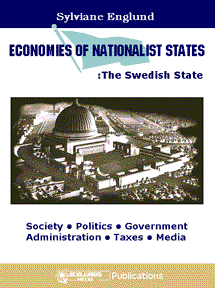
Economies Of
Nationalist States: The Swedish State (English, 130pp.,
$48.50)
First Volume in the collection, focusing on
the emergence of nationalist forms of governance-- No.
04-SE
* * *
REVIEW * * *
Consider
a country in which there is full employment
while in surrounding countries there are
millions without work. Consider a land
inhabited by a people self-confident now that
they have been released from political
servitude. Consider a nation that enjoys a
stable economy, which provides for its
citizens social benefits unmatched by its
neighbours in Europe; a land without slums, a
land without poverty. So socially advanced is
that fortunate country that there is even
talk of emulating and adapting the system of
governance to other countries willing to
undergo reforms by popular decree. Such a
system is NOT offered by the Liberals'
left, Communists or Marxists but by a
Nationalist political and economic system .
Today people may be down-trodden bereft of
trade unions; Western nations are held in the
grips of an all-powerful capitalist empire
that condemns all those who dare criticize
the domination of the new world order. The
dark view of state affairs becomes grimmer as
globalization trends progress, instituting
identity-crisis and ever wider
democratic-deficits in townships. While a
majority of nationalist voters clearly oppose
the status quo, and want to rebel against the
establishment, very few attempt to offer real
alternative solutions to societal ills. Very
few academicians or political analysts
propose another course, a concrete plan or
even offer fresh perspectives on world
affairs. This is what the author here set out
to do--logically, methodologically and
objectively.
This book written by economist and political
sciences expert Sylviane Englund establishes
the ground foundations for an alternative
socioeconomic system, one that traces a
middle path between Liberal and Marxist
dogma. The points raised offer timely
solutions on how simple reforms can be
implemented to turn today's stagnant and
corrupt system of government into strong and
vibrant nationalist powerhouses.
Lucidly Sylviane Englund explains the
peculiar social, economic and doctrinal
approaches of the Nationalist State in an era
of populist revivalism. She draws for her
readers the blueprints of the model society
such as the one a far right elected
government would forge after coming to
power--after some sixty years of respite. She
also outlines the reasons and historical
circumstances for its implementation in
Nordic countries, notably Sweden.
This work presents well the modern tactical
and strategic aims of a movement in its bid
for power as a legitimate political contender
gaining mass popular appeal. Would-be
followers, leaders, patriots or political
contenders--from all classes and ranks--would
be well advised to learn what the points of a
newly revived nationalist programme aims to
achieve in the near future.
Edelweiss
Media Editor (Sweden)
Bo Elmgren, 2004
|

For additional
literature and topics of interest view our index
page:
|

|
PHILOSOPHY
Consult our
Philosophical Database to find the Authors and
theories that have influenced far-right
movements throughout the Western hemispehere in
the last centuries.
|
Home
- Welcome
Introduction -
About
Us - Who
We Are - What
We Do - Our
Program - Our
Products - Our
Markets - Career
Opportunities -
Television
& Video - Radio
Broadcasting -
Art
- Music
- Writing &
Publishing - Editorials
- News
- Sponsors
& Membership Info -
Links
- Contact
Us
