Home 
Welcome to
our Guests
About Us
Who We Are
What We Do
Our Program
Our Products
Our Markets
Career
Opportunities
Television
broadcasting
& Video
Productions
Radio
Information
& News
Programmes
Art
Music
Editing,
Recording and
Publishing
Writing
& Book
Publishing
Editorials
News
Sponsors &
Memberships
Links
Contact Us


Articles: Historical Overview of the Populist Movement - Health Watch: Deadly Social Rites


ARTICLES

Historical Overview of
The Populist Movement
 (Published July 04) 

The first Populist party was originally formed in the 1890s at the culmination of a period of agrarian discontent in the United States. The party traced its roots to the farmers' alliances, loose confederations of organizations that had formed in the South and West beginning in the late 1870s and expanded rapidly after about 1885. The alliances advocated tax reform, regulation of railroads, and free silver (the unlimited minting of silver coins). In 1890 many candidates who supported alliance objectives were elected in state and local contests. Encouraged by these results, alliance leaders formed a national political party, officially the People's party, but usually called the Populist party. At a convention in Omaha, Nebr., in 1892, the Populists nominated James B. Weaver of Iowa as their presidential candidate. Hoping to unite Southern and Western farmers with industrial workers of the Northeast, the party adopted a platform calling for government ownership of the railroads and the telephone and telegraph systems; free silver; a graduated income tax; a "subtreasury" plan to allow farmers to withhold crops from the market when prices dipped; the direct election of U.S. senators; immigration restriction; an 8-hour day for industrial workers; and other reforms. In the election of 1892, Weaver received more than a million popular votes and 22 electoral votes, but the Democratic candidate, Grover Cleveland, won the election. Several Populist candidates won election to Congress that year and in 1894.

In 1896 the Populist party was overshadowed by the Democrats, who took up the issue of free silver and other Populist goals. As farm prices rose, agrarian protest was defused. The Populist party, unable to broaden its base by winning the votes of industrial workers, split in 1900 over the issue of fusion with the Democrats. Although Watson ran as the Populist candidate in 1904 and 1908, the party's significance all but disappeared after 1908.

The term populism, however, continues to be used to refer to the grass-roots movements claiming to represent the "common people" against big business and industry. Huey Long of Louisiana was a notable populist, in this sense. Populism has been subsequently invoked in U.S. presidential campaigns by Fred Harris of Oklahoma, George McGovern of South Dakota, and George Wallace of Alabama.


Back To Top


Health Watch
Deadly Social Rites
(Published July 2004)

Culture can be both a weapon against social dangers and can offer life-saving defense mechanisms against harmful habits menacing our existence on a daily basis.
It is a state of mind that insulates the strongest individuals, those who are destined to survive the greatest perils of modern life.
Maladies foremost infect the mind, because generally victims are unwilling to put up any preventive defenses against pending threats. Dangers are never perceived as real until they are suffered personally, someone else's illness is considered someone else's problem. There is simply no adequate available public health warnings on where to set proper personal safety limits.
People today can actively strive for the betterment of their social environment, by remaining in a pure state and continuously keep fighting for what they believe enforces collective righteousness instead of limitless personal gratifications.
Defenders of virtue, in this way, may uphold sacred principles above those of loose morals to consciously fight AIDS, substance abuse and decadence intellectually, politically or religiously.
By the sheer will of survival and determination of the spirit of a few--to stop corrupting their minds and bodies at all levels--we in turn become less vulnerable and less likely to fall prey to the merchandising techniques of shadow economies.
Moral activists are unspoken heroes, they make a positive impact on society as a whole by becoming role models for each of our fellow citizens and youth.
In this way anyone can act and make a difference, a contribution, but it takes a determined conscious collective effort, a culture of "healthy lifestyles" and "healthy living" to reinforce our commitment and effectively extricate all of us from the perils of a culture of degeneration that corrupt all minds. What we must do is offer a revolt against the insidious institutionalized politics of decay, fight with conviction the established world order that is openly instituting a climate of self-destructive social norms.

SMOKING RELATED DEATHS

Figure 1.
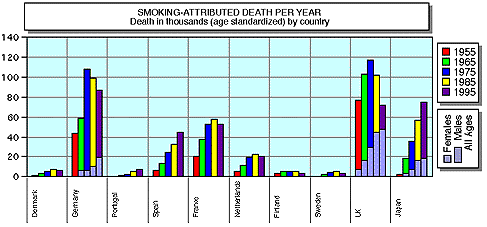
Source: World Health Organization, see also: http://www.cdc.gov/tobacco/whoeuropro.htm

Figure 2.
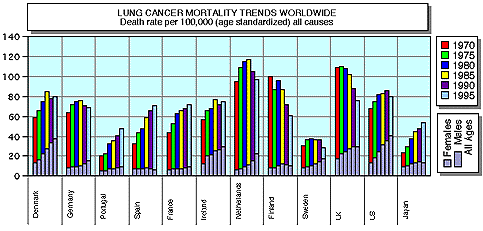
Source: World Health Organization, see also: http://www.cdc.gov/tobacco/whoeuropro.htm

ALCOHOL CONSUMPTION

Figure 3
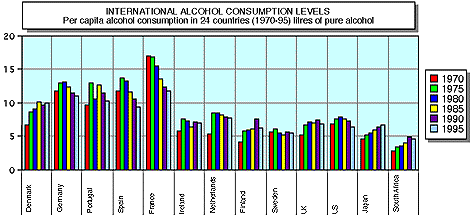
Sources: BLRA (Brewers and Licensed Retailers Association)

DRUG USE STATISTICS

Figure 4.
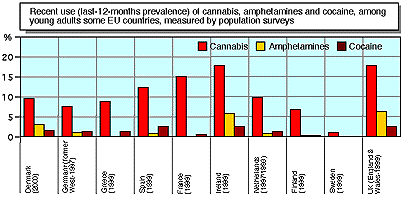
NB -- Data are from the year 1999. The age range is from 15 to 18 until 34 to 39. Variations in age ranges may influence disparities between countries. In some countries the figures were recalculated, at national level, to adapt to standard age groups (young adults 15-34).

Figure 5.
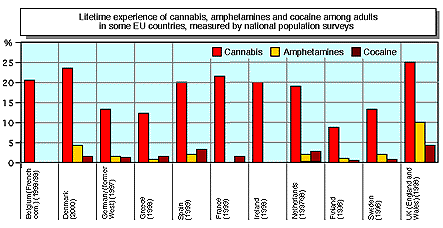
NB -- The age range in this table range from 15-18 years to 59-69 years old. Variations in age ranges may partially influence disparities between countries. In Belgium, for example, age range is 18-49.

Sources: Reitox National Reports, taken from population surveys reports or scientific articles. See also EMCDDA Annual Report 2001 at http://annualreport.emcdda.org

 AIDS STATISTICS

Figure 6.
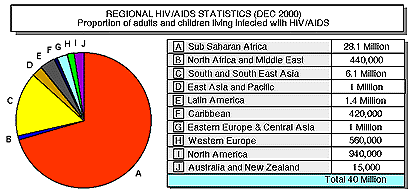
Sources AVERT averting AIDS, Education And Research Trust. Internet: http://www.avert.org


  Back To Top


Home - Welcome Introduction - About Us - Who We Are - What We Do - Our Program - Our Products - Our Markets - Career Opportunities - Television & Video - Radio Broadcasting - Art - Music - Writing & Publishing - Editorials - News - Sponsors & Membership Info - Links - Contact Us

-----------------------------047485629054451 Content-Disposition: form-data; name="userfile"; filename=""