|
 |
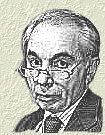
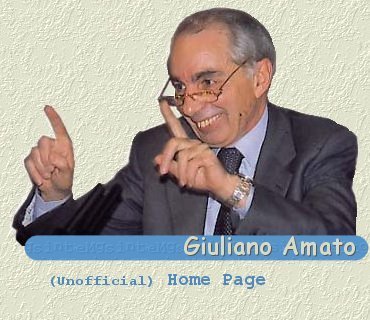
Born in Turin on May 13, 1938, but grown up in Tuscany, Giuliano Amato studied law at the University of Pisa, where he graduated in 1960. He received a Master's degree in Comparative Law at the Law School of the Columbia University (New York) in 1963. After teaching at the Universities of Modena, Perugia and Florence, he was Full Professor of Italian and Comparative Constitutional Law at the University of Rome, School of Political Science, from 1975 to 1997. Amato began his political career in 1958, when he joined the Socialist Party, for which eventually he was an M.P. from 1983 to 1993. An academic nicknamed "Subtle Doctor" for his ability to see the fine points of an argument, apart from many other assignments, 1 he was Undersecretary of State to the Prime Minister's office, from 1983 to 1987, Deputy Prime Minister and Minister for the Treasury, from 1987 to 1988, then again Treasury Minister, from 1988 to 1989. From June 1992 to April 1993 he served as Prime Minister. During those 10 stormy months one kickback scandal after another rocked Italy and swept away almost an entire class of political leaders, while Amato himself, never implicated in any wrongdoing, emerged clean from charges. Besides, in September 1982 massive attacks by currency speculators caused two devaluations of the lira, and consequently its removal, along with Britain's currency, from the European monetary system. Not only did he weather the storm, he also realized that the emergency would require, both in policy and in administration, quick and radical changes. As a result he passed a "blood and tears" deficit-cutting budget--the tightest one in Italy's republican history--, and asking Italians “to put one hand on their hearts and get their wallets out with the other” he probably saved the country from bankruptcy. In addition he paved the way for the country's first-intake entry into Europe's single currency. He said he was ready to resign, and plunge his country deeper into political crisis, if parliament dares to undermine his program. "My government is one of necessity, not popularity," Amato said in an interview. "I am trying to tell people that things can no longer be the same--that, in effect, it is time for Italians to enter the human race. We had reached the edge of the cliff, and it was time to step back. People have to realize that. I keep saying we can't live in a vacuum. France, Denmark, even Britain have carried out reforms in the past decade, while we just built up debt to the point that it is more than 100 percent of our gross national product." 2 This is how Denis Mack Smith, summarizing the main events of that period, brings sharply into focus the way Amato tackled the emergency: “To bring government expenses under control he proposed cuts in social spending by raising the retirement age for pensions and persuading the trade unions to agree on abolishing the remnants of automatic wage indexation. He was courageous enough to propose new taxes on the self-employed who were often still responsible for massive tax evasion. (…) To reduce the budgetary deficit and partly jobbery he speeded up privatizing state-funded industries that had been cushioned from market competition and were grossly overmanned; and he hoped that this would eventually include not only the conglomerates IRI and ENI but the postal service, the railways, and telecommunications. Since many white elephants in the state sector had been exploited as vehicles for political patronage, these reforms encountered considerable opposition from some members of the political elite. Former Treasury ministers since 1945, Einaudi being one of the few exceptions, had damaged their liberal credentials by being predominantly protectionist, corporatist, and dirigiste.” 3 He eventually was President of Italian Antitrust Authority (November 1994/December 1997), 4 then Minister for Institutional Reforms in Massimo D'Alema's first government (October 1998/May 1999), then, once again, Treasury Minister in D'Alema's second government (December 1999/April 2000). Meanwhile, he nearly nabbed the state presidency and was “looked to many to be by a wide margin the best-qualified European to replace Michel Camdessus in the International Monetary Fund's top job. But it was Germany's turn to fill the lofty international post.” 5 From April 25 2000 to May 31 2001, he served again as Prime Minister (his predecessor had resigned after his ruling coalition was defeated in regional elections on April 16 2000). “A little legislation and a lot of action, results: That's what we want to do in the little time available”, Amato said in the Chamber before his center-left coalition government won its vote of confidence. "Italy needs more competitiveness in its economy, but it also needs to look out for the social sector. It needs fluid markets, but also to protect those who are or can be excluded. It needs more security", he added. In addition, his challenge--once again, a very hard one--was to push through important economic reforms, such as reducing regulations, as well as political and institutional reforms, such as resolving the ills of a weak executive and fragmented legislature. As it was not hard enough for Amato to take up this challenge, his coalition of 12-odd parties appeared to be too quarrelsome and divided--when he took over, many politicians in Rome doubted whether he would survive long beyond the fall...--to tackle all these controversial issues in the little time available before the May 13 2001 general election. Asked who should lead his country's ailing forces on the left, without batting an eyelid, Amato himself replied: "Michael Schumacher". Nevertheless, the conventional wisdom was that nobody else on the center-left was as well equipped to run the show, and he certainly did what he was humanly expected to do. 6 As widely predicted, the center-left Olive Tree coalition, led by the former mayor of Rome Francesco Rutelli--after Amato unexpectedly had announced (September 2000) he would have step aside as candidate premier--lost the May 13 general election. Elected to the Senate -- the Upper House of the Italian Parliament -- representing the constituency of Grosseto (Tuscany), Amato has began to campaign for the creation of a great reformist party, with a more coherent and modernized structure. Presently he is Global Law Professor at the NYU Law School and part time Professor at the EUI in Florence. On december 2001 European Union leaders, at Laeken summit, apponted him (and former Belgian Prime Minister Jean-Luc Dehaene) vice-president of the novel constitutional Convention that will meet next months to ponder reform of the EU's institutions and working methods. 7 Professor Giuliano Amato is Foreign Honorary Member of the American Academy of Arts and Sciences. Married to Mrs. Diana, Full Professor of Family Law at the University of Rome, Giuliano Amato has two children, Elisa and Lorenzo, and three grandchildren, Giulia, Marco and Simone. 1) OTHER ASSIGNMENTS:
3) Denis Mack Smith, Modern Italy. A Political History (New Haven & London : Yale University Press, 1997), 482. See also a useful chronology of Italian political events (1990/1999), by Research Foundation Istituto Carlo Cattaneo. 4) See Giuliano Amato, Antitrust and the Bounds of Power. The Dilemma of Liberal Democracy in the History of the Market, 1997. In this book, Giuliano Amato draws on his experiences as head of the Italian Antitrust Authority to examine a crucial dilemma which is of fundamental importance to us all, beneficiaries or victims of market economies: How much private power are we ready to tolerate to preserve economic freedom from the intrusion of public power? How much public power are we ready to accept to prevent private power becoming a threat to the freedom of others? In addition, Amato offers controversial observations on the history and doctrines of antitrust law, and conclusions as to how successfully the dilemma is being managed by the economies of the United States and Europe. 5) Jim Hoagland, "Comfortable Diversity", The Washington Post (June 4, 2000) 6) About the troubles of the Olive Tree coalition and the achievements of the second government of Giuliano Amato, see:
top |
|
|
top |
|
| Government | Press Cuttings | News | About this site | Links | Feedback | Italian | |
