
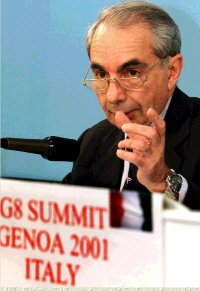
An Outline of His Political and Ethical Views
Giuliano Amato--“Blairite before Tony Blair”,1 as The Economist put it--is a one-man party whose mission is to modernize the left.
An American-trained lawyer who is respected in international financial circles, and an avowed enemy of state monopolies, Amato is a strong believer in the need for creating a more flexible labor market, privatizing state concerns such as the ENI energy group and ENEL, the electric utility, and restructuring Italy's pension system.
As Prime Minister in 1992-1993, he skillfully tackled Italy's huge budget deficit
managing to set in motion, besides tax increases, cuts in social spending--by raising the retirement age for pensions (from 62 to 65) and abolishing the remnants of automatic wage indexation--and
privatizations. Which allowed his successors, including former Prime Minister Romano Prodi, to steer Italy into the Maastricht club of single-currency membership. 2
But Amato and his "new left" will find it hard to persuade the “old left”, made up of trade unionist, unreconstructed Communists, and the most “conservative” fringes of the coalition's main party itself (Democrats of the Left), to adjust to the requirements of globalization, international competitiveness, and economic freedom.
In fact, this is already proving no easy task: “Just before labour day on May 1st, he sent a blunt message to the unions:
«The world is changing; the economy is changing; jobs are changing. We must all innovate.» The unions did not like the sound of it. «Mr Amato had better stick to the job of innovating his own government,» said Mr Cofferati. «We'll take care of the trade unions.»" 3
Yet, Giuliano Amato's main task is not to be regarded as a merely “technocratic” project of modernization. As a matter of fact it is quite the opposite. "I am not a technocrat. I am here to carry out reforms", Amato declared in 1999 as the Treasury Minister of D'Alema's previous government.
His idea is about sayng yes to the market economy, but no
to the market society. Which means, as they say in America, to be
for opportunity, responsibility and community. What he is striving for is to replace a divided way of looking at
politics and talking about our common live with a unifying theory.
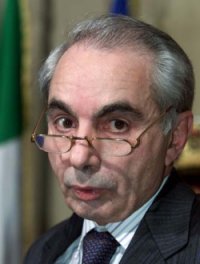 Like Tony Blair, Amato believes that between the politics of the new right--laissez faire, leave everything to markets, social indifference--and the politics of the old left--state control, run everything through the center--, and also between the old principled left and the pragmatic left that sought change gradually, there is a new way. And this new way is not about resisting change, but embracing globalization as inevitable and, actually, also as desirable, in terms of greater trade and international exchange, and equipping people and business to survive and compete in this new global market.
"This is my own idea of reformer--the learning society, which gives everybody a chance", Amato said in an interview. This means, firstly, that we have to spend more money, not less, than ever
before on education, and secondly that there needs to be a system of lifetime learning for
people in transition.
He recently recalled the historical accomplishment of a lay culture: “freedom joined to responsibility” (“towards others, not only towards ourselves”), as well as the historical merit of the left:
“On a political plane, the left, and in particular the reformist wing to which I belong, has had the historical merit--together with the Catholics in politics--of communicating with those whom our society has emarginated. The left has used its political clout to extend the rights of citizenship to those who did not enjoy these rights, and even if enormous errors were committed in this century in the name of the left, those were the goals and those were the roots.
He also complained about the degeneration of the lay world, while "the Catholic church has admitted its past errors" : 5
The millennium now rushing towards us will disclose millions and millions of human beings who risk being unable to enter it fully. They are starving, or diseased, or being bombed, or shot. It's our responsibility to start moving, remembering that that was our mission, and that in the name of that mission there are now roots that cannot be eradicated." 4
"In the lay world and in its degeneration we have allowed liberty to evolve into personal convenience. We have allowed our relationship with others to be guided by their usefulness in furthering our own ambitions. We now risk--and I say this as a convinced supporter of the free market--transferring those values that are positive when they pertain to the economic side of life to areas of our lives where other values should be predominant. In this respect, our non religious culture has good reason to seek purification." 6
Finally, recalling the mith of Ulysses, he pointed out that "life is a path" :
"This means very simply that one cannot walk alone, or be a bystander, and just enjoy the view; living in this way is not permissible.
This is also the mith of Ulysses, a mith that has been lived and preached in a thousand ways, and which is a non-religious mith.
We are human beings, instead, insofar as others are human beings, because those others are the mirror of ourselves. Our path is therefore a common one, not a solitary one." 7
Thus, the modernizing of the left is anything but the eradicating of its roots or the denying of its mission.
1) "Giuliano Amato, Italy's agile stopgap", The Economist (April 24, 2000). Moreover: "He is one of Italy's cleverest politicians--and knows it. He is witty and imaginative, not least in his daring choice of metaphor. He speaks excellent English. He masters legal and economic complexities...". (Ibid.)
2) See Alan Friedman, "Economic Upswing May Help Amato Steer Italy", International Herald Tribune (May 4, 2000), and "Amato to Take Reins Of Italy Government", International Herald Tribune (April 27, 2000).
3) "Italy's edgy new government", The Economist (May 6, 2000).
4) Giuliano Amato, "Reading the Papal Bull", Aspenia, N.10, December 1999. An introduction to the Pontifical Bull for the Holy Year by a tried and true believer in laicism. He sees in Karol Wojtyla’s words a great program for reform in the next millennium.
5) Ibid..
6) Ibid..
7) Ibid..
top