|

 Nashville,
TN Nashville,
TN
Travel
Information
Accommodations
Ceremony
Murfreesboro
Wedding
Traditions


The Engaged

The Bride's Maids
 
The Bride's Family

The Groom's Men

The Groom's Family

USA
Bride
Ungroom'd
iBride
Wedding
Singer
Dillards Registry
Target Registry
|
 |
|
|
|

Wedding
Superstitions & Traditions
|
wedding
traditions section 2
|
When it comes
to Weddings, everyone's superstitious. Even
if you're the kind of person who walks under
ladders on point of principle, or laughs their
socks off when friends touch wood, you can bet
that, when your wedding day dawns, wild horses
couldn't stop you clutching something old and
donning something blue. And thats just for starters.
We guarantee that you wouldn't dream of seeing
your fiance on the morning of the wedding. And
will you expect to be carried across the threshold?
Of course you will!
But where do these
old traditions come from?
Well, some can
be traced back to Roman & Anglo Saxon times,
some to Victorian rhymes and others to folklore
that has been passed down through countless
generations.
All of them are to do with bestowing good luck
and fertility on the happy couple.
There are so many
superstitions and traditions associated with
Weddings that its impossible to follow them
all. Many have changed over time, while others,
thankfully, are very watered-down versions of
old customs. The tradition of tying old shoes
to the back of the Couple's car, for example,
stems from Tudor times when guests would throw
shoes at the Bride & Groom, with great luck
being bestowed on them if they or their carriage
were hit! In Anglo
Saxon times the Bride was symbolically struck
with a shoe by her Groom to establish his authority.
Brides would then throw shoes at their bridesmaids
to see who would marry next.
Something
Old, Something New, Something Borrowed, Something
Blue and a Silver Sixpence in her Shoe
This rhyme originated
in Victorian times. 'Something Old' signifies
that the Couple's friends will stay with them.
In one version of the tradition the 'Something
Old' was an old garter which was given to the
bride by a happily married woman so that the
new bride would also enjoy a happy marriage.
'Something New' looks to the future for health,
happiness and success.
'Something Borrowed'
is an opportunity for the Bride's family to
give her something as a token of their love
(it must be returned to ensure Good Luck), and
'Something Blue' is thought lucky because Blue
represents fidelity and constancy. The custom
began in ancient Israel where brides wore a
blue ribbon in their hair to symbolise their
fidelity. A sixpence was placed in the shoe
to bring the couple wealth in their married
life. Some brides still place a penny in their
shoe during the marriage ceremony.
Flower Power
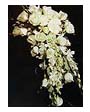
Flowers have always
been a big feature at Weddings. The Groom is
supposed to wear a flower that appears in the
Bridal Bouquet in his button-hole. This stems
from the Medieval tradition of a Knight wearing
his Lady's colours, as a declaration of his
love. Each flower has its own meaning and can
display a special message. Orange Blossom, for
instance, signifies chastity, purity and loveliness,
while red chrysanthemum means " I love you "
The Time &
The Place
Sunday used to
be the most popular wedding day, as it was the
one day most people were free from work. Puritans
in the Seventeenth Century put a stop to this,
however, believing it was improper to be festive
on the Sabbath. Today, Saturdays are the busiest,
despite the rhyme
Monday for health, Tuesday for wealth, Wednesday
best of all,
Thursday for losses, Friday for crosses, Saturday
for no luck at all
As for the time
of year, the saying 'Marry in the month of May,
and you'll live to rue the day' dates back to
Pagan times. May, the start of summer, was dedicated
to outdoor orgies (ie the summer festival Beltane),
hardly the best way to begin married life! Queen
Victoria is said to have banned her children
from marrying in May, and Nineteenth Century
Vicars were rushed of their feet on April 30th
because Brides refused to marry during May.
The sun has always been associated with sexual
stimulation and, therefore future fertility.
In Scotland it was traditional for the Bride
to 'walk with the sun', proceeding from east
to west on the south side of the church and
then circling the Church three times 'sunwise'
for good luck.
Married when the year is new, he'll be loving,
kind & true,
When February birds do mate, You wed nor dread
your fate.
If you wed when March winds blow, joy and sorrow
both you'll know.
Marry in April when you can, Joy for Maiden
& for Man.
Marry in the month of May, and you'll surely
rue the day.
Marry when June roses grow, over land and sea
you'll go.
Those who in July do wed, must labour for their
daily bred.
Whoever wed in August be, many a change is sure
to see
Marry in September's shrine, your living will
be rich and fine.
If in October you do marry, love will come but
riches tarry.
If you wed in bleak November, only joys will
come, remember.
When December snows fall fast, marry and true
love will last.
Food for Thought
The Wedding Cake
was originally lots of little wheat cakes that
were broken over the Bride's head to bestow
good luck and fertility. Today's three tier
Wedding Cake is based on the unusual shape of
the spire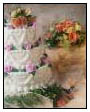 of Saint Bride's Church in London. Traditionally
the newly-weds should make the first cut to
signify sharing their life. Every guest than
eats a crumb to ensure good luck. And sleeping
with a piece under her pillow is said to make
a single woman dream of her future husband.
The giving of almond favours is connected with
the motto: 'A gift of five almonds represents
health, wealth, long life, fertility and happiness'
The throwing of confetti, meanwhile is an
ancient fertility rite. Handfuls of grain or
nuts were traditionally thrown because they
are 'life-giving' seeds. In some European countries,
eggs are thrown instead.
of Saint Bride's Church in London. Traditionally
the newly-weds should make the first cut to
signify sharing their life. Every guest than
eats a crumb to ensure good luck. And sleeping
with a piece under her pillow is said to make
a single woman dream of her future husband.
The giving of almond favours is connected with
the motto: 'A gift of five almonds represents
health, wealth, long life, fertility and happiness'
The throwing of confetti, meanwhile is an
ancient fertility rite. Handfuls of grain or
nuts were traditionally thrown because they
are 'life-giving' seeds. In some European countries,
eggs are thrown instead.
Get me to
the Church..
Walking
is thought to be the best way of getting to
Church, as there's more chance of spotting lucky
omens. Seeing a rainbow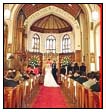 ,
having the sun shine on the Bride and meeting
a black cat or a chimney sweep are all lucky. ,
having the sun shine on the Bride and meeting
a black cat or a chimney sweep are all lucky.
Bad omens include
seeing a pig, hare or lizard running across
the road, or spotting an open grave. Make sure
the road is clear on Monks or Nuns too, they
fortell barreness and a life dependant on charity.
Coming home from
Church can be equally hazardous. Tradition dictates
the new wife must enter her home by the main
door and, to avoid bad luck, must never trip
or fall - hence the custom that a bride should
be carried over the threshold.
Dressing Up
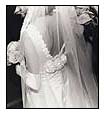
Until the Nineteen
Hundreds Brides hardly ever bought a special
Wedding Dress, opting for their best outfit
instead. Green was always avoided, as it was
though to be unlucky. To say a girl 'had a green
gown' also implied that she was of loose morals,
because her dress would be grass-stained due
to rolling around in the fields! Hence 'Marry
in Green, ashamed to be seen'. White Dresses were made popular by Queen
Victoria, who broke the tradition of royals
marrying in Silver. Symbolising purity and virginity,
white was also thought to ward off evil spirits.
Other traditions are that the bride should never
make her own dress, that the final stitch should
not be completed until she is departing for
the Church and that she should never try on
the entire outfit before the day. This was because
it was felt dangerous for the Bride to count
her chickens. For the same reason, a Bride should
never practise signing her new name until it
is legally hers, and wedding linen was marked
with the Brides maiden rather than married initials.
The tradition of Bridesmaids is evolved from
the custom of surrounding the Bride with other
richly dressed women, in order to confuse evil
spirits.
seen'. White Dresses were made popular by Queen
Victoria, who broke the tradition of royals
marrying in Silver. Symbolising purity and virginity,
white was also thought to ward off evil spirits.
Other traditions are that the bride should never
make her own dress, that the final stitch should
not be completed until she is departing for
the Church and that she should never try on
the entire outfit before the day. This was because
it was felt dangerous for the Bride to count
her chickens. For the same reason, a Bride should
never practise signing her new name until it
is legally hers, and wedding linen was marked
with the Brides maiden rather than married initials.
The tradition of Bridesmaids is evolved from
the custom of surrounding the Bride with other
richly dressed women, in order to confuse evil
spirits.
Married in White, you have chosen right
Married in Grey, you will go far away,
Married in Black, you will wish yourself back,
Married in Red, you will wish yourself dead,
Married in Green, ashamed to be seen,
Married in Blue, you will always be true,
Married in Pearl, you will live in a whirl,
Married in Yellow, ashamed of your fellow,
Married in Brown, you will live in the town,
Married in Pink, you spirit will sink.
info@weddings.co.uk
|
wedding
traditions section 2
|

Return To Top
|
|
|
|
|
|