|
 Home
Page Home
Page
Photo
Album
More
Photos
Favourite
things
Smiths
U2
Radiohead
McAlmont
and Butler
Nirvana
R.E.M.
Blur
kd
lang
Frasier
Favourite
Links
But
don't forget the songs
that
made you smile
and
the songs that
made
you cry"
I
went to London and I
book
myself in at the
Y....W.C.A.
I said
"I like it here -
can I
stay?"
And do
you have a
vacancy
for a
Back-Scrubber?"
"every
day you must
say
how do I feel about
my
shoes"
"But
last night
the
plans for a future
war
was all I saw on
channel
4"
|
|
So
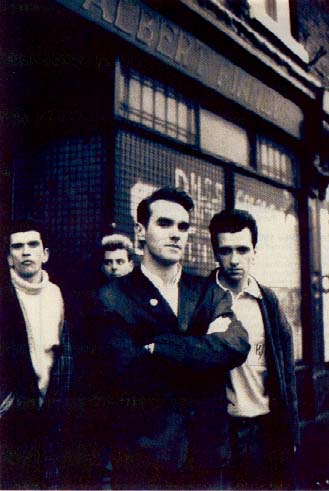
here is a little biography taken from Microsoft
Music Central. The photo on the left, was I'm told,
taken just after the Queen is Dead. Dont they look
a bunch of know alls, but hey, they were, so there
!
|
Acclaimed
by many as the most important UK group of the '80s, the
Smiths were formed in Manchester during the spring of 1982.
Morrissey (b. Steven Patrick Morrissey, 22 May 1959,
Davyhulme, Manchester, England) and Johnny Marr (b. John
Maher, 31 October 1963, Ardwick, Manchester, England)
originally combined as a songwriting partnership, and only
their names appeared on any contract bearing the title
"Smiths." Morrissey had previously played for a couple of
months in the Nosebleeds and also rehearsed and auditioned
with a late version of Slaughter And The Dogs. After that he
wrote reviews for Record Mirror and penned a couple of
booklets on the New York Dolls and James Dean. Marr,
meanwhile, had played in several Wythenshawe groups
including the Paris Valentinos, White Dice, Sister Ray and
Freaky Party. By the summer of 1982, the duo decided to form
a group and recorded some demos with drummer Simon
Wolstencroft and a recording engineer named Dale.
Wolstencroft subsequently declined an offer to join the
Smiths and in later years became a member of the Fall.
Eventually, Mike Joyce (b. 1 June 1963, Fallowfield,
Manchester, England) was recruited as drummer, having
previously played with the punk-inspired Hoax and Victim.
During their debut gig at the Ritz in Manchester, the group
was augmented by go-go dancer James Maker, who went on to
join Raymonde and later RPLA. By the end of 1982, the group
appointed a permanent bassist. Andy Rourke (b. 1963,
Manchester, England), was an alumnus of various past groups
with Marr.
After
being taken under the wing of local entrepreneur Joe Moss,
the group strenuously rehearsed and after a series of gigs,
signed to Rough Trade Records in the spring of 1983. By that
time, they had issued their first single on the label, "Hand
In Glove," which failed to reach the Top 50. During the
summer of 1983, the group became entwined in the first of
several tabloid press controversies when it was alleged that
their lyrics contained references to child molesting. The
eloquent Morrissey, who was already emerging as a media
spokesperson of considerable power, sternly refuted the
rumours. During the same period the group commenced work on
their debut album with producer Troy Tate, but the sessions
were curtailed, and a new set of recordings undertaken with
John Porter. In November 1983, the group issued their second
single, "This Charming Man," a striking pop record that
infiltrated the UK Top 30. Following an ill-fated trip to
the USA at the end of the year, the quartet began 1984 with
a new single, the notably rockier "What Difference Does It
Make?," which took them to number 12.
The
Smiths ably displayed the potential of the group, with
Morrissey's oblique genderless lyrics coalescing with Marr's
spirited guitar work. The closing track of the album was the
haunting "Suffer Little Children," a requiem to the child
victims of the '60s Moors Murderers. The song later provoked
a short-lived controversy in the tabloid press, which was
resolved when the mother of one of the victims came out on
Morrissey's side. A series of college gigs throughout
Britain established the group as a cult favourite, with
Morrissey displaying a distinctive image, complete with
National Health spectacles, a hearing aid and bunches of
gladioli. The singer's celebrated miserabilism was
reinforced by the release of the autobiographical "Heaven
Knows I'm Miserable Now," which reached number 19 in the UK.
Another Top 20 hit followed with "William, It Was Really
Nothing." While the Smiths commenced work on their next
album, Rough Trade issued the interim HATFUL OF HOLLOW, a
bargain-priced set that included various flip sides and
radio sessions. It was a surprisingly effective work, that
captured the inchoate charm of the group.
By 1984,
the Smiths found themselves feted as Britain's best group by
various factions in the music press. The release of the
sublime "How Soon Is Now?" justified much of the hyperbole
and this was reinforced by the power of their next album,
MEAT IS MURDER. The work displayed Morrissey's increasingly
tendency towards social commentary, which had been indicated
in his controversial comments on Band Aid and the IRA
bombings. The album chronicled violence at schools ("The
Headmaster Ritual"), adolescent thuggery ("Rusholme
Ruffians"), child abuse ("Barbarism Begins At Home") and
animal slaughter ("Meat Is Murder"). The proseletyzing tone
was brilliantly complemented by the musicianship of Marr,
Rourke and Joyce. Marr's work on such songs as "The
Headmaster Ritual" and "That Joke Isn't Funny Anymore"
effectively propelled him to the position of one of
Britain's most respected rock guitarists. Despite releasing
a milestone album, the group's fortunes in the singles
charts were relatively disappointing. "Shakespeare's Sister"
received a lukewarm response and stalled at number 26, amid
ever growing rumours that the group were dissatisfied with
their record label.
Another
major UK tour in 1985 coincided with various management
upheavals, which dissipated the group's energies. A
successful trek across the USA was followed by the release
of the plaintive summer single, "The Boy With The Thorn In
His Side" which, despite its commerciality, only reached
number 23. A dispute with Rough Trade delayed the release of
the next Smiths album, which was preceded by the superb "Big
Mouth Strikes Again," another example of Marr at his best.
During the same period, Rourke was briefly ousted from the
group due to his flirtation with heroin. He was soon
reinstated, however, along with a second guitarist Craig
Gannon, who had previously played with Aztec Camera, the
Bluebells and Colourfield.
In June
1986, THE QUEEN IS DEAD was issued and won immediate
critical acclaim for its diversity and unadulterated power.
The range of mood and emotion offered on the album was
startling to behold, ranging from the epic grandeur of the
title track to the overt romanticism of "There Is A Light
That Never Goes Out" and the irreverent comedy of "Frankly
Mr Shankly" and "Some Girls Are Bigger Than Others." A
superb display of Morrissey/Marr at their apotheosis, the
album was rightly placed alongside MEAT IS MURDER as one of
the finest achievements of the decade. A debilitating
stadium tour of the USA followed and during the group's
absence they enjoyed a formidable Top 20 hit with the
disco-denouncing "Panic." The sentiments of the song,
coupled with Morrissey's negative comments on certain
aspects of black music, provoked further adverse comments in
the press. That controversy was soon replaced by the news
that the Smiths were to record only one more album for Rough
Trade and intended to transfer their operation to the major
label EMI. Meanwhile, the light pop of "Ask" contrasted with
riotous scenes during the group's 1986 UK tour. At the
height of the drama, the group almost suffered a fatality
when Johnny Marr was involved in a car crash. While he
recuperated, guitarist Craig Gannon was fired, a decision
that prompted legal action. The group ended the year with a
concert at the Brixton Academy supported by fellow
Mancunians, the Fall. It was to prove their final UK
appearance. After another hit with "Shoplifters Of The World
Unite" the group completed what would prove their final
album. The glam rock inspired "Sheila Take A Bow" returned
them to the Top 10 and their profile was maintained with the
release of another sampler album THE WORLD WON'T LISTEN.
Marr was growing increasingly disenchanted with the group's
musical direction, however, and privately announced that he
required a break.
With the
group's future still in doubt, press speculation proved so
intense that an official announcement of a split occurred in
August 1987. STRANGEWAYS, HERE WE COME, an intriguing
transitional album, was issued posthumously. The work
indicated the different directions that the major
protagonists were progressing towards during their final
phase. A prestigious television documentary of the group's
career followed on 'The South Bank Show' and a belated live
album RANK was issued the following year. The junior members
Rourke and Joyce initially appeared with Brix Smiths's Adult
Net, then backed Sinead O'Connor, before Joyce joined the
Buzzcocks. Morrissey pursued a solo career, while Marr moved
from the Pretenders to The The and Electronic, as well as
appearing on a variety of sessions for artists as diverse as
Bryan Ferry, Talking Heads, Billy Bragg, Kirsty MacColl, the
Pet Shop Boys, Stex and Banderas. In 1992, there was renewed
interest in the Smiths following the furore surrounding
Johnny Rogan's controversial biography of the group, and
Warner Brothers acquisition of the group's back-catalogue
from Rough Trade.
|