| Datum | Länk | Egen kommentar |
| 1999-08-31 | Millennium bug fears threaten gilts market |
"Stocks to bonds, bonds to T-bills, T-bills to bank accounts, bank accounts to currency..."
Ett tecken på framtida trubbel är minskad likviditet. Det här är från Sunday Times:
Millennium bug fears threaten gilts market FEARS over the millennium bug threaten an almost complete shutdown of the gilts market, traders fear, as almost a fifth of the market's liquidity has evaporated over the past fortnight. Market watchers say investors are showing great reluctance to roll over gilt futures positions from the September contract to December because they are concerned that the markets may not be liquid enough to trade in December. Amanda Sudworth, fixed income analyst at Barclays Capital, said the problems in the gilts market had grown sharply worse as the date approached to roll over the September contract, and fears over the millennium bug were to blame. "Three large UK institutions have called me this week and said they are very concerned about trading in December contracts because they fear liquidity will entirely dry up by the end of the year and they won't be able to get out," she said. The market has been hit by a shortage of long-dated issues, which has forced up their price to levels that are out of line with prices of shorter-dated gilts. The causes of this have been twofold. The Government has been borrowing less and so issuing fewer gilts, while more stringent funding requirements imposed on pension companies have sharpened their appetites for such investments. The Debt Management Office, which handles government borrowings, has already agreed to bring forward the issue of £400 million of UK government bonds to alleviate the shortage. But a threatened buyers' strike over the millennium would have serious knock-on effects for other markets. |
| 1999-08-31 | Kaos väntar i Japan |
1) Den japanska regeringen har haft en kampanj sedan 1998 om att företag och myndigheter måste uppmärksamma och åtgärda 2000-problemen. Tills för någon vecka sedan hade ingen talat om för dem att också PC:ar påverkas... 2) Bara en bank i Japan har offentligt sagt att de har börjat åtgärda sina PC:ar. 3) I möten med företrädare för PC-tillverkare framkommer att de INTE har testat om BIOS klarar övergången till år 2000. 4) Den ansvarige för Japans "katastrofmyndighet" anser att y2k-frågan bara är hype och har därför inte tagit fram någon beredskapsplan. ... Allt detta (och lite till) enligt Karl Feilder, PC-guru och VD i Greenwich Mean Time. Japan är det mest riskutsatta landet i världen med avseende på y2k-frågan inför årsskiftet. Tokyo - 23 August 1999 - Japan's lack of Y2K readiness poses a serious threat to the stability of the world economy. This is the opinion of Karl W Feilder, President and CEO of Greenwich Mean Time and acknowledged world authority on the year 2000 PC problem. Currently on a conference tour of Japan, Feilder is calling for more Y2K-advanced countries to act now or they will not be able to trade with Japan next year. "Japanese business needs to be brought to a level of Y2K understanding very quickly so that they can act against the threat Y2K poses to their economy - and, therefore, the world economy. The quickest way of doing this is to transfer other government's existing Y2K campaigns to Japan." While the West may rightly think this is the responsibility of the Japanese government, Feilder, who has met their government representatives, says there simply isn't time to bring them to the point of understanding that breeds action. "Most Western governments took a long time to understand what needed to be done. The UK, US, Canadian, South African and Australian governments acted very strongly when they understood that Y2K had the ability to shut their economies down if they didn't encourage business to act. Today these are the nations I rate as furthest ahead in Y2K preparation." Feilder acknowledges that many other nations need help too, but says the case for transferring accumulated knowledge to Japan is most urgent. "We've recently experienced the domino effect of Japanese recession and stock market fluctuation, compounded by the interdependence of the traditional keiretsu. These groups of large companies - all with strong connections to the same bank and significant cross-holdings in each other's shares - dominate Japanese business culture. I don't think anyone would argue that it is in the interests of the West to prevent their economic failure." ...THE MESSAGES WESTERN GOVERNMENTS NEED TO GET ACROSS IN THE JAPANESE PRINT AND BROADCAST MEDIA: The year 2000 problem is real and will shut businesses down if not resolved. It has a far higher impact on PCs and PC networks than any other type of computer. Every single PC needs to be checked at all five layers: hardware (BIOS), operating system, software programs, user data and data sharing. Identified problems need to be solved. There is still time to solve problems - prioritise on mission critical systems. It's not about the 1st of January 2000. Its impact will be felt throughout 2000 and especially in the first quarter. |
| 1999-08-30 | Vietnam långt efter |
Vietnam? Jamen, det rör väl inte oss här i Sverige?! Det är precis vad det gör det. Inte direkt, men indirekt. Instabilitet i Sydostasien (och övriga delar av Asien, Ryssland, Latinamerika och Östeuropa också för den delen) leder till oroliga finansmarkander och den globala finanskarusellen är sedan i full gång igen. Och den här gången blir sannolikt nedgången mer utdragen än 1998 års nedgång. Vi kanske får uppleva en riktig bearmarket för första gången sedan oljekriserna på 1970-talet. I så fall blir det inte trevligt.
``Embarrassingly late,'' said Chu Hao, the government's point man on the year 2000 problem and a deputy minister at the Ministry of Science, Technology and the Environment. ``Thumb-twiddling,'' sneered one state-run newspaper. ``Pick a card, flip a coin, roll the dice. That seems to be the conventional wisdom about the preparations (nationwide),'' said one expatriate businessman, a longtime resident in Hanoi. The Y2K bug is expected to disable many computers by confusing their internal clocks as the year turns from 1999 to 2000. Especially vulnerable are 486 computers and older models, which predominate in Vietnam. One government estimate said 61 percent of all the computers in Vietnam are Y2K-vulnerable, along with most of their software and 90 percent of their applications. |
| 1999-08-28 | Der Spiegel: Totalt sammanbrott en möjlighet |
Der Spiegel rapporterar att tyska underrättelsetjänsten fruktar att problemen med övergången till år 2000 kan leda till ett totalt sammanbrott av samhällen överallt.
The millennium bug has become globalized through the international vagabond nature of hardware and software. A study by the Federal German Intelligence Service (BND) from this spring assesses the worldwide efforts to thwart the data loss worst case scenario as follows: "function failures up to complete breakdown can be expected almost everywhere". Of the estimated 80bn computer chips worldwide, 800m have not been tested. Ninety-three per cent of all personal computers made before 1997 or which have older chips in them are considered at risk. |
| 1999-08-26 | Finanstidningen: Miljardflöde ut från börsen inför millenniumskiftet |
Som jag har hävdat länge...
Millenieskifte skapar börsfrossa - 8 procent tänker minska sina innehav - Räcker för att sänka börsen Knappt en av tio privata aktie- och fondsparare har planer på att sälja sina innehav inför millenieskiftet. Gör de slag i saken kommer drygt 65 miljarder flöda ut från börsen. Det är tillräckligt för att skapa en rejäl nedgång. En stor majoritet av svenskarna tänker behålla sina aktier och fondandelar över millenieskiftet. Men en knapp tiondel har planer på att sälja sina innehav, vilket motsvarar uttag stora nog för att sänka hela börsen. Enligt en undersökning genomförd av Finanstidningen/Demoskop har sammanlagt 8 procent av svenska aktie- och fondsparare planer på att sälj sina innehav inför millenieskiftet. Bland dessa har knappt hälften, 37 procent, redan bestämt sig för att göra slag i saken. Övriga tvekar. Trots att det är så få privatpersoner som har planer på att ta ut pengar från börsen rör det sig om rätt många miljarder kronor som kan sättas i rullning. Totalt har svenskarna 962 miljarder kronor i aktieplaceringar, enligt Statistiska centralbyråns finansräkenskaper. Av dessa är drygt 516 miljarder direktinvesterade på Stockholmsbörsen, medan omkring 370 miljarder finns i svenska fondandelar. Övriga 75 miljarder finns investerade i utländska aktier och fondandelar. Skulle 8 procent av aktie- och fondspararna sälja av sina investeringar betyder det ett utflöde på uppåt 65 miljarder kronor från Stockholmsbörsen under dagarna före nyårshelgen. Nog för att knäcka hela börshandeln, menar analytiker. "Det skulle kunna bli en rejäl sättning om folk väl börjar sälja sina tillgångar. Men samtidigt så är ju millenieskiftet en enstaka händelse, vilket betyder att andra investerare skulle se möjligheter att gå in om börsen börjar falla", säger Olle Djerf, chefekonom på Meritanordbanken. Djerf tror att det kan bli viss turbulens inför millenieskiftet, av flera skäl. Dels väntas såväl lageruppbyggnad och konsumtion hos hushåll och företag att öka, vilket också kan kräva att tillgångar säljs av. Samtidigt visar också undersökningar att fler kommer att vilja ha kontanter i oro för att det inte ska gå att göra uttag efter millenieskiftet. Men Djerf tror att effekterna kommer att vara av övergående natur. "När väl millenieskiftet har passerats så finns det ju ingen anledning till oro längre. Det mesta talar för att allting då återfaller till det normala. Millenieskiftet innebär ju inte några radikala förändringar i ekonomiska fundamenta". Det där håller jag definitivt inte med om! Jag säger bara Asien, Sydamerika och Östeuropa... Den ekonomiska krisen kommer att bli djup och global. En mycket stor andel av svenskarna planerar dessutom inte att göra några förändringar inför årsskiftet. 65 procent av spararna har redan bestämt sig för att låta pengarna sitta inne över nyårsnatten och ytterligare 27 procent är ganska säkra på sin sak. "Hushållen brukar agera klokt när det gäller turbulens på marknaden. Också det talar för att effekterna av millenieskiftet nog inte blir så stora", säger Djerf. Det kan han ju tro... |
| 1999-08-26 | CS First Boston fruktar ny global kreditkris till följd av y2k |
Investmentbanken Credit Suisse First Boston (en av de riktigt stora aktörerna) säger, enligt denna Reutersnyhet, följande:
LONDON, Aug 26 (Reuters) - Eastern Europe and Southeast Asia are the emerging market regions most vulnerable to millennium bug disruption, Credit Suisse First Boston (CSFB) said. The investment bank also said its survey of 250 companies in 18 emerging market countries reinforced concern that fears about the Year 2000 (Y2K) computer glitch could lead to another credit scare for emerging markets. ``Aggregated data suggest that Eastern Europe and Southeast Asian markets are most at risk from critical system failure,'' it said in a report. ``A large credit crunch could start hitting the markets, much like we saw in late summer and autumn of last year. Tror du fortfarande att Du inte drabbas? |
| 1999-08-26 | Excel klarar inte år 2000 |
Den här artikeln är från IDG:
Microsoft Excel klarar inte år 2000 1999-08-23 17:30 Igår släpptes en buggfix för Excel 97 och Excel 2000. Men ännu en bugg har upptäckts i Microsofts kalkylprogram! Det kan nämligen uppstå problem med vissa Excel-filer år 2000, närmare bestämt i Date()-funktionen. Microsoft har haft det allt annat än lätt den senaste tiden. Senast igår kunde du läsa om en buggfix som släppts för Excel 97 och Excel 2000. Nu har det uppdagats ännu en bugg som påverkar både Excel 95, 97 och Excel 2000. Lite ironiskt är att buggen gör så att vissa makron som är gjorda i Excel inte kommer att fungera korrekt efter årsskiftet. Problemet ligger i en funktion för datum som används i Excel kallad Date(). Funktionen använder sig av endast två siffror för att representera årtal, oavsett hur Windows är inställt i kontrollpanelen. Det hela kan resultera i att Excel kan ta fel på årtal efter årsskiftet, och därmed ställa till det med siffrorna. Mer information hittar du här. |
| 1999-08-26 | 1/3 av skotska småföretag har inte lyft ett finger för att säkra sina system inför årsskiftet |
När dessa företag med mellan 10 och 249 anställda börjar säga upp folk en bit in på nästa år kommer den ekonomiska krisen att slå hårt mot Skottland (och England och Europa). Synnerligen oroande, och jag är rädd att situationen är liknande i Sverige. Eftersom debatten är obefintlig i media och alla bara möts av positiva "rapporter" från regering och storföretag antar alla (felaktigt) att det inte finns något att oroa sig för.
Action 2000's latest research shows that 32% of businesses employing 10-249 people in Scotland are putting their businesses and employees' jobs at risk by taking very little action, a figure which compares with 25% UK-wide. Gwynneth Flower, managing director of Action 2000, said: "The historical 'wait and see' attitude illustrated by Scottish business is not going to work against the Millennium Bug and our latest figures show there are grounds for a great deal of concern. "There is still a hard core number of companies that are adamant that they need do nothing. This lack of perception of risk shows a worrying short-sightedness." Further findings as a result of the research showed that companies with 20-99 employees are of more concern because of their lower levels of readiness. The vast majority of these companies have business critical systems or run IT networks within their own businesses, yet around 40% in the UK are not taking appropriate action. "The 40% employ around one million people. Do they really want to put not only their own but their employees' livelihoods on the line? Those who are doing work also need to increase the pace. Suppliers need to be contacted. Equipment - old and new - needs to be checked. Legal and health issues must be addressed. Time has very nearly run out," said Flower. |
| 1999-08-24 | Räkna med stora störningar i tre månader, säger rådgivare till nyzeeländska regeringen |
Det här är från CNNfn.
THE Y2K computer bug could result in disruption for three months beyond the first day of the new millennium, says Y2K Readiness Commission special adviser John Good. ...There was also the possibility of cascading effects, where some businesses that were Y2K compliant might not be able to operate because their suppliers were having difficulties. Mr Good rejected the suggestion from some cynical observers that the Y2K bug was not a big issue. "You have to look at the work being done to diagnose and find Y2K problems and put them right so that some of those sceptics are not going to be inconvenienced. "In some ways it is understandable because we have put so much confidence in computers that the notion that they are not going to work is seen as preposterous. ...Mr Good said keeping the public well-informed was vital. During the Melbourne gas crisis, for example, rumours started that there was no bread and people began panic buying of food, causing an artificial food crisis. |
| 1999-08-23 | Parlamentsledamöter varnar för kaos i Storbritannien |
Det här är från Scottish Daily Record, rapporterat av CNNfn. Borde inte svenska riksdagsmän också ifrågasätta?
MPs have warned that the UK faces Millennium chaos because the Year 2000 computer bug still hasn't been tackled. With just four months to the new year, the powerful Public Accounts Committee said crucial services, including nearly every police force and 40 per cent of fire brigades, faced bug problems. They urged the Government to name and shame organisations which were lagging behind. And in a report out today, the committee said the public should be told more about the threat in Britain and abroad. Committee chairman David Davis said: "It is a matter of concern that there is still much to be done to minimise the risks of material disruption to key services." |
| 1999-08-21 | ABB varnar |
Ta inte lätt på hotet mot kraftverken i samband med övergången till år 2000! Det säger ABB på sin website.
...Based on the described analysis and ABB's experience, the risk of losing a power plant due to Year 2000 non-compliance of some components must be taken very seriously, especially in the case of plants with a complex and diverse control and supervision computer infrastructure originating from different suppliers. Even if individual components have been certified as being Year 2000 compliant, the plant operator must verify that the complete chain is Year 2000 ready and will function smoothly. |
| 1999-08-21 | The Economist: USA:s inflation är låg, men ekonomin är farligt nära överhettning |
The Economist från 21 augusti oroas över den ekonomiska utvecklingen i USA:
...Two important—and related—uncertainties could cloud this picture. One is the stockmarket. If Wall Street shrugs off higher interest rates entirely, as it did in June, an orderly slowdown will be harder to achieve. Conversely, a big correction in the stockmarket could precipitate an uncomfortably sharp slowdown. The other unknown is how foreigners will behave. America’s trade deficit rose to a record $24.6 billion in June, and the country is heading for a current-account deficit of 4% of GDP this year. As the economies of Europe and Asia perk up, foreign investors who are financing this sizeable deficit may demand substantially higher interest rates to do so. The recent slide in the dollar and the strengthening in bond yields could be but the beginning. If foreign sentiment turns sharply, America’s much-needed economic slowdown could occur more suddenly than anyone expected. And Alan Greenspan would then no longer seem a demi-god. |
| 1999-08-21 | Warren Buffet minskar aktieinnehav |
Warren Buffet är känd för att genom LÅNGSIKTIGA placeringar gjort stor överavkastning på börsen under många år. Ni får tolka det hur ni vill, men att han minskar aktietillgångar till förmån för räntebärande papper tycker jag tyder på en viss skepsis till börsvärderingar. Eller?
Min poäng är att jag tror att vi obönhörligen närmar oss ett större börsfall. Och då menar jag en rejäl bear-market, till skillnad mot den mycket snabba återhämtning som skedde efter börsfallet förra hösten. "Det smarta kapitalet" är redan i rörelse mot "säkrare" mark. I en länkad artikel några nyheter ner på den här sidan kallade en aktör aktiemarknaden "halvprofessionell" och denna marknad har sedan länge tappat fotfästet och är på väg upp en bra bit över trädtopparna. Fallet kommer att bli tungt den här gången och eftersom ekonomin har byggt in ett sådant starkt beroende av aktiemarknaden kommer en nedgång på börserna världen över att få mycket allvarliga ekonomiska följder. Och y2k är ingen mildrande faktor i detta sammanhang. Tvärtom. WASHINGTON - Warren Buffett put almost $10 billion in cash to work during the second quarter and reported an increase in bond holdings of almost that much, according to a regulatory filing... ...Buying bonds rather than stocks would be consistent with Mr. Buffett's oft-voiced contention that equities are too expensive. As recently as May, he said that there were "very, very few" U.S. stocks that met his test of being good businesses at low prices. |
| 1999-08-21 | Oro i Sydamerika startskott för global finansoro? | Den brasilianska Realen faller i en allt snabbare takt just nu, vilket drar med sig de andra sydamerikanska valutorna. Frågan är nu bara: När faller korthuset samman? Det fragila globala banksystemet kommer att sättas under hård press under kommande månader. Och y2k kommer inte att vara enda anledningen till detta. |
| 1999-08-20 | Stor debatt i USA om "den hemliga rapporten" |
Den kallas numera "The Navy Report" och har varit andranyhet (efter jordbävningar) på både CBS och ABC och kommenterats av de stora tidningarna, bl a Washington Post. Och på diskussionsforumen avlöser analyserna varandra. Kul med debatt! Har någon hört något om denna rapport i Sverige? Finns det någon enda tidning eller nyhetsprogram i Sverige som har reagerat?
Så här skriver Ed Yourdon, känd programmerare, författare och y2k-debattör: Like most of the people on this forum (and several other forums), I've read all of the postings about Jim Lord's "Pentagon Papers" with great interest and deep concern. A number of excellent points have already been made on this thread; here are a few of my own observations: 1. Credibility of the players: I've met Lord and Koskinen in person, and I know Steve Davis from numerous email exchanges over the past couple of years. I respect the intelligence, sincerity, and integrity of all them; whether they turn out to be right or wrong, I think they all truly believe what they're saying to us -- which is in stark contrast to what I see in the day-to-day business world, where the "rules" of competitive behavior rarely require anything more than a surface-level pretense of sincerity. Nevertheless, the "bottom line" for me is that I would only trust the safety of my family to someone that I've known long enough to have gone through one or more life-and-death crises, in order to have a true sense of how they react under such circumstances. In a few rare cases, that might happen in a new friendship; but in most cases, it only happens after I've known someone 5, 10, or 15 years. For better or worse, I have to say that I don't know Lord, Koskinen, Davis, or many of the other Y2K "notables" well enough to warrant quite that level of trust, which means that I always have to remind myself to take everything they say with a small grain of salt. For many people, discussions like this are great for cocktail parties, but have no relevance in the "real" world; for people who really do think Y2K could pose life-and-death threats, it goes beyond idle cocktail chitter-chatter. Thus, I think one of the questions some of us have to ask ourselves after reading Lord's material, or Koskinen's rebuttal, or any of the related commentaries, is: sounds good, but would I entrust the safety of my spouse and my kids to this person, based on this information? 2. Authenticity of the Navy document: when I first read Jim's material, I was worried about this. Now I'm not -- it appears that Mr. Koskinen has publicly acknowledged that the original document did exist, and was published on a quasi-public web site at some relatively recent point in time. 3. Accuracy and timeliness of the Navy document, as compared to other quasi-official statements about Y2K readiness: bottom line is that nobody knows. Unless and until a more recent document appears from the same naval group, I don't see how we can reject this one as anything less than the "best guess" of at least one group within the Navy. It does seem to contradict the statement issued by Navy brass to their own personnel, but I don't think that necessarily proves that either document is right or wrong. 4. Should it have been released publicly? Obviously, Lord feels the answer is "yes," and Koskinen implies that the answer is "no." I was intrigued to see that Steve Davis seems to have sided with Koskinen on this one. My reaction on this one is entirely selfish, personal, and emotional: if the government is suggesting that the "public" is not entitled to know certain preliminary drafts of the Y2K situation, then I have to assume that I'm going to be included as part of that amorphous "public." It's all very interesting argue, in an abstract and academic sense, about whether John Q. Public is smart enough, mature enough, responsible enough, and experienced enough to be able to handle scary information. But what about you? What about me? And what are the credentials of those who apparently feel they have the God-given right to make such decisions? As noted above, I respect the intelligence, sincerity, and integrity of Lord, Koskinen, and Davis -- but I don't think they're sufficiently smarter, wiser, and purer than me to decide how what information I should be allowed to see, and what I shouldn't be allowed to see. I understand the notion that there may be people roaming the streets with an IQ of 76 who might do harm to themselves if provided access to scary information about Y2K; and in theory, I understand the concern that if the general public was given raw, unadulterated access to Y2K information, they might stampede and head for the banks to withdraw their money. These are serious issues, and I enjoy having a serious intellectual discussion about them ... but when I realize that, by virtue of not being a member of the political elite, I would end up being thrown into the same heap as the IQ-76 folks and the bank-run lemmings, I get very nervous about the possibility that my life is being manipulated. (For whatever it's worth, I would be just as nervous if someone told me that I would be allowed to be a member of the political elite if I would just keep my mouth shut; I don't like the idea of pulling the strings that control another person's life either). 5. Why do we have to "prove" anything about Lord's document anyway? The American system of justice assume that someone (including an individual, corporation, or any other entity) is innocent until proven guilty; even OJ got the benefit of that assumption. On that basis, the private-sector organizations and the government agencies are "innocent" of Y2K bugs until proven guilty; and on that basis, we would have to "prove" that the allegations in Lord's document were accurate, beyond a shadow of a doubt, before we did anything about them. But I think that Y2K is a classic case of safety-critical "auditing" in which one reverses the assumption: we should assume that computer systems, embedded systems, and the organizations that depend upon those systems, to be guilty until proven innocent. Organizations like FAA give lip service to this concept when they tell us that they would never compromise the public's safety with their air-traffic control systems ... but unless every FAA employee put every member of his/her immediate family on a New Year's Eve flight (not just Jane Garvey, John Koskinen, and the born-again optimist Peter de Jager), I'm not sure I trust their sincerity. As a practical matter, I don't think we're going to see any serious Y2K laws or regulations based on this principle -- but it does govern a lot of my thinking. Thus, for me the burden of proof is not on Jim Lord and his supporters to prove that their document is "right," but rather on the Y2K optimists to prove it's wrong. The notion that Mr. Koskinen's "Community Conversations" is providing such proof is laughable: these events have involved nothing more than public officials in some two dozen cities lecturing to an audience of a couple hundred people about why it's a bad idea for them to take their money out of the bank. Ed |
| 1999-08-20 | Existensen av hemlig amerikansk studie bekräftas | Efter att Jim Lord lagt ut information från en källa inom den amerikanska flottan, blev en nyhetsreporter intresserad och ringde upp John Koskinen, presidentens utsedde i y2k-frågor. Koskinen bekräftade att rapporten existerar, men att den, enligt hans tolkning, inte är så mycket att bry sig om! Flottan förutspår "total failure of New York City". Inget att bry sig om? |
| 1999-08-20 | Hemlig amerikansk studie från försvarsdepartementet nära domedagsscenario |
Om informationen i det länkade dokumentet visar sig stämma kan den amerikanska regeringens "3 day storm"-scenario kastas i papperskorgen. Källan till informationen kommer från den amerikanska flottan.
Secret Government Study Reveals Massive Y2K Problems in American Cities How many days could New York City survive without water and sewer services? How long would it take to evacuate eight million people in the dead of winter? Would thousands die in the process? Tens of thousands? More? When would the rioting and looting begin? How many National Guard troops would it take to control the largest city in the nation? What unthinkable devastation would be wrought on the global financial system? How might our enemies seize on the ensuing panic and confusion? Are these the crazed speculations of a Y2K alarmist? Not if you know what the US Navy and Marine Corps know. According to a June 1999 report titled, "Master Utility List," they believe "total failure is likely" for New York City's water and sewer systems because of Y2K problems. And they're holding this information back. The Navy Department assessment is not limited to New York City; it covers all their shore facilities in the world-nearly 500 locations. The results are horrifying. They expect more than 26 million American citizens in 125 cities to be without electricity, water, gas or sewer services next January. Many more would be affected in foreign countries. London, England for example is expected to experience failures of all four types of utilities. Many of the people impacted by these failures would be military personnel and their families. And the Navy Department isn't telling anyone. Forty-five of the cities named in the survey have population greater than 100,000. Eight of the nation's dozen largest metropolitan areas are af-fected. Here's what the Navy expects:
And the Navy Department is saying nothing. |
| 1999-08-18 | 60 procent av japanska företag väntar sig y2k-problem |
Troubles will never occur: 18.0%
Solved within several hours: 19.6% Solved in a day: 14.2% Will take a few days: 15.8% Will take a week or so: 7.0% Will take two weeks or more: 4.0% No idea: 21.4% Undrar om de 21,4% ovetandes har gjort någonting alls för att se över verksamheten... "Men... men dom där politikerna sa ju att det inte var någon fara? De sa ju att det bara var ett problem som existerade i människors huvuden? De sa ju att om jag inte handlar i panik så kommer allt att lösa sig? Men... men... De sa ju..." |
| 1999-08-17 | Commerzbank: Yieldkurvan stegras (längre löptider på räntepapper stiger relativt korta löptider), aktiemarknaden kommer att gå ner och dollarn försvagas inför y2k |
Räntemarknaden består till 100% professionella aktörer. Aktiemarknaden är bara "halvprofessionell", eftersom en stor del av allmänheten är inblandad i prissättningen, enligt Commerzbank. Därför reagerar inte aktiemarknaden lika snabbt som räntemarknaden på nya förutsättningar. Commerzbank menar att aktiemarknaden också kommer att diskontera y2k i allt större omfattning ju närmare årsskiftet vi kommer. Japan väntas få nyckelroll i kommande börsoro. Varning för nedgång!
LONDON, Aug 17 (Reuters) - Mounting risk aversion among global investors, not least because of jitters before the millennium, could create a headache for Japan which is already confronted with a recovery-threatening rally in the yen. The premium that investors are demanding to hold anything but top-rated government debt has risen above levels hit after last year's Russian default while concern about the havoc Y2K could wreak on the world's markets is boosting demand for cash. Although investors around the world are taking money home or looking for safer places to park it, Japanese capital repatriation is seen dominating and unleashing a fresh bout of yen strength given Japan is the world's largest creditor nation. A wash of money returning home to Japan would therefore drive the yen above all-time highs it has already hit against the single currency on Tuesday and beyond the six-month peaks it hit against the dollar earlier this month, analysts said. ``Bond markets are pricing in more problems than the equity market, and the risk is that the equity market, which is semi-professional because of the large amount of public participation, is behind the curve,'' said Shahab Jalinoos, senior currency analyst at Commerzbank Asset Management. ``If there is a major correction in equity markets, the dollar would suffer against the yen given the U.S.'s role as a major importer of capital while the yen will benefit as a capital exporter, and this will be independent of what is happening in Japan.'' ``People are also expecting to see the long end suffer and cash outperform because of millennium fears.'' |
| 1999-08-17 | Marknaden börjar diskontera y2k |
LONDON, Aug 17 (Reuters) - A slew of financial market distortions and anomalies in recent weeks have at last provided hard evidence that international investors are moving to price in the risks surrounding the Y2K problem.
Years of hand-wringing by pundits and politicians about millennium computer problems have until recently caused only slight and arcane moves in market prices. But recent sharp increases in bond market credit spreads, a fresh selloff in emerging markets and the gloomy interest rate horizon implied by short-term futures market have all been at least partly spurred by the Y2K effect, analysts said. ``There is an avoidance of risk and a preference for liquidity,'' said Giles Keating, Credit Suisse First Boston chief economist. ``There has been a lot of discussion about Y2K over the last six months but nobody quite foresaw swap spreads, for example, being driven to such extreme levels.'' In the last two weeks, U.S. swap spreads have soared to their highest levels in a decade. ...``We are entering a surreal environment and as bankers we are paid to be prudent,'' Major said. ``Given that it is only August and we had this amount of dislocation, I would say would say the spread would go up.'' Other measures of bond investor concern around the millennium, such as a preference for more liquid ``on the run'' government bond issues, have so far shown only modest effects. |
| 1999-08-17 | Internet kanske största frågetecknet? |
Det här är ytterligare en story från CNNfn:
As companies and governments rush to make sure their computers will not suffer meltdowns when the year 2000 arrives, experts say there is a large unanswered question in the battle against the so- called millennium bug: the effects on the world's largest and most complex computer network, the Internet. Partly because the global network is so diffuse no one is in charge of it Internet specialists say it is practically impossible to know or to test whether certain parts of the system will crash, whether electronic mail that crosses the globe will be lost or suffer long delays or whether users will be able to reach World Wide Web sites that offer on-line trading and shopping in the first days of the New Year. One thing is clear: Many of the basic elements of the Internet components that go by names such as routers and switches have been identified as "noncompliant " and thus could malfunction if they are not fixed or replaced before the new year arrives. ...The large "servers" managed by each country that assign Internet addresses such as "my" for Malaysia and "it" for Italy. There are 252 such servers in the world, including ones that manage addresses that end in "edu" or "com." Bill Manning, a researcher at the [ University of Southern California ] who was charged at the White House conference with tracking the readiness of these servers, said "a good chunk" of them were Y2K compliant but "a good chunk of them are not." He declined to be more specific. |
| 1999-08-17 | Oron ökar världen över |
Det här är från CNNfn.
Less than five months before the calendar changes to 2000, experts are increasingly worried that many foreign countries are losing the race to ready their computers for the Y2K bug. Interviews with government and private experts suggest that significant sectors of the world community are still scrambling to ensure vital computer systems won't fall victim to the year 2000 problem. "For the rest of the world, it's largely a question of how bad will it be when it fails," said Peter de Jager, a computer expert who's been tracking the Y2K issue for years. A string of recent news reports suggests the problems may be serious: * In Japan, the country's biggest railway says it may stop the trains just before midnight on New Year's Eve because passengers could be stranded if computers malfunction. * Also in Japan, a government report says more than a thousand types of medical equipment could malfunction because of the Y2K bug. * In Thailand, the military says it will shut down all weapons systems that haven't been Y2K-certified in an effort to head off a possible disaster. * In Europe, concern is rising about the possible effects of the Y2K bug on the vast system for delivering government checks to the continent's retired and needy citizens. * In Russia, the prime minister has ordered government officials and ministries to report on their preparedness for Y2K. The decision came weeks after the Russian government admitted that only one- third of its most crucial computer systems were known to be Y2K ready. |
| 1999-08-17 | Y2k-rapporteringen ibland märklig |
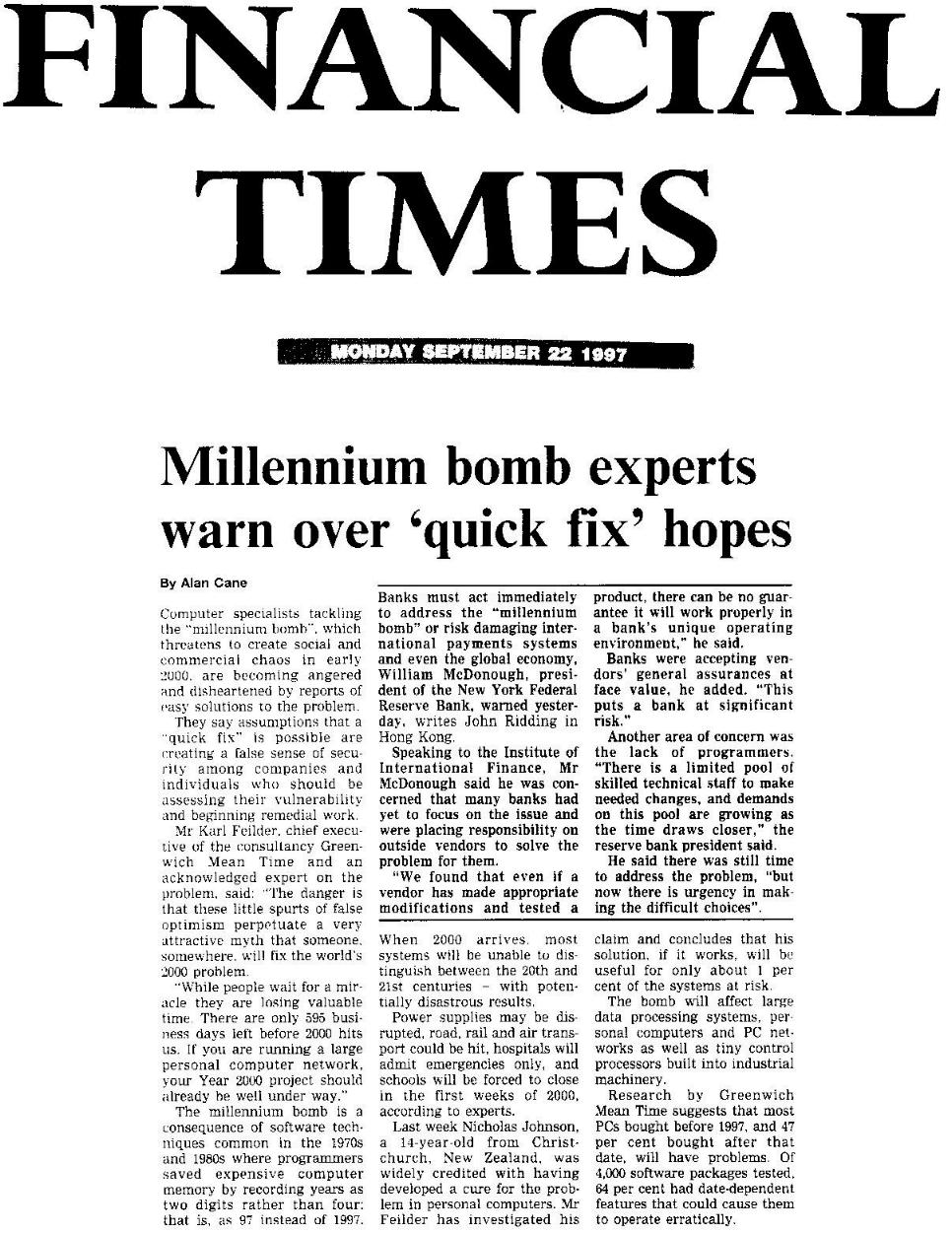
"Företagen borde överväga att byta ut system i stället för att försöka reparera dem. Det kan vara billigare".
Det är mindre än 4,5 månader kvar till årsskiftet och ändå föreslår artikelförfattaren att företagen nog borde överväga att byta ut hela system! Har han inget tidsbegrepp alls? Jag skulle vilja se det företag som lyckas göra något sådant på 4,5 månader. LONDON, Aug. 15 (UPI) - Commodity markets are living in fear of global disruption resulting from millennium bug problems that experts say won't be resolved this year because of the high cost of replacing embedded microchips. In some cases, affected institutions may find it easier to rebuild than to replace production and distribution systems, adding yet unknown costs to trading of commodities, say London commodity traders. Concern over the Y2K problem confronting the global commodity scene emerged in a World Bank report this month. A cautiously worded commentary in the bank's Global Commodities Report warned, "Regardless of whether the disruptions to occur are large or small, the anticipation of Y2K will lead to changes in consumer and producer behavior that could have significant impact on commodity markets." The consequences could include hoarding, shortages and higher prices, the bank warned. Fear of computer and embedded-chip failure has caused pundits to predict "major disruptions - even global recession," the World Banksaid. The U.N. Food and Agriculture Organization has dubbed the millennium bug "one of the most dangerous pests threatening farmers." The FAO warned in a May report that the entire food chain is vulnerable to the Y2K problem. "As we near the turn of the century, concerns will undoubtedly increase and problems will multiply," the World Bank said. The bank based its warnings on the assessment that "Y2K resembles other major events that could have catastrophic outcomes, such as war ora natural disaster." Faced with either, everyone from food and raw material processors, wholesalers and retailers to the ordinary consumer tends to stockpile. This, the bank said, may push up demand and trigger price rises, or lead producers to overproduce, creating glut conditions which in turn could cause prices to crash. |
| 1999-08-17 | Checklista för företag |
Om Du svarar 'ja' på samtliga dessa frågor kanske du inte behöver upprätta en beredskapsplan. Annars är det nog bäst att börja se över verksamheten.
|
| 1999-08-17 | 8 av 10 norska småföretag riskerar att gå under |
... och vad händer då med många större företag som är beroende av de mindre? Det här är från IDG.
Åtta av tio norska småföretag upplever driftsstörningar i samband med övergången till år 2000 om de inte påbörjar säkringen av sina system genast. Aksjon 2000 har i en undersökning gått igenom 30 småföretags 2000-förberedelser, enligt digi.no Undersökningen visar att problemen med inbäddade system är omfattande, men att det är sämst ställt med anpassningen av mjukvara. Dessutom behövde en av fem datorer bios-uppgradering före skiftet. Samma gällde telefonsystem... |
| 1999-08-15 | Israel laggar | Med ett antal fientligt inställda grannar i Mellanöstern borde israelerna vara aningens nervösa inför årsskiftet. Då kanske militären förlorar kontrollen över sitt datoriserade försvar när den israeliska regeringen samtidigt kämpar frenetiskt att bibehålla kontrollen över myndigheter och infrastruktur. |
| 1999-08-15 | Washington D.C. är sent ute, säger övervakningsmyndighet |
The District's late-starting year 2000 repair effort has
fallen behind the tight schedule set to make sure city
services do not fail on Jan. 1, a U.S. General Accounting
Office official said yesterday.
The public works, personnel, employment services and procurement departments and the University of the District of Columbia have missed deadlines to make their computers Y2K-compliant, said Ronald L. Hess, assistant director of GAO's Governmentwide and Defense Information Systems Division. Several of these "priority one" departments and other D.C. agencies also are late in preparing manual backup plans that could be used if computer systems fail. "Services are at risk," Hess said yesterday. |
| 1999-08-15 | Hong Kong fruktar y2k | Hong Kong anser att deras egna system är i ordning inför årsskiftet. Men det är absolut ingen garanti för att Hong Kong inte kommer att drabbas av problem vid årsskiftet. De har ju handelspartners... |
| 1999-08-15 | "When Will The Bubble Burst?" | Det här dokumentet kanske inte har så mycket direkt med y2k att göra, men det är ytterligare ett dokument i raden om varför aktiemarknaden idag är en bubbla. Och jag vidhåller att y2k har förutsättningar att bli en bidragande orsak till att göra marknaderna än mer nervösa. |
| 1999-08-11 | Edward Yardeni, Deutsche Bank Securities, tror fortfarande risken är ungefär 70% för en djup global recession som följd av problemen förknippade med övergången till år 2000 | Du behöver Acrobat Reader för att komma åt det länkade dokumentet. I sin senaste "Y2K Reporter" motiverar Edward Yardeni, chefsekonom för Deutsche Bank Securities i New York, varför han fortfarande håller recessionsscenariot som troligast. |
| 1999-08-10 | Finns det NÅGOT positivt i den här undersökningen från Cap Gemini America? |
Fewer than half of America's largest companies (48 percent) expect all of their critical systems to be prepared for the Year 2000, according to a new survey by Cap Gemini America, Inc., an information technology and management consulting leader.
One in five companies (18 percent) expect that 75 percent or less of their critical systems will be "completely tested and compliant" by December 31, 1999. Thirty-six percent expect between 76 and 99 percent of their applications to be ready for Year 2000, and two percent anticipate completing work on 50 percent or less of their systems. Three-quarters (75 percent) of respondents have experienced a "Year 2000-related failure," up slightly from 72 percent last quarter. Fifty-five percent reported such errors last December. The most frequent failures involved "financial miscalculation or loss" (92 percent), followed by "processing disruptions" (84 percent), "customer service problems" (38 percent) and "logistics/supply chain problems" (34 percent). Two percent reported Year 2000-related "business disruptions." Virtually every respondent (99 percent) anticipates "an increase in systems failures into the remainder of 1999 and beyond." Läs vidare följande makalösa konstaterade: ...In spite of the persistent incidence of Year 2000 failures, IT managers of the nation's largest corporations report improved performance in meeting Year 2000 deadlines. While 92 had reported increases in "milestone slippage" both in December and May, ONLY 81 percent are now experiencing an accelerated incidence of missed deadlines. "Bara" 81 procent av företagen upplever ett accelererat antal missade y2k-deadlines. "Bara"??? Skämtar artikelförfattaren eller? |
| 1999-08-10 | Chernobyl igen? |
Det här är från Computer Sweden.
2000-rädsla i Tjernobyl (1999-08-10 09:24)
Tjernobyl fruktar nämligen att millenniebuggen ska sätta igång ytterligare katastrofer vid kärnkraftverket. Därför tänker också de flesta boende i området se till att resa bort innan 20 december 1999, förutom de som varken har råd eller någon plats att resa till när vi går in i det nya millenniet. De ukrainska myndigheterna har gett invånarna rådet att förbereda sig på att även om det inte skulle uppstå ett nytt reaktorhaveri kan det mycket väl tänkas bli ett totalt strömavbrott i regionen, enligt norska CNN. |
| 1999-08-10 | Volvo famlar i mörkret |
Det är snart september, 1999. Volvo vet fortfarande inte om deras underleverantörer klarar att leverera enligt utsago. Här läser vi från Volvos hemsida om riskerna inför årsskiftet:
Risks Despite Volvo working actively to ensure that suppliers and other key partners take the necessary measures prior to the year 2000, Volvo has little control over whether such necessary action is taken in time. A conceivable scenario which could result in a substantial adverse effect on Volvo’s earnings, liquidity and financial position would be if several "just-in-time suppliers" and other important partners experience problems with deliveries to Volvo at the same time in conjunction with the millennium shift. Volvo is currently working with identifying suppliers, systems and other elements of operations which, despite preparations, could represent a risk in the transition to the year 2000. Based on the results of this inventory, contingency plans are being developed by Volvo which are scheduled to be completed in the third quarter of 1999. |
| 1999-08-10 | Att amerikanska regeringen kväver Hollywood-film om Y2K borde oroa finansmarknaden |
Om nu Y2K inte är något att oroa sig för, som den amerikanska regeringen envetet hävdar (läs: hoppas), borde det väl inte vara några problem att släppa en film med Chris O'Donnell i huvudrollen om ett tänkbart y2k-scenario? Producenten av filmen skakar på huvudet i förvåning. Det borde Du också göra.
Evidently, Washington sees a low probability of a meteor obliterating life on earth. Y2K is simply too real and imminent, and it is clear the Clinton administration is cosy enough with its Hollywood friends to do whatever it can to minimize any self-fulfilling prophecy -- which could be fuelled by films like Y2K. If Y2K really were the simple weekend storm portrayed by the Y2K-OK crowd, why would a major motion picture be scuttled a few months before its release? "It's like they don't even want to talk about Y2K," Bing Howenstein, president of George Street Pictures, the film's producer, told the Boston Globe. This decision has to raise alarm bells in the minds of the public and especially investors. When you think of the garbage Hollywood is permitted to create -- films such as Basketball Diaries or American Psycho -- which have spurred cases of copy-cat violence -- then what is it about Y2K that the U.S. government wants us not to know? This appears to be a blatant case of the Clinton/Greenspan "plunge protection team" springing into pre-emptive action. |
| 1999-08-10 | Kommer folk ihåg den här artikeln om fem månader? |
När otrevliga saker börjat hända lite varstans runt om i världen om knappt ett halvår lär de som läste denna artikel förbanna sig själva för att de faktiskt "vetat om" magnituden av vad som komma skulle...
Y2K bug in Asia poses risks for U.S. firms Silicon Valley firms have received kudos from Y2K bug watchers for their efforts to eliminate the dangers of a disaster scenario from their operations, both locally and worldwide. But that doesn't mean they'll be in the clear on New Year's Eve. LEADVital links in the manufacturing chain that feed the international production base of these high technology multinationals are at risk, analysts say, especially where component production and assembly have been farmed out to independent contractors and suppliers in Asia. Many of these developing countries are seriously out of compliance with international standards for Y2K preparedness. A survey announced by the World Bank at the beginning of the year monitoring Y2K preparedness in 139 developing countries found only 54 countries had initiated national Y2K policies, and just 21 reported concrete remedial steps to combat the millennium bug. ``This is a global problem affecting not only industrial countries which are highly dependent on computers but developing countries as well,'' warned James Bond, the World Bank official in charge of the institution's Y2K compliance program. The situation has since improved somewhat, but several key production markets in Asia -- including Malaysia, Indonesia and Thailand -- continue to lag behind in preparedness, experts say. The alarming tone taken by the World Bank and others is at odds with the tech industry's reliance on Asian suppliers. ``We have a very high degree of confidence that we won't have problems in our Asian plants,'' said Scott Allen, spokesman for chip maker Advanced Micro Devices Inc. in Sunnyvale. The reality is ``somewhere very in between,'' said Durga Ravipati, a senior engineer with IBM in San Jose who until recently spent three months a year reviewing manufacturing suppliers throughout East Asia. ``While it may end up not as scary as some people think, it's certainly not going to be trouble-free either. There might very well be some big problems.'' Indeed, Sun Microsystems Inc. CEO Scott McNealy, speaking recently at an industry conference, acknowledged that his Asian suppliers present the weak link in his Y2K-purged manufacturing supply chain. Many valley manufacturers, including AMD, have taken steps to assess and help their Asian suppliers, but ``with the way the manufacturing chain continues to proceed down the line to more anonymous sub-suppliers, there's always the potential to miss someone,'' warned David Ramsay, a principal at Manufacturing Management Associates, a consultancy headquartered in Oakbrook, Ill. Because of the inter-connectedness of high-tech manufacturing in Asia, a Y2K bug-related closure of a single facility could disrupt the supply of crucial components to the regional manufacturing base and have serious repercussions for Silicon valley companies, said Ramsey, adding that the problem could hinder production and delivery in the first quarter of the year 2000. Intel Corp. has identified Malaysia, for example, as the Asian country it thinks is in most peril of Y2K shutdowns. Although Intel is by all accounts in very good shape itself in terms of internal Y2K compliance and has safeguarded its main suppliers and distribution channels, the company is still exposed to risk overseas. Intel has put into place contingency plans, such as installing backup generators, and identified back-up suppliers at its Malaysia facilities in the event of post-New Year's Day trouble. ``We're certainly not in a position to avoid all possible scenarios,'' concedes Intel spokesman Bill Caulder. The challenge for valley manufacturers is not only to identify which of their individual suppliers are Y2K compliant, but also to assess the infrastructure readiness of an array of different countries where they rely on transportation, power and telecommunications resources. ``It's one thing to have contingency plans for stockpiling inventory or getting second source suppliers, but you still need to deal with the country status,'' said Matt Hotle, a Y2K analyst with the Gartner Group, a consulting firm in Stamford, Conn. Gartner Group rates regions within countries for Y2K preparedness, using a 0 to 5 scale -- from no compliance to a high degree of readiness. China, where many valley companies outsource manufacturing to contractors, has conspicuously low rankings; none of China's regions scored higher than a 4, which indicates that critical remedies are at best only nearing completion. ``Our questions have to do with the infrastructure issues in Asia -- power, for instance. Apparently some of those questions are issues that still need to be resolved,'' AMD's Allen said. At this macro level, even companies trumpeting their oversight of major suppliers may be debilitated by infrastructure issues. Hotle points to customs clearance procedures, which tend to be computerized in even the least advanced markets, as especially vulnerable to Y2K glitches. Y2K analysts, like economists, divide Asia into two categories. Suppliers in ``first tier'' countries, such as Japan and Taiwan, are typically large corporations with the expertise to implement Y2K remedial programs. But ``second tier'' countries, such as Malaysia, Indonesia, Thailand and, to some extent, South Korea, are considerably less resistant to Y2K problems, both at the individual factory level and the infrastructure level. ``There's a big difference whether you're talking about Singapore or China,'' said Jason Dedrick, senior research fellow at the Center for Research on Information Technology and Organizations, in Irvine. ``You can't lump Asia together. Singapore is probably more ready for Y2K than is the U.S.'' Accentuating the problem are the economic and political crises still gripping many of the newly industrialized economies in the region. Companies in countries like Indonesia, Thailand and Malaysia often do not have the financial resources or the mandate from management to initiate expensive Y2K compliance programs, Dedrick noted. The ability for valley companies to assess these various macro-regional factors is even more acute when the focus is on the nebulous realm of sub-contractors, down the supply chain from their more familiar business partners. Sometimes a letter asserting Y2K readiness is the only available test of compliance. ``There's no way to judge if someone is compliant or not,'' Ravipati said. ``They may have to go through some sort of demonstration from certification companies, but the standards are different. When you look at companies in first tier countries, they follow the same rules as we do. But companies in second tier countries really don't.'' |
| 1999-08-10 | Intressant jämförelse |
Computerworld jämför de potentiella effekterna av y2k med substansen "Ice-9" i Kurt Vonneguts bok "Cat's Cradle". Ice-9 var en substans som fick vattnet att frysa vid rumstemperatur. Det dröjde inte länge innan hela världen drabbats efter att substansen släppts ut. Jämför detta scenario med vad som händer när felaktiga data börjar korrumpera allt fler datorer, allt längre ner eller upp i distributions- och produktionskedjorna.
Enter Ice-9. In the Y2K world, the Ice-9 equivalent is the Y2K bug imported from outside your organization. Your company may be Y2K-compliant, but what about the companies with which you share data or applications? Over half the surveyed companies shared data with others, with companies in banking, finance, transportation, communications and health care particularly wired. Those aren't the industries we want to go down on Jan. 1. There is actually a quantification of the likelihood of importing Y2K problems from the outside world. Called the Beach-Oleson Pain Index, after its authors, Gary Beach (publisher of CIO magazine and former Computerworld president) and Tom Oleson (IDC's Y2K expert), it relies on the number of external connections as well as the number and type of applications connected. Large companies with complex systems environments, thousands of applications and hundreds of suppliers and business partners have the highest probability of importing problems. (They're also probably spending the most to prevent Y2K problems.) In the latest survey, the probability of the average company importing a "catastrophic" Y2K problem is less than 0.2%. And even the probability of importing a "business-critical" bug is under 5%. Most of our imported problems will simply be annoying or embarrassing. Those are pretty good odds. But there's one area the Beach-Oleson Pain Index doesn't address, and that's the geography of those external connections. From all accounts, Y2K compliance around the world varies tremendously by country. In another IDC survey of 15,000 companies in 15 countries conducted in December, only 8% of respondents in developed countries expected to miss the Jan. 1 deadline with their Y2K fixes. That number was 61% in emerging countries. Clearly, if you are sharing an application or getting a critical data feed from a power plant in Russia or a mining company in Micronesia, your "pain index" may be much higher than the average. Alas, the first survey I mentioned indicates that one of the last areas for Y2K testing is the data feeds from outside the company. Less than a third have one for testing external data feeds. Ice-9 was fiction. |
| 1999-08-10 | Utlänningar förbereder sig för "större y2k-krasch" i Vietnam |
SINGAPORE - Foreign companies in Vietnam expect major disruptions to their operations due to the year 2000 problem and are making urgent contingency plans to protect their assets over the 'millennium' period, executives said last week...
...Foreign companies have also been taking year 2000 work into their own hands. One company is vetting its entire local supply chain, with Hong Kong bank HSBC providing assessments of the local banking system's year 2000 readiness and Telstra and Alcatel SA doing the same for telecommunications systems, an executive said. A recent report prepared by Vietnam's Year 2000 Steering Committee estimated that less than 10 per cent of non-year 2000-compliant equipment countrywide has been repaired or replaced. In addition, more than 50 per cent of government agencies, cities and provinces are yet to map out year 2000 implementation plans... |
| 1999-08-09 | TechWeek: Halvledarindustrin starkt riskutsatt |
The good news: The semiconductor industry is on the rebound financially. The bad news: Y2K problems could bring fabrication plants to a grinding halt and stifle sales and available capital. A State Department survey of 161 countries found that about half of the supply chains face a medium to high risk of Y2K failures in energy, telecom and transportation sectors, the department’s inspector general said in recent Senate testimony. Asia is high on the list of chipmakers’ concerns, especially Japan, whose companies are major suppliers as well as customers for chipmakers such as Intel. "We don’t have data out of Japan that gives us a reasonable assessment of infrastructure readiness," says Intel spokesman Bill Calder. "We’ve asked our suppliers and MITI [Japan’s Ministry of International Trade and Industry], but they’re not supplying data." Japan is especially vulnerable because of its widespread automation of transportation systems, buildings, banks, telecommunications and other infrastructure facilities. A GartnerGroup study predicts many Asian companies will experience high Y2K failure rates, including 33 percent of the companies in Taiwan, Singapore and South Korea; 50 percent in Japan and Malaysia; and 66 percent in the Philippines and Indonesia. According to Credit Suisse Private Banking researchers, Y2K concerns may cause investors to pull out of the emerging markets in Asia and shift assets to less risky investment categories, Reuters reported on July 28. Some companies may reduce risk by cutting off goods, services and credit to risky countries, researchers said. "Microchip producers were seen as potential losers," the report stated. |
| 1999-08-09 | Otroligt! Fortfarande tror folk att det finns en universallösning |
...eller att någon sådan kommer att dyka upp före årsskiftet. 66% av irländska företagare tror uppenbarligen att y2k-problemet bara är hype, eftersom de fortfarande inte har rört ett finger för att åtgärda några system. De väntar på en "quick-fix". Men någon sådan kommer inte.
The survey showed that a staggering 90 per cent of Irish businesses are confident that Y2K will give them nothing to worry about. Almost two-thirds are waiting for the software industry to produce ``a silver bullet'' or some quick-fix solution. But there is no quick-fix, and time is running out. Indeed, belief in ``silver bullet solutions'' ssuggests a basic misapprehension of the nature of the Y2K problem and the threat it poses. Of the 90 per cent who think they have nothing to worry about, 52 per cent believe the millennium bug is exaggerated. Seven out of ten, in what appears to be unfounded optimism, believe their suppliers will be all right. |
| 1999-08-09 | Brittiska regeringens satsning: "Slöseri med tid" |
Sunday Times rapporterar. Robin Guenier höjer återigen rösten. Den brittiska regeringen har slösat bort både tid och pengar på att förmå de större företagen hjälpa de mindre med 2000-problemen.
ACTION 2000, the government-supported millennium bug agency, has failed in its efforts to use big companies to help small and medium-sized businesses survive the threat to computers. Robin Guenier, head of Taskforce 2000, the independent bug-buster, said Action 2000's mentoring scheme - whereby big companies hold seminars to help smaller suppliers through the bug problem - was a "waste of time". Big companies, including Thames Water and HSBC, have found the exercise worthless, with little response from suppliers invited to seminars. A Thames Water executive described a seminar last month. "Thames invited 30 or so companies to a conference on the bug and only five bothered to show," he said. "To make matters worse Action 2000, in its letter to our guests, got the start time of the conference wrong." HSBC and other leading companies have had similar disappointing responses to their events. Guenier said: "With less than five months to go to the ultimate deadline and a budget of £50m of taxpayers' money, Action 2000 has proved almost totally ineffective. Its task was to get the private sector moving and most of its initiatives, such as bug park, bug busting and the mentoring scheme, appear to be regarded as irrelevant. Its own research has shown that not nearly enough small to medium-sized enterprises, which are its principal target, are getting on with it. "Action 2000 made the mistake of trivialising this issue from the outset. Calling it a 'millennium bug' sounds nerdy, dopey and silly. It is the totally wrong image for such an important problem and prevents many people from taking it at all seriously. "Action 2000 should be concentrating on getting company bosses, of big and small groups, to treat this matter as a priority. Silly schemes such as mentoring will not get businesses through the problem." Last week Gwynneth Flower, Action 2000's managing director, said "woefully slow" preparations were putting businesses and jobs in danger, with many firms taking a negligent "wait and see" approach or holding out for an implausible last-minute solution. Almost one in three of the 190,000 firms with between 10 and 249 workers had done little or nothing to prepare for the bug. |
| 1999-08-08 | Frankrike ignorerar varning från diplomat |
En fransk diplomat stationerad i Ukraina varnade franska medborgare för att vistas i Ukraina över och efter årsskiftet på grund av millenniumproblem. Detta vill inte det franska utrikesdepartementet hålla med om. Vi får väl se vem/vilka som får rätt till slut...
PARIS, Aug 5, 1999 -- (Reuters) France on Wednesday dismissed a warning by one of its own diplomats in Kiev about the hazards posed by the millennium bug in Ukraine, where the world's worst nuclear disaster occurred at Chernobyl in 1986. The French Foreign Ministry's deputy spokesman, Francois Rivasseau, said the warning "does not correspond to the current state of thinking at the ministry". An unnamed French diplomat based in Kiev was reported as saying that French nationals should leave Ukraine before the New Year holidays because of worries tied to potential millennium computer problems. Rivasseau denied that the diplomat had mentioned a risk of a nuclear accident and said the comments had been made in jest and were misinterpreted. Rivasseau said the embassy in Kiev had issued a statement on Wednesday saying there were "no grounds at the moment to issue any security advice whatsoever" to French nationals staying in or travelling to a foreign country around the time of the New Year. Ukraine's nuclear authorities have said the millennium bug will not affect its nuclear plants because of their unsophisticated computer equipment. But independent Ukrainian nuclear power expert Serhiy Parashin has said the plants could be paralyzed. |
| 1999-08-08 | Y2K kan utlösa derivatkris på finansmarknaden |
Några ord från prudentbear.com. När man läser denna marknadskommentar bör man ha i åtanke att y2k är mindre än 5 månader bort.
As we watch a financial crisis unfold right before our eyes and hear market chatter about derivative problems and leveraged players in trouble, we just can’t shake the memory of Alan Greenspan’s speech back in March before the Futures Industry Association. He began by stating: "By far the most significant event in finance during the past decade has been the extraordinary development and expansion of financial derivatives." He continued, "A vast new array of debt, equity and hybrid instruments, as well as newly crafted derivative products have fostered an unbundling of risks, which, in turn, has enabled investors to optimize (as they see it) their portfolios of financial assets... Greenspan also threw out some facts: US commercial banks ended 1998 with outstanding derivative positions of $33 trillion, of which $29 trillion were privately arranged over-the-counter (OTC) contracts, hence, outside of government or exchange regulation. This compares to about $460 billion of total equity for the American commercial banking industry. Greenspan also estimated that total OTC derivative positions globally then likely approached $80 trillion, having grown at a 20% compound rate since 1990. According to the International Swaps and Derivative Association, outstanding interest rate swaps, currency swaps and interest rate options grew 76% last year. Estimates now have total derivative positions at over $100 trillion. And, from a report issued in June by the Bank for International Settlements, we see that there were $50 trillion of interest rate derivative contracts outstanding at year-end. Simply astounding - $50 trillion of interest rate derivatives! What on earth has been going on here? Is this actually part of effective risk management and capital allocation as claimed by Greenspan, or is this just financial "sophistication" and wild excess run completely amuck? ...it is our view that this unprecedented proliferation of derivatives has set the stage for a serious crisis, with a not insignificant possibility of a major financial accident. In this regard, it is definitely no coincidence that derivatives have proliferated simultaneously with history’s greatest period of credit excess. Instead of reducing risk, derivatives have been a close accomplice with unprecedented credit growth, creating an historic financial and economic bubble. ...Taking a quick look, and combining five of the major Wall Street firms, Goldman Sachs, Merrill Lynch, Morgan Stanley Dean Witter, Lehman Brothers, and Bear Stearns, we see that they have total assets of $1.3 trillion supported by equity of about $50 billion. And this, importantly, does not include massive off-balance sheet derivative exposure. ...And as rates rise, the larger the required shorting of securities for hedging, or reinsuring, and the greater the losses for the system as a whole. With liquidity rapidly disappearing, rising rates only leads to greater dislocation and a greater probability of a Russian-style derivative collapse. |
| 1999-08-08 | Amerikanska kärnkraftverk mycket sent ute |
Hur är det med de svenska?
A total of 22 nuclear power plants are either unprepared for possible complications due to the Year 2000 (Y2K) computer problem, or will push an October 1999 deadline to fix the problem, the head of the Nuclear Regulatory Commission (NRC) told the Senate Special Committee on the Year 2000 Technology Problem today. Of the total, six will remain unprepared for possible Y2K complications after Nov. 1, with at least three of those plants having Y2K readiness deadlines set for mid-December, according to the Nuclear Energy Institute (NEI). At least fifteen additional plants were identified to have late October deadlines, NEI also said. |
| 1999-08-08 | Stor del av London förlorade elförsörjning |
Det här talar väl ganska mycket för sig självt. En föraning om vad som kan ske efter årsskiftet, med skillnaden att det i så fall sker i betydligt större skala...
Thousands of London Electricity's pre-paying customers have been left without hot water, light, or cooked food for days, as a plan to save them from the millennium bug goes "horribly wrong". A London Electricity spokeswoman admitted: "It's all gone horribly wrong in London, due to technical problems with a piece of equipment which occurred at the weekend." |
| 1999-08-07 | IDG: 2000-problemet ger följdeffekter |
Per Larsson på IDG funderar:
Effekterna av millenniumskiftet kan få effekter som får en avstannad databas hos försäkringskassan att framstå som en bagatell. Ett scenario: ett kundföretag (KF) stämmer en leverantör (LF) på grund av att produkten de köpte på ett eller annat sätt slutat att fungera vid millenniumskiftet. Om domstolen dömer LF att ersätta KF, kommer då inte LF att hävda att det var deras underleverantör som hade producerat den felande programbiten, och måste i sin tur stämma underleverantören? Resultatet blir en cirkel av stämningar mot varandra som drar ut på tiden och ingen får ersättning. Ett tänkbart parallellt scenario är att LF vid en stämning hänvisar till kundernas försäkringsbolag som i sin tur av domstol döms att ersätta KF, vilket gör att en finanskris kan vara ett faktum. Summan av de belopp som kommer att krävas är niosiffriga och kan leda till att försäkringsbolagen går omkull, Vi vet vad som kan hända med statens finanser i en sådan situation. Å andra sidan är en möjlig utveckling att försäkringsbolagen inte ersätter sina kunder, utan stämmer LF som i sin tur svarar med att stämma sina underleverantörer som i sin tur stämmer sina underleverantörer... Än en gång är den riktiga förloraren i det här juridiska spelet Sverige som land. 2000-problemet gäller hela världen vilket gör att finansmarknaden över hela världen kan bli instabil. En ökad misstro till IT-företag ju närmare millenniumskiftet vi kommer, kan komma att ge en allmän försäljning av IT-aktier. Ett rimligt antagande är att försäljningen börjar någon gång i oktober, med börsoro till följd. Först en liten uppgång, men sedan en generell nedgång på alla världens börser. |
| 1999-08-07 | 2000-konsulter nästa hot |
Inte nog med att år 2000 är ett problem i sig självt. Nu varnar två säkerhetsexperter för att det kan finnas illasinnade
konsulter som lagt in elak kod hos de företag de arbetat för. Den elaka koden kan bestå av rutiner som stänger av ett
datasystem helt och sedan kan konsulten utöva utpressning mot företaget för att få datasystemet i drift igen.
Ett annat scenario är konsulter som lagt in funktioner som gör att de kan komma åt känslig data och sedan sälja vidare till företagets konkurrenter. Trots att företagen utför rigorösa tester av själva driftsäkerheten efter årsskiftet är det näst intill omöjligt att finna eventuella "bakdörrar" till deras datasystem. Originalartikeln finns på CNN här. |
| 1999-08-07 | Air Force Magazine sammanfattar |
Nobody knows what will happen when Y2K sweeps east across Chinese and Russian nuclear facilities. ...Deputy defense secretary John J. Hamre, the Pentagon's point man on the Y2K problem, referred to uncertainty in a press interview. "Probably one out of five days I wake up in a cold sweat, thinking [Y2K] is much bigger than we think," said Hamre, "and then the other four days, I think maybe we really are on top of it. Everything is so interconnected, it's very hard to know with any precision that we've got it fixed." ...The biggest fear is that, even in modernized nations that have been working diligently to lessen the impact of Y2K, a cascading effect will occur. In the worst-case scenario, even systems that have been meticulously tested as Y2K compliant rapidly will be infected with the Y2K bug as a result of their connection to noncompliant systems through the Internet or other networks. Further, they, in turn, will contaminate others. ...Nobody is relaxed, however. In a Pentagon press briefing, Hamre said, "My sense is that Russia is not as fully aware of the extent that [Y2K] is a problem. They don't seem to have the same level of urgency that we've had over it. ... They've got a lot of other pretty serious problems. So I think therein lies our nervousness about it." He added, "They have come to this much later. The country is going through some fairly profound changes. ... Undoubtedly, they're going to have problems that they don't anticipate right now." ...US officials are very concerned that a computer failure in Russia's interconnected power grid could cascade through the entire nuclear system and lead to a massive power outage. Such an event could easily end in catastrophe at one of the 65 Sovietmade nuclear reactors. ...Moreover, there are worries that the diesel generators designed to provide backup power at nuclear reactors in the event of a main power outage could fail as a result of problems within embedded chips. One audit of the Seabrook nuclear reactor in New Hampshire, conducted by the US Nuclear Regulatory Commission, revealed that a single nuclear power plant had 1,304 separate software items and embedded chips affected by the Y2K bug. No one believes that the Russian counterpart to the NRC has been as thorough in alerting Russian technicians to the vulnerability. Without steady electric current, the cooling systems in Russia's nuclear reactors could fail. Even if many of the reactors were successfully shut down, that would leave millions of people facing a Russian winter without heat. Far more worrisome is the prospect of meltdowns at one or more of the 65 Sovietmade nuclear reactors. An NRC report on the issue noted that, in a worst-case scenario, a total loss of power could result in problems tracking the reactor facility's status and make recovery all but impossible. Even if handled well, loss of power and cooling at the numerous waste pools where atomic fuel rods are kept could cause the water to boil away and permit the release, into the local atmosphere, of lethal levels of radioactivity. Recently loaded rods-those placed in the waste pools within the past two years-could begin to melt down within 48 hours of a loss of power. ...many technology experts have warned of the vulnerability of the Japanese banking sector. If Japanese banks crash as a result of the millennium bug, the shock could lead to a selling panic in Asia that dwarfs the Asian economic flu of the past few years. Oil refineries in Saudi Arabia and Venezuela have also been cited for their vulnerability, raising concerns about the availability of oil. Power outages could condemn countless millions of Chinese and Russians in brutal winters without power or heat and raise the prospect of a major catastrophe in the world's network of over 400 nuclear reactors. |
| 1999-08-07 | Japans premiärminister ska ju inte vara sämre... | ...får också en övervakningscentral. |
| 1999-08-07 | President Clinton får "Y2K bunker" | Det är mer än vad de flesta världsmedborgare får... |
| 1999-08-07 | U.S. State Department får kritik för kritik | För några veckor sedan klargjorde Jacquelyn Williams-Bridgers, inspector general of the U.S. State Department, inför Senatens Y2K-panel att hon trodde att Y2K kommer innebära allvarliga samhällsstörningar. Nu får State Department kritik. Av Världsbanken. De, om några, har anledning att känna oro inför millenniumskiftet. Världsbanken lever av bidrag från regeringarna. Och om regeringarna får svårigheter att betala, blir det svårt för byråkraterna i Världsbanken att behålla sina jobb... |
| 1999-08-07 | MSNBC påbörjar bevakning av "Y2K concerns" | "As the world prepares for the millennium, Y2K is on everyone’s problem-solving list. NBC affiliates bring you coverage of Y2K concerns and what you can do to protect yourself." |
| 1999-08-07 | Tanzania klart med inventeringen! | Det är snart september. Tanzania meddelar att deras företag och myndigheter har avklarat den första procenten av arbetet mot 2000-säkring - medvetenheten och inventeringen. Nu är det "bara" 99 procent kvar. I december ska en plan vara klar och så ska man, håll i er, hålla möten. Fortsätt prata bort problemen. De försvinner säkert då. |
| 1999-08-07 | Kraftbolag i USA har medvetet ljugit för myndigheter om sina 2000-framsteg |
WASHINGTON, D.C. -- Power companies
have purposely kept federal officials in the
dark about their Y2K computer bug troubles,
and one government official has expressed
serious concern upon learning of the
deception.
The Federal Emergency Management Agency is concerned that federal agencies and private industry are not anxious to admit their Y2K problems. When agency heads and private sector executives report to FEMA at Y2K planning sessions, they most often state that "all is well," according to one FEMA official. He expressed concern to learn that power companies have purposefully covered up information about their Y2K preparations. FEMA has no oversight of privately owned power companies, which would enable it to shut them down if they are not ready for the Y2K rollover. WorldNetDaily uncovered plans by the North American Electric Reliability Council to hide the truth about power companies and their true Y2K readiness. A spokesman for that organization confirmed the problems and the plans to hide the truth from the Department of Energy. |
| 1999-08-07 | Omfattande strömavbrott i Taiwan - y2k-orsakade, enligt anonym källa | Tillförlitligheten i det som framkommer i följande länk kan förstås ifrågasättas, eftersom det rör sig om ett inlägg på ett diskussionsforum. Den som vill kan ta det på allvar. Den som vill slipper. Men det är hur som helst en intressant diskussion. |
| 1999-08-07 | Kärnkraftmotståndare i USA kräver att alla kärnkraftverk stängs inför årsskiftet |
Men NRC verkar inte ge med sig i första taget...
The nuclear power industry has failed to prepare properly for the Year 2000 computer bug, according to a watchdog group, making the potential for a nuclear meltdown high. The Nuclear Information and Resource Service continues to call for the shutdown of all nuclear power plants to avoid possible Y2K computer bug problems. A recent report from the Nuclear Regulatory Commission has given critics additional reason for concern. The NRC has confirmed that at least 35 nuclear power plants are not Y2K compliant and at best could only be Y2K ready by the end of the year. ...It is also possible that global positioning satellites could fail in orbit, and some electric power plants depend on time signals from those satellites to run energy management systems. If the satellites fail the power system will fail. NERC is quick to point out that the satellites are controlled by the U.S. Government. |
| 1999-08-07 | Tragikomiskt |
För några veckor sedan sade den brittiska flygsäkerhetsmyndigheten att deras system var 100% 2000-säkrade. Men på lördag ska de göra en större ('major') 2000-uppgradering av sina system. Vilket ju direkt implicerar att de LJÖG för några veckor sedan. En brittisk minister blev "chockad" över denna information och har begärt en utredning.
The UK`s air services are about to feel the force of Y2K - just weeks after the National Air Traffic Service was given the blue light by Action 2000. NATS was given the blue light - which means it is 100% ready for the New Year following an assessment that did not identify any risk of material disruption - at the National Infrastructure Forum last month. But, y2k-news.co.uk has learned that the NATS computer is being shut down on Saturday night for a major upgrade to make it Y2K compliant, which suggests it is not 100% blue just yet. The shutdown will affect all airports in England and Wales as air traffic controllers will be forced to revert back to pen and paper, receiving information about flight arrivals and departures via radio links. This is usually handled by a IBM 9020 computer that y2k-news.co.uk understands is about 25 years old and unable to deal with the Y2K date change at present. The shutdown has come as a surprise to many MPs, who thought NATS was already Y2K ready following reassurances from the service itself and the blue light from Action 2000. ...MP John McDonell, whose constituency includes Heathrow, said he too would be writing to the deputy prime minister. "It is quite extraordinary that such a time of the year has been chosen to switch off the computer. "I am genuinely shocked about this and I fully support calls for an inquiry. "I cannot understand why this is happening in August - the high season - when there is maximum risk to safety and the highest chance of delays for passengers," he said. Air traffic controllers are also believed to be concerned about the shutdown, with one saying: "it is a big mistake. There is no margin for error in what we do". |
| 1999-08-07 | 40 procent av brittiska företag kommer att ha en "vänta-och-se"-attityd. "Självmord", säger Gwyneth Flowers |
Det här är från CNNfn.
Gwyneth Flowers, managing director of the Department of Trade and Industry-backed organisation, menar att denna attityd är livsfarlig. En miljon arbetstillfällen är direkt hotade. Med tanke på Flowers uttalanden är det hög tid att ställa sig frågan när talesmän och företrädare för myndigheter och företag ska sluta använda orden "anledning till oro" och ersätta dessa med "fara för välgrundad panik hos allmänheten"...? Nyheten är från 4 augusti. A STUBBORN "hard core" of Britain's small businesses are foolishly putting their employees and shareholders at risk by ignoring the millennium bug, Action 2000 warned yesterday. The government-backed body's latest State of the Nation report says that widespread adoption of sensible contingency plans was the best thing businesses could do to ensure they would be able to operate in the New Year. Gwynneth Flower, managing director of the Department of Trade and Industry-backed organisation, said: "The historical wait-and-see attitude of British businesses is not going to work against the millennium bug. "This shortcoming of British business could be its downfall. Our figures are cause for concern. We have been reporting our research for more than a year now and yet there is still a hard core number of companies that are adamant that they need do nothing. "This lack of perception of the risk shows a worrying short- sightedness among British managers." The report focused on small companies with between 10 and 249 employees. Of the smallest firms, 40 per cent were not doing enough work on the bug, said Ms Flower. "These 40 per cent employ around one million people. Do they really want to put not only their own, but their employees' livelihoods on the line?" she added. |
| 1999-08-07 | Det kom ett brev... |
"By the way, I am concerned about the readiness of small
businesses. In May, I was asked to attend a Y2K workshop
given in my area by my bank. There were 30 other businesses
in attendance. As the workshop facilitator went through his
presentation, he asked how many of us had done an inventory
to determine our risk for Y2K problems...chips, programs,
hardware, etc. I was the only person to raise their hand. No
one else had done any inventory activities, let alone system
upgrades, remediation activities, contingency planning, etc. I
find that staggering. All I could think of was that the other
attendees had better start some very serious continuity
planning...because they may not be in business if they don't
get going. I didn't leave the workshop feeling good at all
because I'm ready. All I could think of was the danger to our
economy because of the lack of preparation of other small
businesses."
Tror Du fortfarande att Y2K inte kommer att påverka ekonomin? |
| 1999-08-07 | En artikel som garanterar sammanbrott av världshandeln |
Den här artikeln konstaterar att risken är stor att 40% av alla företag i Asien missar deadlinen 1 januari, 2000.
Med andra ord, världshandelns sammanbrott kan mycket väl vara ett faktum i januari, 2000. Asien kommer inte att
återhämta sig ekonomiskt under år 2000. Det kommer att dröja länge.
Up to 40 percent of Asian businesses may not be ready by December 1999 to tackle the Y2K problem in computers, market research firm International Data Corp (IDC) said on Monday. "About 35 to 40 percent of businesses in Asia are expected not to be Y2K ready by December," Dane Anderson, vice-president for computing systems research, IDC (Asia/Pacific), told an industry meeting in Bangalore... |
| 1999-08-07 | Ryssland ska ha konferens om y2k-problemet i Ryssland. I oktober. | Jag vill inte vara alltför negativ... men är inte detta ungefär tre år för sent?! En rådgivande konferens.... i oktober, 1999. Jösses. Tidpunkten där 2000-problemet fortfarande kunde diskuteras passerades för länge, länge sedan. Vid det här laget borde man ha kommit igenom Sluttestfasen, EFTER Medvetenhet (där Ryssland är idag), Inventering, Reparation, Tester, samt Ny reparation. |
| 1999-08-07 | Varför gräver inte media djupare i y2k-frågan? |
Frågan ställs av David Eddy, krönikör på Westergaards site.
...Yet somehow the press is willing to accept at face value reports of Y2K project progress. Not a single reporter questions what any given organization's track record has been with on-time project delivery. Not a single reporter questions when a company says they're going to replace supply chain partners who aren't making acceptable progress. Is it feasible to replace supply chain partners? What does it take? How quickly can it be done? The press is just sitting there like a lap dog having its ears scratched. Tell me more good news. Tell me about the latest Internet IPO that sextupled on its issue date. Tell me about the wonders of the "new economy." ...So why hasn't the press been able or willing or interested in digging into the meat of the Y2K story? Please let me know if you've got any ideas because, quite frankly, I'm stumped. |
| 1999-08-07 | Utmärkt introduktionssida! Läs! | Den här sidan är en enastående introduktion till varför y2k-problemen INTE kommer att vara lösta i tid till 1 januari, 2000. Till varje argument finns länkad dokumentation. Skicka denna länk till bekanta! |
| 1999-08-07 | Dataöverföring kärnproblemet, enligt DCI |
Den här artikeln hävdar att många företag "redan" uppnått "compliance". Det är ett mycket bestridbart påstående, vill jag hävda. Men sedan säger man vidare att betydligt fler inte har kommit så långt och att många heller inte kommer att uppnå "compliance" till 1 januari, 2000. Och det kommer att ställa till problem för de företag som faktiskt själva ansett sig klara med sina 2000-problem. De "icke-klara" kommer att dra med sig de "klara" ned.
So what’s the problem? In two words: data exchange. With regard to achieving Y2K compliance, today’s technological world is divided into two segments – the “haves” and the “have nots.” Multiple layers of interdependent systems increases the potential for Y2K glitches. When the clock strikes midnight on 31 December 1999, not all computer systems will have achieved the same compliance standards – they will all be stop-clocked at varying levels of preparedness. As they continue to share information in the new millennium, the laggards could pull the leaders down with them. Y2K experts predict that data exchange issues will be a major source of Y2K worry for organizations dealing with the date change. Mary Reynolds, Chief Technology Officer for the state of Illinois, opines that even the best of compliance efforts could be hurt by faulty data or Y2K-related failures in external systems. “Some systems are completely dependent on the quality of data they get from other systems,” she says. “The real issue and real difficulty in predicting the impact of Y2K will really be those [data] exchanges.” ...Analysts warn that these levels of progress could spell trouble. “It’s no longer somebody else’s problem,” says Mark Leese, an independent Y2K consultant. “Somebody else’s problem could soon turn out to be yours.” |
| 1999-08-07 | Företagen är inte redo för Y2K... men advokaterna är det |
Under förutsättning att rättssystemet överlever övergången till år 2000 (och det får vi väl ändå förutsätta... eller?) kommer omfattande rättegångar och skadeståndsmål att fylla rättssalarna under lång tid framöver. Åtminstone i USA...
Every business and industry in the United States has companies that still have not done enough of the work needed to fix the Year 2000 computer problem, speakers at a symposium in San Francisco said yesterday. But there are more than enough lawyers primed and ready to go to handle the flood of lawsuits that are expected if Y2K failures start to appear, said Steven L. Hock, chief executive of Triaxsys Research LLC of Montana. "If you check the Web pages of major law firms in this country, (at) 99 percent of them, you'll find Y2K featured as a specialty practice area," Hock said during the opening day of a Year 2000 conference at the Fairmont Hotel. "The mere fact they are gearing up for litigation means that there will be lots of it." |
| 1999-08-07 | Presidentrådets jätterapport: Videobandspelaren slutar troligen inte att fungera | Den här rapporten är gigantisk. Bland annat kan vi läsa att videon troligen fortfarande fungerar efter årsskiftet. Bra. Undrar bara om vi har elförsörjning...? Där är rapporten inte lika glasklar. |
| 1999-08-07 | William Ulrich: "Windowing" en farlig väg |
Det finns kanske ett dussin olika sätt att angripa y2k-problemet när det gäller felaktiga datum i kod.
Det vanligaste sättet, som ca 80% av alla företag väljer, kallas Windowing. Denna teknik innebär
att man i stället för att expandera datumfältet till 8 siffror (vilket är det sätt som ALLA BORDE
använda, men som är dyrare) "lurar" datorn att tro att ett visst datum tillhör 1900-talet och ett
annat 2000-talet. En del programmerare tycker att Windowing är en kanonteknik. Andra är starkt skeptiska.
Som t ex programmeraren William Ulrich. Den här intervjun är från 10 maj, 1999.
...DJ: How does windowing work? WU: It's pretty simple. If you give me a year value that is 01, I've got a little routine that says, "Hmmm, 01 is probably in the 21st century, not the 20th century." That doesn't work for birthdates, because people span three centuries now, but it does work for things like mortgage, bond, maturity, and many other types of dates. It works also for driver's license dates, because if you're still driving you're probably under 100. In order to make this work you've got to pick something called a pivot date, a year for which you can say, "If it's past this year, then it must be this century, and if it's under this year, it must be in the next century." Most of the pivot dates right now are floating between 1930 and 1940. Some are a little older, and some come forward to 1950. This is by far the most popular solution worldwide, used more than 90 percent of the time by both governments and corporations. The problem with this solution is that it doesn't actually solve the problem. We're adding code that makes programs act like the problem has been fixed, but the problem remains. In the end all you've done is make the program more complicated than it was before. For any given program, you might have added hundreds or maybe a thousand lines of code, each line being a chance to introduce a new error. You can introduce wrong logic, you can miss a place, and you can introduce it to the wrong place. But even the possibility of adding errors isn't the worst of it. In the end I believe choosing this short-term solution to a long-term systemic problem will become one of our biggest follies, because we're going to roll into the next century with 95 percent of the data out there still using a two-character year data field. Right now we're probably sowing the seeds of our next year 2000 problem... ...A lot of dates don't have the term "date" associated with them. So to find and fix them you first have to do a lot of detective work, actually figuring out where the dates are... Any given system might have a million occurrences of a date, half of them called "date" and half of them not. And if you change one, you have to change them all. That means it's a fairly complex process to convert all of the year fields to four characters. And of course most companies and governments have not wanted to deal with the systemic problems, and so have just continued to layer patch over patch. For example, in 1994 and 1995 the big insurance companies and the financial institutions began working to fix the year 2000 problem. But they realized quickly that to change and standardize all dates from six to eight character fields would be so expensive, so time consuming, and so error prone that they would never finish. So instead they created a technique they call windowing, whereby they add logic to the program so it can approximate -- some programmers will probably get mad at me for using that term -- which century a year falls into... |
| 1999-08-07 | Märkliga faktum | Den japanska centralbanken anser inte att y2k är någon anledning till oro. Ändå trycker man upp Yen motsvarande 347 MILJARDER USD... (vilket är lika med 2,8 BILJONER KR) "...ifall det skulle bli bankpanik". Undrar om artikelförfattaren (oklart om det är denna person eller BOJ som står för denna kommentar) verkligen inser vad bankpanik innebär. Den japanska finansmarknaden kommer att kollapsa, liksom hela det globala finansiella systemet. Men det blir ännu konstigare. Man planerar testa sina system för att se om de klarar omställningen till år 2000 smärtfritt. Den 2:a januari, 2000... Hmmm... Lite väl sent, va? Och resultatet skall presenteras på webben. Vad händer om ett flertal affärskritiska system oväntat inte klarar omställningen? Hur lång tid tar det innan systemen är uppe igen? En dag? En vecka? En månad? Vad händer om aktörerna inte kan få fram nån information från webben t ex på grund av bortfall i elförsörjningen? Verkar lite ogenomtänkt... |