 BASA
WAVECAMP
BASA
WAVECAMPChamber Ride
|
Accomodations Chamber Ride Oxygen Equipment Barographs/Badges Clothing Tips PASCO Wavecamp Brochure Reno Airspace Minden Wave Windows SUA file Participants List |
The BASA
flight rules require a pilot who desires to fly above 18,000 feet in a
BASA glider to participate in the FAA / Air Force
physiological training course. This is also known as a “chamber ride”. The Chamber Ride is administered by the FAA out of Oklahoma but run by the Air Force. The closest base is Beale AFB 40 miles north of Sacramento. (405) 954-4837. The class (at Beale) starts at 7am to 4:30pm. Be certain to allow enough time to clear security at the base. Most people travel to Yuba City / Marysville the night before and stay overnight to avoid long early morning travel. For information about the physiological training course, see the FAA website at http://www.faa.gov/pilots/training/airman_education/aerospace_physiology/ , http://www.faa.gov/pilots/training/airman_education/aerospace_physiology/enrollment/index.cfm and http://www.faa.gov/pilots/training/airman_education/aerospace_physiology/enrollment/how_to/index.cfm. 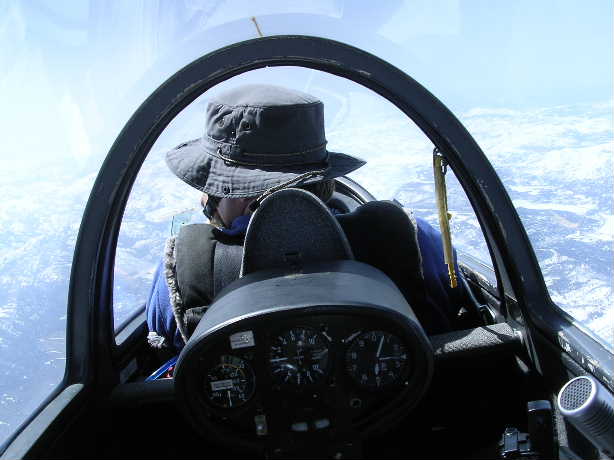 You must have a Class 3 medical before taking the chamber ride, and 2 forms of ID (e.g. CA/DL and your pilot's license). You can go to the following site to find the nearest AME for the Class 3 cert: http://ame.cami.jccbi.gov/search.asp The Chamber Rides are only conducted once a month and the registration fills up pretty early. If you did not make it in by early registration, inquire about cancellations. I was able to go pretty much last minute due to space becoming available after cancellations. Note the the BASA flight rules also stipulate the the DG1000 is limited to a max altitude of 17999 ft. Picture to the right: Richard Cramer and Hans Van Weersch in the BASA Grob103 at 25000 feet over the Sierras close to Minden Here an interesting article about the chamber ride learning from Jim Herd. Minden Soaring Club - Message Board
Physiological Training (The Altitude
Chamber Ride)
There were 5 soaring pilots at the Beale AFB (near Sacto) on 5/19/04 –
determined to get really high! (We actually saw a bunch of U2’s doing
exactly that!)For $50, you get a full day of comprehensive training on all physiological aspects, and this is a helluva deal! But be aware of strict requirements like a Class 3 medical, car insurance certificate, and no beards. This class is available to civilians about once a month, and it is usually booked up several months ahead (through FAA in Oklahoma). If you are interested, I can offer a package of details. But for now, here are some tidbits that I found rather surprising: 1. O2 bottles should be filled very slowly, over a 20 minute period – to avoid major capacity loss caused by compression heating up the gas and the bottle. 2. Nasal canulars dry the nasal cavity and saline spray should be used. 3. Pulse oximeters are an excellent tool to avoid hypoxia – be sure to stay above the 85% threshold for O2 saturation. (See report on this web site of Dr. Montejo’s presentation to MSC last year.) 4. The effect of 3 cigarettes on the lungs is roughly equivalent to an 8000 foot altitude gain. 5. Vibration can cause hyperventilation – so isolate your body from airframe vibration due to engines (or fly only a motorless glider!). 6. Some practical and usable facts for guidance about dehydration: The thirst sensation indicates you are already 1 ½ quarts low. It takes 30 minutes to digest a drink and enjoy it’s hydration effects. During exertion or stress, water loss from the body is faster than the ability to ingest new water through the small intestine. Frequent need to pee does not indicate you are “topped up” with water – but a light color of pee is a good guide. Best hydration fluid is cool water with light flavoring (e.g. Propel). The balance of flavor/hydration in Gatorade is too biased to flavor. It encourages a sensation of “full” too early. Avoid alcohol, caffeine, soda, and juice. They de-hydrate. Before exposure to dehydration you can “pre-load” with water – 3 cups 2 hours ahead, 2 cups 10 mins. ahead, ½ cup every 15 minutes, unlimited drink after. Oh, the actual chamber ride is fascinating. A real exploration into your own body. I bet it’s quite a while since you have done that! At least, in any kind of new way! It is a very formal procedure because your life may be literally at stake. And certainly, it is common for some folks to have minor difficulties. But don’t be alarmed, the military folks are very professional and close at hand. During our ride, Dave Bingham took the prize for duration unmasked at 25K’ msl, with virtually no symptoms. Yes, that old codger! (His secrets are: religious exercise, good diet, a positive outlook, a refusal to get “old”, and living at 5,000 feet msl.) It isn’t really a duration competition in the chamber, because the key objective is to experience and understand your own personal symptoms of hypoxia – they vary greatly. Only with that knowledge will you be able to recognize you are in trouble up there, before you keel over in the cockpit. Go ahead – get high while still on the ground! Jim Herd |