
|
|
|

Smart
'n Savvy Nutrition
Basic Nutrition
101
Food Guide Pyramid
Dietary Guidelines 2000
Healthy Attitude
What's Happening?
Nutrition News
Nutrition Research
Soap Box Topics
Nutty NutriQuiz
Grandma Nibbles' Food Facts
Dieter's
Survey
Self Assessment
BMI
Calories Running
Discussion Forums
Just
for Fun-
Games
The
Food Guide Pyramid
Yours to use!
(Page
two of a three page article)
There are five major food groups represented in the Food Guide Pyramid. Each group provides some, but not all, of the vitamins, minerals, and other nutrients we need each day. (remember: variety, moderation and balance) The shape of the pyramid demonstrates a part of it's recommendations; that is, consume more from the larger-base- part of the pyramid and less from the upper-top- portion. Research has shown that the largest portion of our diet should be from grains, cereals, breads, fruits and vegetables. The Pyramid emphasizes intake of a higher percentage of these foods over the dairy and meat groups that form a smaller proportion of the pyramid.
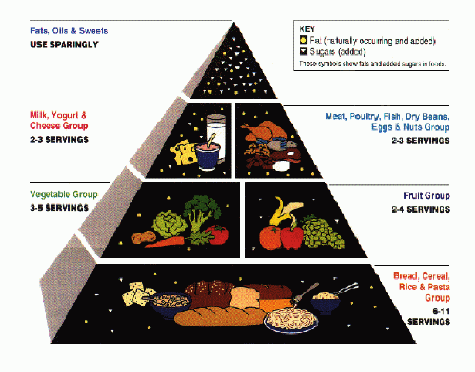 |
| ««««Click on each section to go to a list of foods in that group. »»»» |
Remembering that the Food Guide Pyramid is for healthy people, the number of servings that you need from each group depends on your own individual needs and circumstances. For example; if you're trying to lose weight--- eat the smaller number of servings from each group; and also choose leaner, lower fat foods, especially when it comes to the dairy and meat/meat alternative group. If your goal is to gain weight, then aim for the larger number of servings. For a more specific recommendation, you need to know how many calories you need each day to meet your own individual nutrition needs. Follow this link to estimate what this calorie amount is for you.
Below is a table that should give you some general information of how many servings from each group is needed for three calorie levels. These levels are not specific for any one individual. You have your own nutritional needs that need to be calculated based on your own medical history, height, age, sex, and how active you are. These are only rough guidelines for the population as a whole.
|
WHERE
DO YOU STAND? |
|||
|---|---|---|---|
| Milk, Yogurt & Cheese Group² | |||
| Meat & Meat Alternatives Group | |||
| Vegetable Group | |||
| Fruit Group | |||
| Bread, Cereal, Rice & Pasta Group | |||
| Total Fat (grams)³ | |||
| Total added Sugars (teaspoons) |
6 |
12 |
18 |
-
¹These calorie levels are dependent on how lean your food choices are within each group. Intake of high fat foods may cause this number as well as the fats and sugars numbers to increase substantially.. ²Pregnant or Breastfeeding women, teenagers, and young adults to age 24, need 3 servings at least (or additional calcium from alternative sources). ³The lower number is 20% of daily calories from fat; the higher number is 30%. For those concerned with prevention of heart disease as well as other illnesses, a good goal would be to get down to 20% by making wise choices within each group.. In addition, the values for fat and added sugars include those in the five food groups plus those in the fats, oils and sweets group. ***Some women who are pregnant or breastfeeding may need more calories than this. - Sources: U.S. Department of Agriculture, U.S. Department of Health and Human Services
The above guidelines tell you how many servings you should have for different calorie amounts. So, just how large a serving size is becomes the next important question. If Jack is told to eat only 2 servings of meat or alternative a day and he chooses a steak about 8 oz from a local restaurant as one of his servings, how do you think he did?
Our friend Jack would have actually gotten more like three servings of meat in just that one meal! And if he continued to eat portions that large, he would, in all likelihood be increasing saturated fat and cholesterol and calories in his diet to the "danger" point.
Below in a brief summary of some of the common serving sizes recommended in the Food Guide Pyramid:( Each example tells you how much you should have for one serving from that group.
Food Group |
Serving sizes |
| Milk, Yogurt, Cheese | 1
cup ( 8 oz.) of Milk or Yogurt 1 1/2 ounces of natural cheese 2 ounces of process cheese |
| Meat, Poultry, Fish, Dry Beans, Eggs, Nuts | 2-3 ounces
of cooked lean meat, poultry or fish (about the size of
a deck of cards or the palm of a woman's hand) 1/2 cup cooked dry beans 1 egg or two tablespoons of peanut butter count as 1 ounce of lean meat |
| Vegetable Group | 1 cup raw
leafy vegetables 1/2 cup other vegetables, cooked or chopped raw 3/4 cup of vegetable juice |
| Fruit Group | 1 medium
apple, banana, orange 1/2 cup chopped, cooked or canned fruit 3/4 cup fruit juice |
| Bread, Cereal, Rice & Pasta | 1 slice
bread 1 ounce ready-to-eat cereal 1/2 cup cooked cereal, rice, pasta |
Source: U.S. Department of Agriculture; Department of Health and Human Services
If you are familiar with the diabetic food exchanges and portion sizes you will notice some differences between the two recommendations. Since they are created for different populations, they are not the same! For example, starchy vegetables like potatoes, corn and peas are grouped with vegetables instead of breads, cereals and other grain products.
There are also subgroups within the major food groups. These emphasize foods that are very good sources of things like dietary fiber, and certain vitamins and minerals that are particularly low in diets of many Americans. The Pyramid recommends increased consumption of foods in these subgroups. Examples include dark-green leafy vegetables, legumes, and whole grain bread and cereal products.
The creators of the Pyramid also have classified different forms of certain foods in different groups. Sweet corn is in the vegetable group, while popcorn and cornmeal products such as corn tortillas are counted in the bread, cereal and grain group. Hominy is a starchy vegetable, but Hominy grits are a grain product.
Foods such as cakes, cookies, ice cream, french fried potatoes and such are counted in the food group of their major ingredient. It is strongly recommended, however, that use of foods such as these with high fat and/or sugar content be limited to keep total fat intake to the recommended level. On the other hand, foods that are predominantly fat or added sugars, such as butter, jams, jellies, and even cream cheese, are grouped with fats, oils and sweets at the top of the Pyramid.
Another unique aspect of the Pyramid is the location of dry beans, and legumes. These can count either as a meat alternative or as a starchy vegetable, because they are good sources of protein and other nutrients like iron and zinc from the meat group, but also are high in carbohydrates and good sources of vitamins, minerals and dietary fiber. The Food Guide Pyramid suggests including them in your diet as a vegetable several times a week. To clarify which foods go where, see the breakdown at this link.
Don't be discouraged if you eat a little different from the "average" American. There are many different versions of the Food Guide Pyramid. For links and information on alternative eating styles, including Vegetarian, continue by checking out this link.(Page 3 of 3 page article)