














___________
View/Sign my
Guestbook
___________
E-Mail Me
AIM: Dogasu
- Network pulls popular kids' show
Brilliantly flashing scenes blamed for causing convulsions

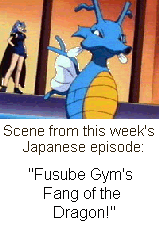
This is a television scene from the popular cartoon show
"Pokemon," which caused hundreds of Japanese children to go into epilepsy-like
seizures. The children were taken to hospitals after watching the
TV Tokyo broadcast.
By BRAVEN SMILLIE
Associated Press
TOKYO--A TV network canceled broadcasts of a popular action-packed cartoon show Wednesday and a rental chain yanked video versions from its shelves because of brilliantly flashing scenes blamed for causing convulsions, spasms or nausea in hundreds of children.
Nearly 600 children were rushed to hospitals Tuesday night after watching the program "Pokemon." By Wednesday evening, the number of afflicted children climbed to more than 700 after others watched videotaped versions of the show.
The case had many wondering: Is Japanese animation too intense for children?
"Kids don't watch this program the way most people watch TV," said Toshio Okada, a writer specializing in animation and comic books. "You can't take your eyes off it without missing crucial visual clues about the meaning of the action."
Japanese cartoons over the past eight years have developed unforgiving packages of fast-paced action that require intense concentration to be understood, Okada said. And children watch it all on increasingly large TV screens from less than a yard away--typical viewing style in Japan's cramped homes.
"I was shocked to see my daughter lose consciousness," Yukiko Iwasaki was quoted as saying by the national newspaper Yomiuri. "She started to breathe only when I hit her on the back."
TV Tokyo canceled the airing of "Pokemon"--which means "pocket monsters"--on 30 stations around Japan on Wednesday.
National broadcaster NHK said 729 people had been taken to hospitals by late Wednesday; about 200 remained hospitalized.
The first victims had been watching the program separately at homes all over Japan, and doctors and psychologists discussing the illnesses on national television did not suggest contagious mass hysteria.
The second wave of seizures among children watching videotapes led a video rental chain to pull the series from its 940 stores.
Dr. Philip Sheridan, chief of the epilepsy branch of the National Institute of Neurological Disorders and Stroke in Bethesda, MD., said the children's reactions could have two quite different causes.
Some children may have started to hyperventilate from the excitement and the flashing lights, he said. That can cause dizziness, nausea and fainting. This kind of problem often spreads in groups of children as they see each other having trouble, Sheridan said.
In other children, the flashing lights might have acted directly on the brain to cause seizures, he said. An affected child would momentarily stare and not respond even to shouting, or have a stiffening of the body with jerking arms and legs for up to a minute. That would happen if the flashing disrupted the natural pacemakers that regulate patterns of activity in the brains' circuits, he said.
Such brief seizures do not damage the brain and do not mean a child has epilepsy, Sheridan stressed. Epilepsy is repeated seizures without provocation, rather than a reaction to something like flashing lights or a high fever, he said.
The illness has been linked to a scene featuring a vividely colored explosion mixed with a few seconds of rhythmic strobe-like light flashing bursts of blue, red and white, each one about one-thirtieth of a second long.
That type of mind-bending scene is no rarity in Japanese cartoons. Program producer Takemoto Mori said similar visual effects are featured widely in other animtion and frequently in "Pokemon."
"During editing, that particualar portion didn't call my attention or bother me," Mori said. "I'm really sorry that the kids got sick watching their favorite cartoon."
"Pokemon" has been broadcast on 37 TV stations nationwide since April and has the highest ratings in the Tokyo area for its 6:30 p.m. slot. The weekly show is based on characters in a game produced by Nintendo Co.
Several years ago, a handful of teen-agers suffered seizures while playing video games sold by Nintendo CO. The company now attaches a warning that epilepsy-like symptoms can be triggered by the games.
Kyoichi Sato, a spokesman for the Post and Telecommunications Ministry, which oversees TV and radio broadcasting, said officials are investigating, but it could lead to new programming guidelines.
Pocket Monsters was not created by me. It was created by Satoshi Tajiri and the crew at TV-Tokyo. Pokemon is (c) Game Freak, Nintendo, 4Kids Productions, Hasbro, Bandai, and a ton of other companies. When you have a popular anime like Pokemon, lots of people own it so it's impossible to list every company who owns a piece of Pokemon. No infringement of copyrights is meant by the creation of the web site. All images were gotten from official websites (Nintendo, TV-Tokyo, etc.) unless otherwise noted (I don't steal images from other sites!).