|
Money
The State
Bank of India (first floor) near Lal Darwaja and the Bank of
Baroda, at the west end of Relief Road, have money-changing
facilities. For quicker money changing, try either Green
Channel Travel Serivces (+91 79 656489) - the local
representatives for American Express - or Wall Street Finances
(+91 79 6426682), both on C G Road, close to Mirch Masala
Restaurant. The Bank of Baroda on Ashram Road can give
cash advances on Visa cards, while HDFC ATM on Ashram Road,
Navrangpura, Naranpura, Satellite, Gurukul Road, Ambawadi etc
services Visa, MasterCArd and Cirrus.
E-Mail and
Internet Access
The best
connections are at Interscape Cyber Cafe (+91 79 6404134; espey@interscapeworld.com)
which open 24 hours. It's on the first floor of the
large while building called white house opposite the Standard
Chartered Grindlays Bank on Pachwati circle; it costs Rs. 30
per hour. Another good option is itbaag.com Cyber Cafe
(+91 79 6585873, itbaag@itbaag.com),
close to the tourist office on Ashram Road. It csots Rs.
25 per hour. Apart from these there are several other
Cyber cafes and Internet Access Centers. They generally
cost Rs. 15 to 30 per hour. And one can easily find them
at every cross roads.
Bookshops
Crosswords,
in the Shree Krishna Complex at Mithakali Six Roads, has a
wide range of books, plus CDs, maps and a coffee shop.
It's open from 10.30am to 8.30pm daily. It also has
branch in Maninagar. The other good options are
Book-Shelf (At C G Road) and Natraj Book Store (At Ashram
Road).
Don't have enough
time to visit Crosswords in Ahmedabad. Don't worry visit
Amazon.com,
just now. And buy books for your Indian Trip.
Medical
Services & Emergency
The Civil
hospital (+91 79 2123721) is around 2.5 km north of the
Ahmedabad Railway station. The other option is
V.S.Hospital on Ashram Road. These two are government
run hospitals. You can also find lot of good private
hospitals in Ahmedabad. For ambulance call 102.
Bhadra
Fort & Teen Darwaja
Bhadra Fort
was built by the city's founder, Ahmed Shah, in 1411 and later
named after the goddess Bhadra, an incarnation of Kali.
It now houses government offices, where you can ask for access
to the roof for views of the surrounding streets. There
is a post office in the former Palace of Azam Khan, within the
fort. Some of the bastions inside the fort fell during
recent earthquake, although the overall structure remains
intact. To the east of the fort stands the Teen Darwaja
(triple gateway), from which sultan watched processions from
the palace to the Jama Masjid. It too, was damaged by
the tremors - at least one of the balconies collapsed.
Mosques
& Mousoleums
The Jama
Masjid, built in 1423 by Ahmed Shah, is beside Mahatma Gandhi
Road, to the east of the Teen Darwaja. Although 260
columns support the roof, the two "shaking minarets"
lost half their height in the great earthquake of 1819, and
another tremor in 1957 completed their demolition.
Sadly, the earthquake of 2001 also took its toll with
significant cracks appearing in the domes and pillars.
Much of the mosque was built using items salvaged from
demolished Hindu and Jain temples.
The Tomb of
Ahmed Shah stands just outside the east gate of the Jama
Musjid. It was built shortly after his death in
1442. His son and grandson also have their cenotaphs in
this tomb. Women are not allowed into the central
chamber. Across the street on a raised platform is the
tomb of his queens, which is now a market and is in very poor
shape compared to his own tomb.
Dating from
1414, Ahmed Shah's Mosque was one of the earliest mosques in
the city and was probably built on the site of a Hindu
temple. It is to the south-west of the Bhadra
Fort. The front of the mosque is now a garden.
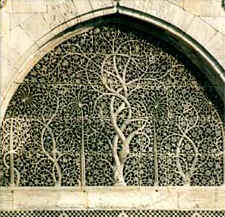
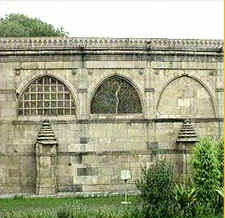
Sidi Saiyad's
Mosque is close to the river end of Relief Road. It was
constructed in 1573 by Sidi Saiyad, a slave of Ahmed Shah, and
has beautiful carved stone windows depicting the intricate intertwining
of the branches of a tree. These can be viewed from
outside (women can't enter).
A little
north of the city center, Rani Rupmati's Mosque was built
between 1430 and 1440 and was named after the sultan's Hindu
wife. the minarets were partially brought down by the
great earthquake of 1819. Note the way the dome is elevated
to allow light in around its base. As with so many of
Ahmedabad's early mosques, this one displays elements of both
Hindu and Islamic design.
The small
Rani Sipri's Mosque, south east of the city, is known as the
Masjid-e-Nagira (Jewel of a Mosque) because of its extremely
graceful and well-executed design. Its slender minarets
again blend Hindu and Islamic styles. The mosque is said
to have been commissioned in 1514 by a wife of Sultan Mahmud
Begada after the latter executed their son for some minor misdemeanor
- she is also buried here.
Just south of
the train station, outside the Sarangpur Gate, the Sidi Bashir
Mosque is famed for its jhulta minars or shaking
minarets. It was believed that they were built to shake
in order to protect against earthquake damage.
This
technique didn't save the shaking minarets of the Raj Babri
Mosque, southeast of the train station in the suburb of
Gomtipur. One was partially dismantled by an inquisitive
Englishman in an unsuccessful attempt to find out how it
worked. They were rebuilt only to collapse again in
January, 2001 when the tremors proved too much.
Undaunted, the city authorities are planning to rebuild the
minarets.
Temples
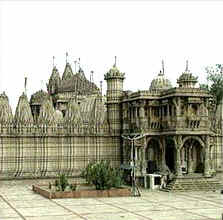
Just outside
the Delhi Gate, to the north of the old city, the Hathe Singh
Temple, as with so many Jain temples, is made of white
marble. Built in 1848, it is dedicated to Dharamanath,
the 15th Jain tirthankar (teacher).
For a
complete change, you could plunge into the narrow streets of
the old part of town and seek out the brightly painted, wood
carved Swami Narayan Temple. Enclosed in a large
countryard, it dates from 1850.
Baolis
(Step-wells)
Baolis
(Step-wells) are strange constructions that are unique to
northern India, and Dada Hari Wav is one of the best.
Built in 1501 by a woman of Sultan Begara's harem, it has a
series of steps leading down to lower platforms terminating at
a small octagonal well. The depths of the well are cool,
even on the hottest day, and it must once have been quite
beautiful. Today, it is completely neglected and often
bone dry, but it's a fascinatingly eerie place with galleries
above the well and a small portico at ground level.
The best time
to visit and photograph the well is between 10 and 11 am; at
other times the sun doesn't penetrate to the various
levels. Entry is free. AMTS Bus no. 111 to Asarwa
goes nearby.
Mata
Bhavani's Well is about 200m north of Dada Hari's. Ask
children to show you the way. Thought to be several
hundred years older, it is much less ornate and is now used as
a simple Hindu temple.
Museums
The City
Museum (+91 79 6578369), just west of the Sardar Bridge, is
well-orgainzed exhibition of all aspects of Ahmedabad's
history with sections on each of the city's religious
communities, Gujarati literature and the independence
struggle. There are some fine photos, examples of local
contemporary art as well as beautiful textiles and
carvings. This excellent museum is open 11 am to 8 pm
Tuesday to Sunday and entrance is free. On the ground
floor is the Kite Museum (which has the same opening hours and
is also free).
The Calico
Museum of Textiles (+91 79 7868172) exhibits antique and
mordern textiles including rare tapestries, wall hangings and
costumes. Also on display are various old weaving
machines. The museum is in Sarabhai House, a former haveli
(mansion) in the Shahi Bagh Gardens, about 4.5 km north of
the city. You can only enter on one of the free guided
tours which depart at 10.30 am and 2.45 pm. The museum
is closed on Wednesday and photography is not allowed.
To get there, take bus no. 101, 102 or 105, out through Delhi
Gate. An auto rickshaw should cost Rs. 30.
The Lalbhai
Dalpatbhai Museum (+91 79 6306883), on University Road near
Gujarat University, houses a fine collection of stone, marble
and wood carvings from around India, bronzes, cloth paintings
and coins. Among the sculptures is the oldest known
carved image of the God, Rama, a sandstone carving from Madhya
Pradesh dating from the 6th centruy AD.
On the same
campus is the N C Mehta Gallery (+91 79 6302463, ext. 31)
which contains an important collection of illustrated
manuscripts and miniatures from all over the country. It
is particularly known for its Chaurapanchasika (the
Fifty Love Lyrics of a Thief). These are attributed to
Vilhana, an 11th-century Kashmiri poet who was sentenced to
hang for loving the kind's daughter. Just before his
execution he composed the poems and so impressed the king that
he gave his daughter to Vilhana in marriage. There are
also some Rajashthani miniatures from the Mewar, Bundi, Kota
and Bikaner schools. Both museums are free and open from
10.30 am to 5.30 pm (closed Monday). In summer , the
hours are sometimes changed to 8 am to 1 pm, so ring before
heading out there.
The Shreyas
Folk Museum, about 2.5 km west of the Sabarmati river in the
suburb of Ambawadi, displays the folk arts and crafts of
Gujarat, particularly textiles and clothing. It's open 9
am to noon and 3 to 5 pm Thursday to Tuesday. Take AMTS
bus no. 34 or 200.
Sabarmati
Ashram
About 5 km
from the center of town, on the west bank of the Sabarmati
River, this ashram (also known as Satyagraha Ashram) was
Gandhi's headquarters during the long struggle for Indian Independence.
The ashram was founded in 1915 and moved to its current site a
few years later. It was from here, on 12 March 1930, the
Gandhi set out on his famous Salt March to the Gulf of Cambay
in protest against government monopolies over the production
and sale of salt, vowing not to return to the ashram until India
was free. Handicrafts, handmade paper and spinning
wheels are still produced on the site. Gandhi's spartan
living quarters are preserved as a small museum and there's an
excellent pictorial record of the major events in his
life. There is also a bookshop selling books by and bout
the Mahatma and the library contains the letter sent by
Gandhiji to Hitler on 23 July 1939 asking him to pull back
from war.
The ashram is
open from 8.30 am to 6 pm (to 7 pm between April and
September). Admission is free. There is
sound-and-light show (65 minutes, Rs. 5) at 7 pm (in Gujarati;
daily) and 8.30 pm (in English on Sunday, Wednesday and
Friday; in Hindi on other nights). the booking office
(+91 79 7556073) opens from 2 pm. Bus no. 81, 83/1 or
84/1 will take you there. An auto rickshaw will cost
about Rs. 25.
|