
 |
 |
 |
 |
 |

| Home CRM | Ch1 Retention | CRM Webcasts | Ch2 BI |
| Ch3 On Demand | Ch4 ABM | Ch5 Opinion | Ch6 Hospitality |
| Ch7 Automotive | Appendix | CRM MAGAZINES |
|
||||||||||||||||
| Please read the Introduction of CRM first | ||||||||||||||||||||||||||
| CHAPTER [7] AUTOMOTIVE EXAMPLES
[1] 
Manufacturing and marketing cars used to be relatively
straightforward: Now more than ever the automotive industry is looking for opportunities to speed innovation, shorten product lifecycles, reduce costs, and collaborate with new partners...all on a global basis. Consultants must deliver leading vehicle capabilities in strategy, operations and technology to OEMs, suppliers, systems integrators, dealer groups and aftermarket retailers through in depth knowledge of all sides of the market. They must provide leading edge thinking supported with exclusive research, proprietary automotive databases, global benchmarks and best practices. Almost anyone who has been following the auto industry, especially in the U.S., will agree that lately it has had a bumpy ride. For one thing, the difficulties of GM and Ford have filled the headlines for several months now, and there has been lots of speculation about how severe these problems are. As a recent example, the auto parts maker Delphi, which was spun off from GM in 1999, was in the midst of bankruptcy proceedings and actively negotiating with both the United Auto Workers union and GM. Yet another challenge is growing global competition: Virtually all the Japanese brands are showing an increase in market share in the U.S. And finally, questions continue to persist about advances in technology, especially as they concern the new hybrid models. The turmoil and uncertainty among auto manufacturers and their suppliers have left people wondering when a shakeout can be expected. Experts who follow the auto sector say consolidation will take place among suppliers to a much greater extent than among carmakers, which may not experience mergers and acquisitions at all in the near term but will be engaged in ever-shifting strategic alliances and joint ventures. Now, more than ever, customer relationship management (CRM) is a critical component of any successful business operation. A key goal of CRM is to create a truly customer-centric approach –one that empowers the enterprise and its ecosystem to orchestrate all employees, partners, and resources so that they focus on delivering visibility and value around customers. Another goal is to enable a dynamic enterprise to seamlessly and quickly perceive, adapt, and respond – before its competitors – to changing market conditions, customer needs, and opportunities. For an enterprise to be successful, it needs a CRM solution that delivers more than just efficiencies from the automation of transactions and interactions. The solution must also support every customer interaction intrinsic to a customer life cycle and intuitively provide employees with clear customer information relevant to role and responsibility. Integration into current systems is also key to leveraging existing IT investments and supporting collaborative processes across suppliers and partners. Customer Relationship Management solutions provides
today’s market-leading companies with everything they need to become
customer-centric enterprises. CRM processes are not limited to just the front office. They also provide – out of the box – the seamless incorporation of tasks in supply chain, financials, and human resources – across departmental boundaries and to your customers and partners.
Faced with the increasingly complex and competitive environment that characterizes the automotive industry – with challenges ranging from tighter profit margins to new entrants in the new vehicle and aftermarket service business – original equipment manufacturers (OEMs) and dealers are turning more aggressively to customer relationship management (CRM) to help attract new customers, increase brand loyalty, reduce costs, increase efficiency, and maintain a competitive advantage.
Acting on these imperatives is hampered by the reality that heterogeneous systems preclude a single view of the customer or vehicle, resulting in a poor understanding of customer preferences, higher costs, decreased responsiveness, and eroding brand equity. A single, integrated solution can help connect disparate sources of relevant data and lead to a better understanding of the automotive customer and to improved implementation and execution of the processes involved in serving that customer.
Car distribution.
A study of Volvo cars owners examined the links
between customer satisfaction with three attributes – car purchase,
workshop service and the vehicle itself – and loyalty and
dealer
business performance. The results indicated that a one scale-point Increasingly, many brand owners are leveraging partners to drive revenue and meet customer demands. In fact, partner-generated revenues now account for a growing share of total brand owner revenues. Many industry segments drive significantly more than 40 percent of revenue through the partner channel. The Automotive industry, for example, sells as much as 90 percent of products through indirect channels. As competition intensifies and globalization continues, the use of partnering will only continue to increase, helping brand owners increase revenue and profits, decrease costs, and enhance customer satisfaction and loyalty. In a survey conducted by Accenture, approximately 82 percent of executives believed alliances would be a prime vehicle for future growth. The same study predicted that by late 2004, the average company would derive 16 to 25 percent of shareholder value from partnerships, representing between US$25 trillion and US$40 trillion. As former General Electric CEO Jack Welch has observed, “If you think you can go it alone in today’s global economy, you are highly mistaken.” The expanding role of partnering in today’s business environment brings with it a new set of opportunities and challenges. Accordingly we need to examine these facets of business partnering and identifies the key business benefits of enabling a partner value network by deploying a comprehensive partner relationship management (PRM) strategy.
|
||||||||||||||||||||||||||
 Registration Required
Customer Success GuideThis comprehensive reference guide shows how customers of all sizes are benefiting from mySAP CRM. Read the guide (PDF, 21 MB). Our Server
Now, more than ever, customer relationship management (CRM) is a
critical component of any successful business operation. A key goal
of CRM is to create a truly customer-centric approach –one that
empowers the enterprise and its ecosystem to orchestrate
all employees, partners, and resources so that they
focus on delivering visibility and value around customers.
Another goal is to enable a dynamic enterprise to seamlessly and
quickly perceive, adapt, and respond – before its
competitors – to changing market conditions, customer needs,
and opportunities. For an enterprise to be successful, it needs a
CRM solution that delivers more than just efficiencies from the
automation of transactions and interactions. The solution must also
support every customer interaction intrinsic to a customer life cycle
and intuitively provide employees with clear customer information
relevant to role and responsibility. Integration into current
systems is also key to leveraging existing IT investments and
supporting collaborative processes across suppliers and partners.
|

Automotive -- Sales and service organizations gain support for channel management as well as brand and customer management.
Explore how companies in the automotive industry are achieving their customer satisfaction goals with mySAP CRM:
As part of the family of SAP CRM on-demand solutions, the SAP Sales on-demand solution and SAP Marketing on-demand solution, and the SAP Service on-demand solution are available globally today.
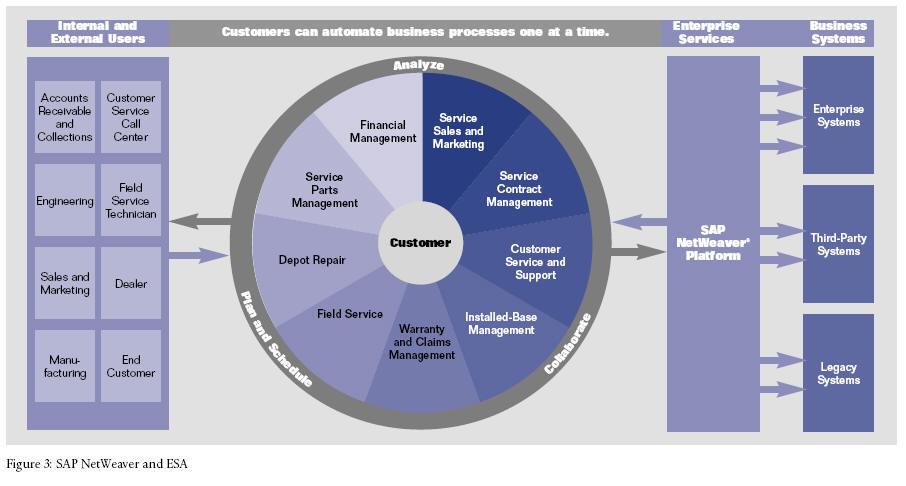
With the SAP NetWeaver platform, you can align IT with business requirements. SAP combines composition technologies and application functionality to reduce IT complexity and increase business flexibility. With SAP NetWeaver, you can compose applications using enterprise services, orchestrate business processes and events, manage enterprise information, and deliver applications and content to users more quickly and cost-effectively.
Read an overview of the SAP NetWeaver platform (PDF, 682 KB). Our Server
SAP NetWeaver COMPONENTS
SAP NetWeaver means you get a single platform with all
components synchronized into a single package. It means
one installation process, one integrated platform, and
one resource to turn to when you need support.
SAP NetWeaver is provided as a general-purpose platform.
Its capabilities are delivered by the following components:
• SAP Enterprise Portal provides a complete portal
infrastructure along with knowledge management and
collaboration software.
• SAP Business Intelligence makes information
actionable by helping companies identify, integrate,
and analyze disparate business data from heterogeneous
sources.
• SAP Master Data Management is the foundation
for providing harmonized, consistent information to
heterogeneous applications across the enterprise.
• SAP Exchange Infrastructure provides open integration
technologies that support process-centric
collaboration among SAP and non-SAP components
both within and beyond enterprise boundaries.
• SAP Mobile Infrastructure supports multichannel
access through voice and mobile technology, so people
can stay connected to the information they need, offline
or online.
• SAP Auto-ID Infrastructure provides a complete
auto-ID middleware solution. It connects radio
frequency identification (RFID) data directly from
auto-ID data capture sources, such as RFID readers,
and integrates the data directly into enterprise
applications.
• SAP Web Application Server is a development and
deployment platform that supports Web services,
business applications, and standards-based development
based on key technologies such as J2EE
and ABAP™.
SAP NetWeaver also includes the following tools:
• SAP Solution Manager provides centralized management
for all stages of the software life cycle, from design
to development, deployment, implementation, versioning
and testing, and ongoing operations.
• SAP Composite Application Framework provides the
environment for building composite applications and
comprises design tools, methodologies, services and
processes, an abstraction layer for objects, and user
interface patterns.
• SAP NetWeaver Developer Studio enables a model driven
development methodology for building professional
Web user interfaces.
Flexible, Step-by-Step Approach
By implementing crucial IT practices with SAP NetWeaver, you can address your immediate IT needs first, then expand your practice projects over time within a sustainable cost structure. The SAP NetWeaver platform enables:See the complete list of IT practices.
With the SAP NetWeaver platform, your organization can implement crucial IT practices in a flexible, step-by-step approach at low cost. You can address your immediate IT needs first and, since the platform components are tightly integrated, you can expand your practice projects over time within a sustainable cost structure.
SAP NetWeaver enables the following IT practices. For each practice, SAP NetWeaver supports a variety of key IT activities -- all of which are easy to perform using the platform's integrated components.
Experience firsthand the features, functionality, and benefits of mySAP Customer Relationship Management (mySAP CRM). These brief, user-friendly demos show how mySAP CRM performs in a real-world environment:
Complaint Handling for Logistics Service Providers
Discover how mySAP Customer Relationship Management allows you to
aggregate customer information from disparate systems, integrate
processes to improve customer service, resolve customer problems in real
time, and provide services that enhance customer relationships.
Watch the demo.
-- Log-in required.
mySAP CRM: Improving Order Management
Find out how mySAP CRM enables your sales staff to create sales orders,
check product availability in real-time, and change orders on-the-fly --
so you can drive effective sales processes, respond to changing customer
needs, and achieve a faster time to value.
Watch the demo.
-- Log-in required.

Need Registration
Automotive Applications as a whole
|
CUSTOMER SPOTLIGHT
Toyota relies on Oracle for vehicle order management and to power its finance transformation
Ford Motor Company establishes global accounting processes with a single database with Oracle's PeopleSoft Enterprise products (PDF)
The Business Benefits of CRM by Oracle Our Server
Learn how you can reduce the cost of acquiring, selling to, marketing and serving customers. Enhance revenue by increasing sales per representative, sales per customer, average order size, and other revenue driving metrics. See the quantitative results from 10 companies who improved their business using CRM.
For the automotive industry, it's not enough just to survive today's volatile economy—you need to create a decisive competitive advantage. Oracle helps OEMs accelerate build-to-order and rapidly develop vehicles, and also helps suppliers achieve continuous cost reduction and improve delivery execution.
|
Oracle / Siebel Files Automotive
|
|
|
|


 |


The 2006 Market Leaders, Part 1
They say that timing makes
champions. These eight winners in as many categories
(plus up-and-comers in our One to Watch boxes) prove the
adage as they join more than a score of industry leaders
in a year of opportunity-making industry changes.
Click here to view the Market Leaders chart. Our Server
Click here to read Part 2.
| SAP | NetSuite | Maximizer Software Inc. | RightNow Technologies | Amdocs ClarifyCRM |
| SAS Institute Inc. | Aprimo | Business Objects | NCR Teradata | Unica Corporation |
CRM Buyer Guide
Use this directory to find and research the leading CRM technology and service providers.
|
Virtual Motorshow Visit the virtual Mercedes-Benz stand at the Middle East Motorshow.
|
|
||||||||||||||||


