














___________
View/Sign
my
Guestbook
___________
E-Mail Me
AIM: Dogasu
Episode Stats:
Japanese Episode 32: "Sekichiku Ninja Taiketsu!" ("Sekichiku Ninja
Battle!")
American Episode 32: "The Ninja Poke-Showdown!"
Pokemon Dare Da? Konpan
Japanese Air Date: November 4th, 1997
American Air Date: October 20th, 1998
Important Characters: Kyou (Koga), Aya (Aya)
Important Places: Sekichiku Gym (Fuchsia Gym)
Satoshi and the gang are resting while looking for the Sekichiku Gym. As they're resting, a mysterious figure spies on them...it's a Konpan!
Satoshi and the gang are back on the road, trying to pass a steep chasm by crossing a log. They reach the gym, which looks like a ninja mansion. After finding a few secret doors, the gang sees a Konpan. The Konpan runs off and Kasumi thinks it wants them to follow it, so Satoshi follows. Satoshi is running when he is suddenly electrocuted. He thinks Pikachu did it, but he was really shocked by a Biriridama. Satoshi gets back on the trail again, but he runs into an invisible wall. Then another. Then a wall caves in on Satoshi. Satoshi starts yet again to chase after Konpan. Soon, Satoshi is attacked by throwing stars! Soon, a female ninja clad in pink reveals herself as the one who threw the throwing stars and challenges Satoshi to a battle. Aya uses a Konpan while Satoshi uses Fushigidane, but Fushigidane easily wins by using its leach seed technique. Unable to battle, Satoshi wins! Then another ninja, Kyou, enters and reveals himself as the Sekichiku Gym Leader.
Meanwhile, the Rocket Dan plan to raid the mansion and steal all the poison pokemon.
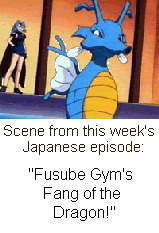
Kyou sends out a Konpan (one that has a lot more experience) and Satoshi uses Pijyon. Before the battle can begin, Konpan evolves into Morufuon. It uses its sleep powder to put Pijyon to sleep, so Hitokage comes out next. Before they can begin their battle, the Rocket Dan intrude, wearing Kabuki kimono! Musashi and Kojirou have trouble moving around in the kimono, so they lose the outfits and attack. Kojirou shoots webbing out of his hand and snags Satoshi's Hitokage, Kyou's Morufuon, and Aya's Konpan. Then Musashi shoots webs out of her hands to catch Pikachu. Kasumi calls out Starmii, but Koduck comes out. She decides to use it in battle, but its attacks prove to be pathetic and ineffective. Kyou releases a bunch of Biriridama from the ceiling to use against the Rocket Dan, but they catch all the electric pokemon with their webbing.
Now the room starts to slant (in order to confuse Kyou's enemies). Satoshi and the others are unable to free their pokemon from the webbing, so Koduck is the only one who can fight. Kojirou wonders if they should steal Koduck as well, but Nyasu refuses to catch it and whacks it. Koduck is upset as its headache is getting worse. Then its eyes start to glow, and it uses some of its most powerful attacks: disable and confusion. The Rocket Dan are psychically thrown out of the gym! Koduck then uses its powers to dissolve the webbing on Pikachu and Hitokage. Now that the Rocket Dan are gone, Kyou and Satoshi decides to finish their match.
Kyou sends out Golbat while Satoshi uses Hitokage. Golbat uses its screech attack and Hitokage retaliates by using its flamethrower attack. Hitokage finishes the battle with its fire spin, and Golbat is defeated! Kyou gives Satoshi the Pink Badge and Satoshi and the gang walk off as Kasumi congratulates Koduck.
Nothing really was changed in this episode, but it is worthwhile to give you a little background information to Musashi and Kojirou's kabuki appearance. The first paragraph here will give a brief history of kabuki (I promise not to make it boring!) and the next will relate kabuki directly to Musashi and Kojirou's scene.
A brief history of kabuki theatre! Kabuki started around the late 16th-century. The plays were began with merchants who had acquired great wealth but could not advance socially because they were stuck in their "commoner" class. So they produced these kabuki plays to make themselves more prominent in the commoner class (if you can't go up, become the best at where you are). The plays are usually taken from a variety of sources: jidai-mono (historical dramas, which tell of the adventures of noble warriors and such), sewa-mono (domestic dramas which tell of commoners), plays adapted from noh and kyogen dramas (the little comic relief plays between noh plays), and plays adapted (sometimes verbatim) from the puppet theater (which had a person on the left narrate and say the dialogue while the puppets mimed out the performance-in Kabuki, the actors themselves spoke the dialogue). Then there are plays made soley for kabuki plays, but they are few compared to the other kinds. Music is very important as it sets the mood. The actors usually say their dialogue to a song-like rhythm. Emphasis is placed on gestures, as almost every gesture is accompanied by a sound effect and has signifigance in the play-a wrong gesture could ruin the meaning of the entire play. Kabuki actors are usually prepped from the time they start school, and many families pass down the job from generation to generation (as many as fifteen or sixteen generations).
-So what about Musashi and Kojirou's appearance. This time the curtains are the right colors (see Episode 31) and are drawn from the side (see? didn't I tell you?).
-The music effects in the background (underneath the usual Rocket Dan theme) is a combination of the wooden clappers and shamisen (a three-stringed instrument used in most kabuki plays).
-Musashi and Kojirou's outfits are traditional kabuki outfits, but technically Musashi should not be included in the scene. You see in the early days of kabuki, women usually played the parts. But when they called attention from young men in the audience, it was decided kabuki plays would be taken more seriously if women were excluded, so in 1629 a ban was put on women in kabuki theatre. For the female parts in the plays, men would do the parts of the females and would be known as onnagata. The ban was finally lifted about 250 years later, but by that time the onnagata had become so important and such an intregal part in kabuki theatre that there was no parts for women. Musashi could have been in a real kabuki play, but she most likely would have been played by an onnagata instead.
-When Musashi and Kojirou cross their eyes during their motto, they're doing a technique of kabuki known as mie. During a climatic part of the play, kabuki actors will pause momentarily, assume a picturesque pose, stare out into the audience, and cross their eyes.
That pretty much covers it. That's a lot of notes for just thirty
seconds of an episode. Hopefully the next time you see this episode
you'll notice some of these historical references.
| Previous Episode |
Pocket Monsters was not created by me. It was created by Satoshi Tajiri and the crew at TV-Tokyo. Pokemon is (c) Game Freak, Nintendo, 4Kids Productions, Hasbro, Bandai, and a ton of other companies. When you have a popular anime like Pokemon, lots of people own it so it's impossible to list every company who owns a piece of Pokemon. No infringement of copyrights is meant by the creation of the web site. All images were gotten from official websites (Nintendo, TV-Tokyo, etc.) unless otherwise noted (I don't steal images from other sites!).