The first classifications of the variations of the romany were carried out among the years 1872 and 1881 by Miklosich, but this was made of agreement with the most recent data and, then, the lexical levels coming from loans and the own etimological appeared mingled. Later on this improved (Ventzel (1964)), but none of two received a lot of attention. The classification that it has let later formulations has been of Gilliat-Smith (1915-1916). This distinguishes, in a first moment, among" Vlax varieties", strongly influenced by the Rumanian, and the "varieties non Vlax" that do not show so much influence for the Rumanian. The speakers of the Vlax varieties, among those are the
Kalderash and the
Lovara , arrived from Asia to what is today Romania (the first documents that are about their arrival are dated in the 1382 [Wala-chia]). In Wala-chia and in Moldavia they lived until the beginning of the second half of the XIX century. These varieties are characterized by the centralized vowels and for its sufix forms, among other things. Are also important its shortened forms (/ -kro / instead of / -kero /…). Also, the varieties
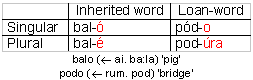
Vlax have specific classes of nominal inflection for the Rumanian's borrowed names; the inherited words are also distinguished of the word-loan by means of marks of accentuation:
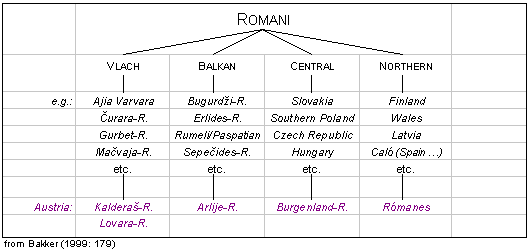
The Vlax group is important in all the new classifications (refers to Hancock 1988) and, consequently, it has been included in the classification by Bakker/Matras (1998) or for Bakker (1999), that he has been the author of the following classification:
Neglecting, of a side, the fact that those
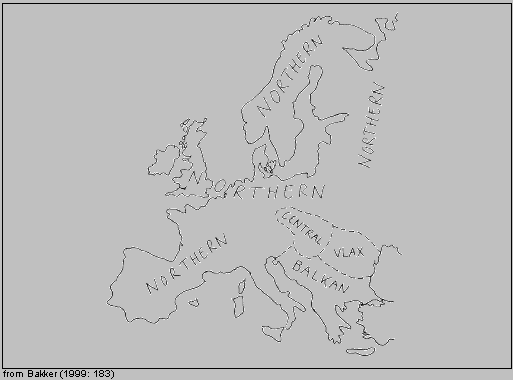
Vlax groups have begun to extend in the second half of the XIX century for Europe and, in the other side, the foreign emigration of groups of Vlax as well as those balkan groups , the four groups of variations are distributed inside Europe like it continues:
Although in this development the position of Bakker is continued, a shade must be added to the outline of this, and it is the possibility / necessity to divide that that he calls like "Northern Group" in two: the northern (welsh romany (United Kingdom); kalo-finnish romany (Finland); baltorromany (Poland)) and the western (caló: France, Portugal, Spain).
The classification of the romany language in groups of varieties is based on the following approaches (according to Bakker (1999: 179-181)):
Common innovations inside the group . Like sample of this, and being opposed to the other three groups, the vocalism of the first person of the singular of the verb to be it has changed in the group Vlax: seem: hom / som "I am". Another distinctive approach is the term for "others": vaver in the northern romany; aver in the rest of the groups.
Lexical and grammatical particularities . The verb xacer ("to burn"), for example, as lexical peculiarity, it can only be in the northern varieties. Also, in this group the appearance of a particle that it introduces the direct style highlights, that it would be inside the grammatical peculiarities .
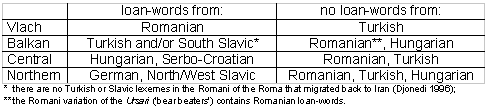
Linguistic contact: Actions on the word-loan and the existence or not of this type of recent words in the groups of varieties:
This group is relatively homogeneous, guaranteed by the fact that the speakers of the different varieties of this group can understand themself. Thanks to that this group is very extended for all Europe and to the commitment of these with the problems of the civil rights and political, the use of a pseudo general Vlax-romaní is extending". This could end up working like a norm in an international-political level in the future.
The homogeneity of the mentioned group only allows a subclasification in western and southern Vlax, under these the individual varieties are grouped.
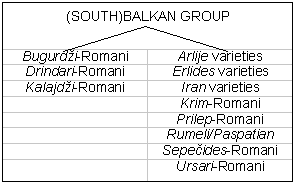
The balkan varieties are spoken, in general, in the central and south places of The Balkans: Albania, Bulgary, Greece, Macedonia, Moldova, Romania, Kosovo, Turkey and in the south of Serbia. Some names of the individuals varieties, used by the own speakers and related with professions, are Xoraxane Roma (the roma turkish), Arlije ("¿?"), Erlides, Bugurdzi ("makers of drills"), Kalajdzi, Sepecides ("weavers of baskets")...
Boretzky (1999)summarize the balkan varieties under the term "balkan dialects of the south" and - due to the common legitimate changes, among other things - he distinguishes the Bugurdzi / Drindari / Kalajdzi of the other ones: the varieties of Romani of Iran, Rumeli like Paspati has called them (1870); the varieties of Erlides extended for Bulgary ; Ursari-Romany, spoken in
Romania and Moldova; Krim-Romany, the variety of
Sepecides that it resides in Volos
(Greece ); Izmir, Turkey, Arlije-Romany, the biggest dialect with quite different varieties", in Macedonia and
Kosovo (Boretzky 1999: 22); and the variety of romany spoken in Prilep,
Kosovo .
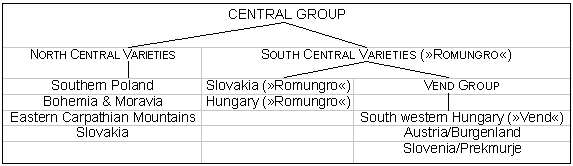
Boretzky (1999, 1999a) also distinguishes two subgroups inside the central group: the central-northern variety and the central-southern one. The distinctive factor is Hungarian's strong influence on the central-southern varieties. Then, these are called "hungarian-romany dialects" or "Romungro" and its speakers, " romungríes " (both terms are pejorative). The division of the central-southern group in the Hungarian and Slovak varieties, of one hand, and the "group Vend", of another hand, it is something problematic at the moment and it should be re-formulate (probably, the Hungarian varieties can be subdivided even more).
A similar situation is given in the central-northern varieties; also in this case it is a geographical classification, a mere inscription of the areas where varieties of central-northern Romaní are spoken. There is a lack of extensive investigations, these would allow a detailed classification. In many cases this group is diluted in the other big groups.
Being opposed to the groups Vlax and Balkan, there is not any name of variety that relates to the specific professions with the speakers of the central varieties. For this reason (as it has already been suggested) geographical terms are used to differ among the two groups of varieties.
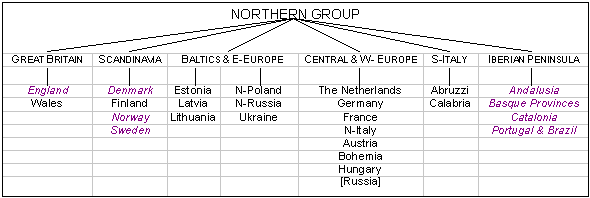
Geographically it is a very extended group for all Europe. The varieties romany northern are a very heterogeneous group whose connections have always been under the point of aim of the re-formulations and the critics. Inside this group, and following Boretzky (1992a, 1998) and to Bakker (1999), they can be distinguished six different subgroups, according to its geographical distribution:
Those called "romany para-varieties" has also been marked with purple color in the graph. These are non standard varieties that are conformed by the grammar characteristic of the majority language of the country together with a very rich lexicon in romany words. An example is the called anglo-romany, English's variety with vocabulary romany, or the spanish caló , a variety of Spanish with lexical romany. In opposition to these para-varieties, in United Kingdom is another northern variety, the welsh-romany, considered as a full variety of romaní spoken until today (Grant 1998: 165f). The only full variety in the Scandinavian subgroup is the finnish variety. The varieties of Sweden, Norway and
Denmark are all romany "para-varieties ".
The Baltic varieties, such as the Latvia, are very closely related with the northern european varieties of the Est of the Russian Xaladitka-Rome and to the romany variety Polska-Rome described by Matras (1999). We can establish a bridge among the continuous of the central and northem varieties starting from the union of this variety (Latvia) and the central-northern varieties of the South of Poland (Bergitka-Rome), they form a link. The Ukrainian variety, belonging also to the group european-baltic oriental of northern romany, has been described by Barannikov (1934).
The bigger and wider subgroup among the northern varieties is the central-western european variety, called Sinte group -Manuš. All the varieties of romany of this subgroup are not only determined by German in the lexical level, but rather also in its grammatical structures. Geographically, the group embraces the countries german-speakers and its more immediate neighbors: Netherlands,
France , Italy , Slovenia,
Hungary , Bohemian. Those
Sinte that live in
Russia they also call themselves Esterajxara, that points to the Austrian origins. The same arguments can be sustained for the Estrekari of Italy , that can be clearly differentiated, in linguistic terms, of the Sinte Piemontese. The groups that reside in
France they call themselves to themselves Manuš.
Among the groups settled down in
Netherlands, Germany and
Austria , a distinction has been made among the Sinte Gadžkane, the German Sinte and the Sinte-Lalere that it immigrated of Bohemian. In Austria, the Lalere also called themselves Sinti-Bemtike ("Bohemian Sinti"). The Sinte that live in Hungary , as well as in Eslovenia and other countries of the old Yugoslavia , probably immigrated also from or crossing Austria .
Inside the term"
Northem Group ", it is necessary to include two western / southern subgroups wich make be in danger the own name of the group.Some people recommend to separate them to part: the subgroup Iberian and the subgroup formed by the South area of Italy.
Inside the Iberian subgroup, that only contains "para-varieties ", the basque varieties are differentiated (Errumantxela), described by Bakker in 1991, and the caló. The caló is a variety of Andalusian-Spanish or Catalan-Spanish with romany elements lexical. Due to the emigration from the Iberian Peninsula and the deportation of the iberian Rom, the Portuguese and brazilian caló varieties can still exist.
In conclusion, a feature common of the northern varieties should be mentioned: in contrast with the use in the other three groups of variations, in the northern varieties the term Rom is not used by the gipsies for calling to themselves. The terms Sinte, Manuš, Romanicel, Romanó and Kaló/Caló or its plural Kalé/Calé generally work here as the denomination forms. These forms, however, will not be found in the other three groups of varieties.