|
The Theory of the Time-Energy Relationship: A Scientific Treatise |
PART I
MODERN PHYSICS
1
INTRODUCTION TO PART I
I remember a statement in the introduction of Steven Hawking's book, A Brief History of Time, in which someone informed him that, for every equation you put into a book, you cut your readership in half. In response to that, he put only one equation in it, which was Einstein's famous energy equation
E = mc²
(1.1)He said he figured that since it was such a familiar equation, he could safely insert it without scaring too many people away. I am not so concerned about selling books; I am concerned about scaring readers away. Unfortunately, in order to keep this book useful to as many people as possible, I must include a small number of equations.
My response to the problem of scaring readers away is my promise that every equation will be completely explained or will not need to be understood. The result of this is that you, the reader, will not need to understand the equation itself to understand the underlying concepts, but simply what it means.
In a large group of randomly selected individuals representing the general population in this country, you will find a few individuals who know something about physics. You may also find one or two individuals who know a lot about it. Then you will see the remainder, the vast majority, who know absolutely nothing about it. This is not the crowd I intend to deal with. Since I cannot teach physics, in this book, from the ground up, I must expect at least some knowledge of physics from most of the people who read it.
The fact that you are reading this book now indicates to me that, because of your interest in the subject, you probably do have some knowledge of physics to begin with and I am not dealing with a "blank slate" as I would have with a general readership.
It has been a large task for me to develop this popular version. If you are not familiar with the Theory of Relativity or Quantum Mechanics, you need not be too concerned since I have explained, in simple terms, as much as one will need to know in order to understand the ideas presented here. But since there are so many old (and contemporary) theories, most people need to be brought up to speed on them so that the new theory presented here will make sense.
I am certain that, at the mere mention of the word physics, many readers are ready to drop this book and run for the nearest fallout shelter. The last thing I want to do is scare people away from physics. As a physics tutor at my hometown university, I constantly ran into this attitude among my students. Many of those who came to me for assistance with their physics classes were absolutely terrified of physics. For lack of anything better to say, I was usually very quick to explain to them that they actually had nothing to fear.
Their response was typical, "That's easy for you to say, you're a physicist! This stuff is easy for you." This was a natural response and one that I welcomed. You see, physics is not easy for me, either. But the reason for that response came out of a conversation with another physicist and, coincidentally, a good friend of mine by the name of Ed Cerasuolo.
We were taking a walk around campus one evening, and Ed began to explain to me how we, as a society, had placed the so-called "hard sciences" out of reach of the so-called "average person." This sort of thinking had come out of the 1950's role of the scientist in Hollywood movies as an out-of-reach, barely understandable "superbrain" whose accomplishments and knowledge were far beyond the reach of "ordinary mortals."

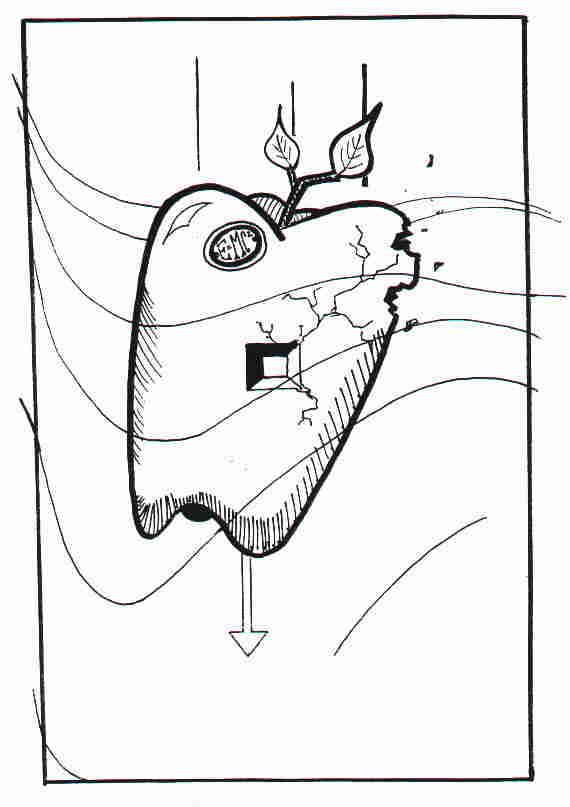
Figure 1.1
Bob and Ed discuss the ways of the world while strolling (or sitting) around the campus, drinking sodas and smoking cigarettes. Here, Bob expresses his opinion about some of Ed's ideasNo, he did not blame the Hollywood movie makers for all our ills in this regard. They were simply reacting to a social stigma which had grown out of many of the most recent scientific discoveries. Brilliant scientists, such as Albert Einstein and Niels Bohr, were seen as "typical," and if you were not one of them you would not be able to understand science. The people in Hollywood merely made it "common knowledge" that, "science is hard, and only the chosen few can understand it (so don't try)."
"So what's your point, Ed?" I asked, getting only this far after several hours of intellectual wrangling. And his point was simple and correct; Not everyone can do physics, but everyone can understand physics. Admittedly, I did not agree with his argument at first (hence, several hours of intellectual wrangling), but after having considered the success rate that I had with many of my own students, I realized that he was right.
Most of my students were not afraid of physics; they were simply afraid of the name "Physics." They had been raised on the notion that physics was a "hard science" and that they would never be able to understand it. Many of my students were so worried about it that they would put off their college physics requirements to the very end. "This is my last semester in college-if I pass this physics class I can graduate," is a comment familiar to my ears. I have often run into previous students and, having asked them, found that, for them, the subject was not as difficult as they thought it would be.
Unfortunately, physics professors are also partly to blame for this attitude. Many students getting back their first exam in a physics class, having received a score of 50%, are quick to get to the registrar's office and withdraw from the course, not realizing that this grade is probably a C. Even in graduate school, there is a tendency among physics professors to make exams virtually impossible to pass. Naturally, this tendency helps to reaffirm the typical student's notion that the understanding of physics is beyond his reach.
Some Dogs Bark, Some Dogs Bite
As with almost any situation, however, there are dogs that bark and dogs that bite. There are a rare few professors who will assign the grade of F for a score of 50%, failing more than half the class. I refer to this type of class as a blood-bath, and they do exist. Those are the professors who will cause some students to change majors or even quit college entirely. Students do so not realizing that they could very likely pass the course simply by taking it over with a different professor.
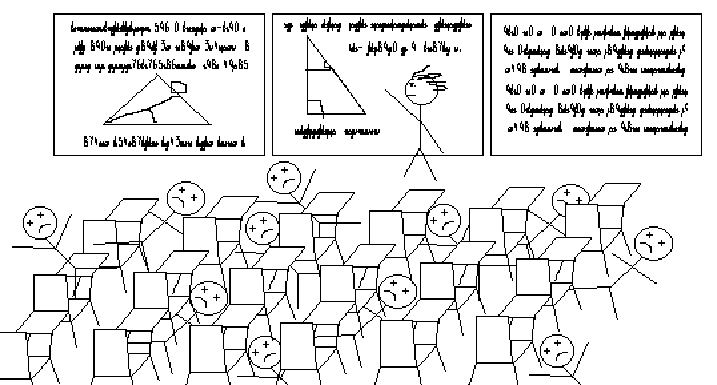
Figure 1.2
Some dogs bark and some dogs bite. The students of this professor of physics are caught in a bloodbath.I once suggested to a friend that most of the people who graduate from college are the ones who manage to avoid (either by accident or by other means) the "rough-grading" professors. This, of course, suggests that getting a college degree, for most students, is partially a matter of luck and only partially a matter of skill.
At any rate, my own story is similar to others who ran from physics. In 1976 I came out of military service and decided to go to college. As a young person during middle and high-school, my desire had been to study physics and eventually earn a degree in it. When the time came to choose a career, I shied away from physics and selected engineering instead, doing so with the firm belief that the other physics students were far brighter than I was and there was no way that I would be able to compete with them to pass the classes or earn even a bachelors degree.
I paid for that mistake by having to return to college ten years later, unhappy as an engineer, and earn the degree that I had wanted in the first place. But the most amazing thing I found when I got there was that the other physics students were not the "brainiacs" I had earlier made them out to be-they were just as confused as I was!
So, if you believe that you are not smart enough to understand physics, then you have been fooled like me. But I also believe that if you really understand a subject, then you should be able to explain it to anyone. If you cannot, then you do not truly understand the subject. I did not come up with that one, but I wish I had. This one is mine, though; "Knowledge is knowing what big words mean in terms of little words." So, in this book, I will use a lot of big words, but I will also explain them in terms of little words.
Home Begin Preface Acknowledgements Contents Chapter 1 Chapter 2 Chapter 3 Chapter 4 Chapter 5 Chapter 6 Chapter 7 Chapter 8 Chapter 9 Chapter 10 Chapter 11 Chapter 12 Chapter 13 Chapter 14 Chapter 15 Chapter 16 Chapter 17 Chapter 18 Appendix A Appendix B1 Appendix B2 Appendix C1 Appendix C2 Appendix D Appendix E Appendix F Appendix G General References Future Books About the Front Cover About the Author Index