
|
The Theory of the Time-Energy Relationship: A Scientific Treatise |
6
QUARK THEORY
This chapter relates directly to some of the most theoretical particles ever proposed. Even today, many scientists are skeptical about the existence of quarks (including myself). As a result, I will only brush lightly over this material.
Talk today runs around quarks, gluons, bosons, weak and strong forces, electroweak forces, mesons, force mediators, multiple dimensions, superstrings, cosmic strings, ring theory and et cetera. Sometimes it could drive a person crazy just trying to keep up with any particular field of research and discovery. An even more difficult task is to find up-to-date material on any of these subjects.
In the most recent list I have been able to lay my hands on, I have counted well over a hundred different "known" particles, not including the quarks which consist of six "flavors," six "anti-flavors," three "colors," and, of course, three more "anti-colors," making a total of (12 x 6 =) 72 (this number is actually incorrect for reasons concerning the Pauli Exclusionary Principle) particles in addition to the hundred or so mentioned above.
Quarks are a lot like "Bigfoot". They have never actually been "seen," and are only believed to exist because of their "footprints." In actuality however, almost all other particles we know about have only been "seen" as a result of their "footprints," so quarks we really only suspect exist because we are seeing the "shadows of their footprints," which makes them even more theoretical.
This is due to the nature of our present-day means of detecting "loose" particles-that is-lone particles which by one means or another, have been pried loose from other particles or created by combining pairs of other loose particles.
Usually ordinary particles like electrons and protons or even extraordinary particles like positrons and anti-protons, are first separated from their "parent" atoms or particles and then accelerated to very high velocities (near c-the speed of light). After they are accelerated to a sufficiently high velocity they are smashed into other things (usually each other). Accelerating these particles to very high velocities gives them very high energies, i.e. very high masses, which conform to an offshoot of Einstein's energy equation
E =
γmc² (6.1)Where γ is the gamma factor from Lorentz's Equation (Eq. 2.1) due to relativistic effects.
These experiments usually take place in very large and expensive facilities such as SLAC (Stanford Linear Acceleration Center) in California, Fermi Labs (Fermi National Accelerator Laboratory) outside of Chicago, or CERN (European Center for Nuclear Research), in Geneva. There are of course, several other such laboratories throughout the world, but these are the ones most people might be familiar with.
However, for all of their fabulous and expensive machinery, each and every one of these facilities has two major limitations:
1) They can only ever accelerate charged particles and
2) They can only ever detect charged particles.
There is one exception to this; they can also detect photons, which are typically described as "uncharged" particles (respecting the discussion of such in previous chapters)-but so can the human eye. But since photons already "move" at the "speed of light" (again, respecting previous discussions), they cannot be accelerated.
There are several ways to accelerate an object or a particle:
1) You can push it or pull it (physically),
2) You can magnetize it and place it in a magnetic field (thereby pushing or pulling it),
3) You can place it in a gravitational field (pulling it only) or,
4) You can charge it and place it in an electric field (pushing and/or pulling it-depending on how
you look at it).
The first option is out of the question since the technology for physically pushing things up to near-light-speed simply does not exist, presently.
Use of the second option must imply that an object can be magnetized (is a magnetic material such as iron or tin) and then "held" in line (or in a large circle) while it is accelerated. While technology certainly exists for such an experiment, we are fantastically limited by the forces that would be needed to keep an object going in a circle (trying to accelerate it in a straight line would require much too large a distance to make it economically feasible).
For the third option, we are limited to whatever gravitational field might be available to us-in this case, the earth's, which is far too feeble to give an object any serious velocity.
This leaves us with the only choice available-to accelerate charged particles in an electric field. Chances are that you own and have in your home a linear particle accelerator, which most people refer to as a T.V. set.
Your T.V. Set-A Particle Accelerator
Every modern-day television set (excluding the LCD [Liquid Crystal Display] types) has within it a device called a Cathode Ray Tube (CRT), one end of which is the screen that you watch. The other end (which is the end that sticks out of the back of the T.V. set-producing a "hump" in the back of the encasement) contains a heating filament and a (mildly) radioactive source.
Heating the filament allows electrons (charged particles) to be ejected into an electric field of about +six volts, on a surrounding charged plate, causing the electrons to accelerate toward the viewing screen into a higher voltage field (about 15 volts). This, again, causes the electrons to move into an even higher electric field, accelerating them even more. This goes on several times until electrons are accelerated to a sufficient velocity that they will be attracted to the positive 15 Kv (15 kilovolt-15 thousand volt) grid near the T.V. screen.
When they strike the screen, they give off their kinetic (motional) energy to a phosphorescent material on the inside surface of the screen which reacts by giving off photons (light).
Charged plates inside the CRT direct the beam of electrons to the correct place on the T.V. screen and magnetic field coils on the outside of the CRT help to control the focus and orientation of the picture.
If you have a black and white T.V. set, it will have only one cathode ray gun in the back of the CRT. But if you have a color T.V., there will be three; one each of red, green and blue (black is no colors, and white is all three). The color of the gun is determined by how much initial kinetic energy is given to the electrons leaving it. Figure 6.1 shows a (rough) diagram of the innards of a typical T.V. CRT.
Figure 6.1
The Cathode Ray Tube is part of an ordinary T.V. set, but is also a linear particle accelerator.The point of this discussion is to help understand some of the problems associated with experimental particle physics. In order to accelerate particles to very high velocities, there must first be a source from which to get particles. Secondly, particles intended to be accelerated and detected must have a charge.
Electrons carry a negative charge (e- or -1.6 x 10- 19 Coulombs-the most commonly accepted unit of electric charge) and are fairly light and, as such, are easy to accelerate. Because they are light (low mass) particles, the energy they acquire is not as great as it would be for heavier particles with the same velocities. Positrons are almost the same as electrons except that they have a positive charge (e+) rather than negative. The main reason for using positrons is that experimentalists can get electrons and positrons going in opposite directions to each other (in a large circle) and smash them into each other to see what happens.
Protons also have a positive charge (p+) but are about 1836 times heavier than electrons, and so are a little more difficult to accelerate, requiring much more energy to do so. These are easily acquired simply by stripping away the electrons from hydrogen atoms. Hydrogen atoms usually have one proton and one electron, although a very few will have both a proton and a neutron for a nucleus- this is called deuterium or "heavy hydrogen." Even fewer still however, may have a proton and two neutrons-called tritium, which is very rare indeed! Particle accelerator physicists are not typically interested in deuterium or tritium since they are generally only useful in the construction of hydrogen bombs.
Anti-protons are a little more difficult to produce and the process itself is tedious and difficult. These have about the same mass as a proton but are negatively charged (p- ). They are used in particle accelerators for the same reason that positrons are used; to smash against their anti-particles-the protons.
Neutrons (as their name suggests) are neutrally-charged particles (n0), and so cannot be accelerated or directly detected. Their appearance in a reaction however, can be "implied" by reactions with other charged particles. Otherwise, a neutron "track" cannot be seen even though they have almost the same mass as protons. To the particle accelerator physicist, these are "invisible" particles.
Another type of invisible particle is known as the neutrino (v). Each neutron is believed to be comprised of one proton and one electron, but their individual masses do not add up to the total mass of a neutron. When a neutron decays the proton and electron move off at different angles, so it was theorized in 1931 by Wolfgang Pauli that a third, very small and very fast, uncharged particle was ejected during the decay in order to "balance" it, which was named the neutrino. Subsequent "discovery" of this type of particle has only been implied by the observation of reactions with other particles.
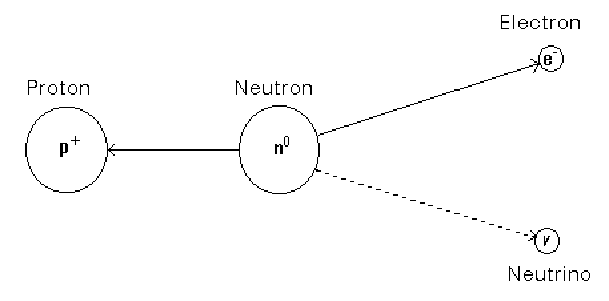
Figure 6.2
A neutron decays into a proton and an electron, which leave at different angles. The neutrino accounts for this imbalance of momentum.Neutrinos, however, are extremely difficult to detect because they are very light and very fast. More importantly, they do not have much of a propensity for "bumping" into things-which is the only way they can be detected. In one book I have recently read (The Cosmic Onion-see references) the author claims that a neutrino could pass all the way through the Earth without ever bumping into anything, but there are other claims which make this a drastic understatement.
In a more recent book, it is claimed that a neutrino could go through millions of miles of solid lead without bumping into anything. In yet another case, I will not vouch for the accuracy of this claim (also, I am unsure of the exact numbers or magnitude), it was suggested that a neutrino could pass through 17,000 light-years of solid iron without striking a single other particle. These statistics, if true, would make neutrinos extremely difficult (if not impossible) to detect.
By definition, leptons are particles that do not experience the nuclear strong force. All of these are closely related to their respective neutrino companion particles. A list of these particles is provided at the end of this book in Appendix D. The word lepton comes from the greeks, meaning "light one." This suggests that members of the lepton family are typically very light particles, such as electrons, muons, neutrinos and tauons (tau particles). In the quark environment, these particles have no meaning-that is-they do not have a quark constituency; only the heavy particles do. Leptons are seen as "end products" or particles that can no longer be split; they are irreducible.

Figure 6.3
Almost all of discovered particles today can be classified into one of two major categories: Leptons and Hadrons. Hadrons can be broken into two additional categories: Mesons and Baryons.Hadrons are heavy particles consisting of two groups of particles called the mesons and the baryons (which will each be discussed shortly). All hadrons are seen as having a quark constituency-that is-they are made up of quarks. These are typified quite simply as being able to experience the nuclear strong force; there is no other definition. The oddity of this is that, while we may suggest that hadrons are simply heavy particles and leptons are light particles, we run into a problem in that some heavy particles (i.e. muons) are known not to interact with the nuclear strong force, and so, are classified as leptons.
As mentioned above, mesons experience the nuclear strong force and are a subgroup of the hadron family. These are seen as mediators of the nuclear strong force, which means that these are the particles that hold nuclei together. The first ever discovered, as previously mentioned, was the pion suggested by Yukawa. There is now, a large family of mesons, a table of which can be found at the end of this book in Appendix E, which are seen as having a two-quark constituency. This is to say that each meson consists of two quarks. The quark constituency of each meson can be found in the table in the appendix.
The most common of Baryons are the protons and neutrons, but there are additionally a large number of these which have been discovered. The baryons, as mentioned above, are a subgroup of the hadron family, which experience the nuclear strong force. A table of baryons can be found at the back of this book in Appendix F. Baryons are seen as having a three-quark constituency, each being made up of three different quarks. While originally some baryons were believed to have two quarks of the same flavor, a new science known as Quantum ChromoDynamics (QCD), has arisen out of the Pauli Exclusionary Principle, which states that whenever two quarks of the same flavor occur in a baryon, one has to be of a different color.
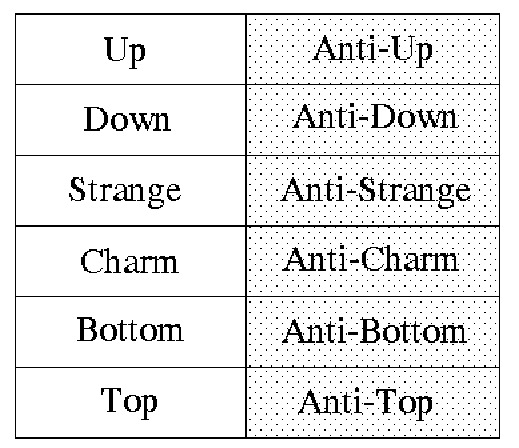
Figure 6.4
Quarks are said to have six different flavors, but each quark has an anti-quark, so there are also six different anti-flavors.Today, quarks are seen as having six different flavors: these are up, down, strange, charm, bottom and top. There are also six anti-flavors: anti-up, anti-down, anti-strange, anti-charm, anti-bottom and anti-top. At the time just prior to the completion of this book, scientists had discovered evidence of the theoretical top quark.
Protons are described as being constructed of two up-quarks and a down-quark. Each quark is assigned an electric charge as shown in Appendix G. Up-quarks have an electric charge of +2e/3 and down-quarks have an electric charge of -e/3. When you add all of these charges up, you get a net charge of +1e for a proton-which is correct. Conversely, a neutron is seen as being constructed of two down-quarks and an up-quark, in which the electric charges add up to 0 (zero).
Also, if a particle is said to have a strangeness value of -2, then it is believed to have two strange-quarks as part of its quark constituency. If the particle is a meson, such as a kaon, then it can only have a single strange-quark. For example, a positive kaon is said to consist of one up-quark and one anti-strange-quark. To date, no mesons have been detected with a strangeness value of ±2. Hadrons can have strangeness values of 0, -1, -2 or -3.
Recent discoveries in the big accelerator laboratories have suggested the existence of other types of quarks as well. These are called charm, truth (or top) and beauty (or bottom)-quarks.
As indicated above, each quark is seen as having (or being) one of three colors: red, blue and yellow. These also have anti-colors: anti-red, anti-blue and anti-yellow. A table showing a listing of all the (predicted) quarks is provided at the back of this book in Appendix G. Quarks, as previously mentioned, are highly theoretical and have very little basis in actuality. They are theoretically feasible particles which seem to explain a lot of things and more importantly, seem to follow some semblance of a theoretical model.
Home Begin Preface Acknowledgements Contents Chapter 1 Chapter 2 Chapter 3 Chapter 4 Chapter 5 Chapter 6 Chapter 7 Chapter 8 Chapter 9 Chapter 10 Chapter 11 Chapter 12 Chapter 13 Chapter 14 Chapter 15 Chapter 16 Chapter 17 Chapter 18 Appendix A Appendix B1 Appendix B2 Appendix C1 Appendix C2 Appendix D Appendix E Appendix F Appendix G General References Future Books About the Front Cover About the Author Index