|
The Theory of the Time-Energy Relationship: A Scientific Treatise |
13
THE MATTER MODEL
In a previous chapter, I made the very bold remark that "leptons (light particles) generally move backward in time and that hadrons (heavy particles) generally move forward in time." In this chapter, I do not want to undermine this remark, but rather I would like to correct it for it is actually only partially true (in a general way).
The reason for this is simple; I want to narrow down the number of basic particles in the universe to two-a particle and its antithetical particle (anti-particle). And while it would be tempting to consider these to be electrons and protons, an overwhelming amount of evidence tends to indicate otherwise.
There is one crucial point that I want to make before I go into this chapter; and this is that the "quarks" I will be describing here are in no way related to the ones described in previous chapters. In order to make this discrimination clear, new names will be applied to them.
The theory of quarks can explained to a large degree by the Time-Energy Theory (as can many other aspects of physics). Here I am going to theorize a little (quite a bit actually) and suggest that quarks basically come in two sizes; heavy and light, and I am going to attach names to these two types and a general name to the idea, but instead of giving them prefixes I am going to give them suffixes as follows:
Type Suffix Name
any quark et quarket
heavy quark eh quarkeh
light quark el quarkel
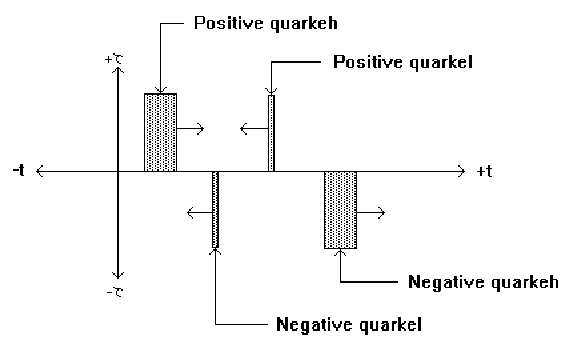
Next, I am going to invoke Theorem 14 for the quality of temporal direction of d-particles and suggest that both quarkehs and quarkels have one degree of freedom for moving forward or backward in time. This suggests that the most basic d-particles may indeed be quarkets, and this will give me four basic types to work with. Note here, that there are from this point of view, only two types of basic d-particles; positive quarkets and negative quarkets- the negative quarket being the anti-d-particle to the positive quarket.
This implies that the positive quarkeh is identical to the positive quarkel, except that the quarkel moves backward in time. Both quarkets will produce a positive temporal density (twice the normal density) in local q-space, but when combined as a pair, their q-masses will (roughly) cancel. The same naturally, will hold true for negative quarkets. Similarly, if a positive quarkeh is paired with a negative quarkeh, the result is a doubling of q-mass but a net temporal density of (roughly) zero (0).
Figure 13.1 Two basic types of quarkets and two directions gives four different quarkets to work with: positive quarkeh, positive quarkel, negative quarkeh and negative quarkel.
These are depicted in Figure 13.1. The pairing of two positive quarkehs would represent an unallowed state. Likewise are the cases for two negative quarkehs, two positive quarkels or two negative quarkels.
Given this set of allowable and unallowable conditions, what possible combinations could exist in nature? Because this chapter is very theoretical, I do not wish to "lock" myself into a firm set of rules by insisting that "this is the way things must be." But I will throw out some ideas on this and suggest that we start with the thirteen-quarket particle.
In this scenario, protons and electrons each consist of 13 quarkets, the proton having seven quarkehs and six quarkels, and the electron having six quarkehs and seven quarkels. In this application, I will also model the anti-proton and the anti-electron (positron). With 13 quarkets there are so many possible combinations of quarkets that I decided to write a computer program in BASIC (see Appendix B.1) to find out just how many possible combinations there were. Each and every quarket carries an electric charge equivalent to 1/3e (a number I shall call eq), so that it takes a net balance of three extra charges to have a particle with a whole charge of e±. The (enhanced) output of this program is shown in Appendix B.2.
Once again, just because I have selected 13 as the number of quarkets in a typical particle does not mean that we are limited to this. The only pure limitation that can be imposed on this system is that each particle with a charge greater than zero must have an odd number of quarkets. As an incidental suggestion, baryons should have at least one more quarkeh than the number of quarkels and leptons should have at least one more quarkel than the number of quarkehs.
The proton model has 13 quarkets, as mentioned above; seven are quarkehs and six are quarkels. From Appendix C.1, the total charge (net number of positive eq) will be three, and the total q-mass (net number of un-matched quarkehs) should be three. In that table, there are six combinations which match this description. These are displayed in Appendix C.2.
In that appendix, I can see that the only possible combinations of quarkets which would create a 13 quarket proton must have four matches between the quarkehs and the quarkels-that is-four of the quarkehs must be canceled out (in q-mass) with four of the quarkels of equal charge. The five remaining quarkets can be used to balance out the charges to produce a total charge of 3eq. Figure 13.2 shows how this looks.
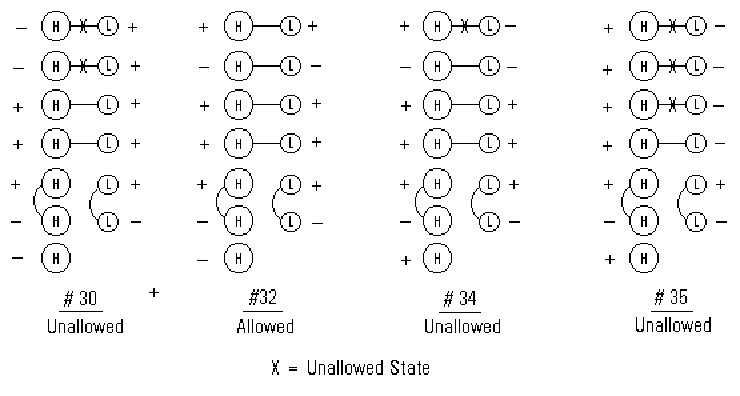
Figure 13.2 Designing a proton using 13 quarkets. In this model, heavy and light pairs are matched for mass while positive and negative pairs are matched for charge.
I do not want to go too far into other types of particles because at this point, everything I am writing here is almost purely speculative and may even get changed in the future. But I do want to show how every aspect of present-day physics can be understood or explained in terms of the time-energy relationship. Using the 13-quarket model I can also build an anti-proton, an electron and a positron, all from the set of particles listed in Appendix C.1. Most of the states from the appendix are un-allowed, but using the same method as the one above, I can easily determine which ones are.
In fact, I was able to modify the BASIC program mentioned above (in Appendix B.1) to "filter out" the remaining unallowed states and bring out only the four that I wanted (see Appendix C.2). This program however, may be a bit too harsh in its selection and hopefully, a more lenient program can be developed which would allow for more possibilities.
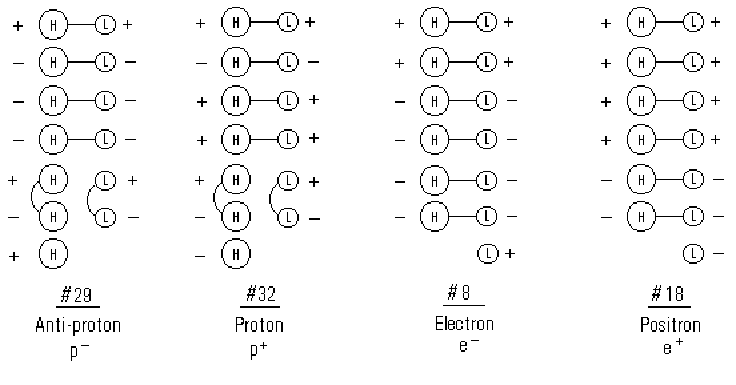
Figure 13.3 Quarkets can be used to make up four of the most common particles: the anti-proton, the proton, the electron and the positron.
The choice of 13 quarkets is not entirely arbitrary. It allows for a sufficient number of degrees of freedom to create a vast array of particles, suggesting that certain types of unallowed states may exist, but only momentarily. If there are too few quarkets in the model, I am not able to create the minimum number of stable states; if there are too many quarkets, I end up with too many stable states. In a word, I do not know how many quarkets would be required to produce the normal stable particles that we know of (yet). This is because there are still some problems with the Theory of Relativity which may only be worked out later; Here, I am simply making suggestions. Figure 13.3 shows the four most common particles excluding the neutron, which in this case, is simply the combination of an electron and a proton or a positron and an anti-proton.
There is one more thing I want to note before closing this chapter; When I wrote the two programs for adding masses so that I would get either particles with a mass of "3" or "0", I assumed measurement from the "heavy" temporal baseline. What this means essentially, is that light particles (leptons)-and I want to qualify this statement by saying that when I am speaking of "light particles," I am referring to their complex (13-quarket) forms-will have a zero mass and heavy particles will have a non-zero mass.
The reasons for this have to do with the concept of temporal direction in quarkets. The connection here, stems from the earlier example of cars going down the freeway and the amount of time required to pass each other. In the one example, our car was going 30 mph while the other car passed at 60 mph. I was able to use this idea to explain the contrast of masses, but "neglected" to explain why our car was going slower than the others.
From the time-energy viewpoint, this metaphor is revealing in the sense that it suggests that for a proton (for example) to "detect" the existence of another proton, or more succinctly for a positive quarkeh to detect the existence of another positive quarkeh, one must have a greater mass (temporal length) than the other-from the viewpoint of the "observer" particle. More importantly, however, it suggests that for the measurement of various qualities of matter to take place, there must be differences in the "relative" accelerations of matter. This hails the difficulties evoked by the Theory of Relativity, and reaffirms the Time-Energy Theorems.
Home Begin Preface Acknowledgements Contents Chapter 1 Chapter 2 Chapter 3 Chapter 4 Chapter 5 Chapter 6 Chapter 7 Chapter 8 Chapter 9 Chapter 10 Chapter 11 Chapter 12 Chapter 13 Chapter 14 Chapter 15 Chapter 16 Chapter 17 Chapter 18 Appendix A Appendix B1 Appendix B2 Appendix C1 Appendix C2 Appendix D Appendix E Appendix F Appendix G General References Future Books About the Front Cover About the Author Index