|
The Theory of the Time-Energy Relationship: A Scientific Treatise |
10
THE TIME-ENERGY THEORY
Before we can go into this chapter, we need to understand the meaning of this term. The reasons for this should be clear from the results of the previous chapter. Since the notion of "space" as a real entity has been eliminated as a causality of existence, what remains in existence (matter, energy, time, etc.) needs to be described in better terms.
What do we mean by a "node?" To some extent, we can mathematically describe a node as a point of intersection. In reference to the Time-Energy Theory, this will be an intersection of the key vibrations that define all of the temporal oscillations in the universe.
In simpler terms, what this means is that whenever certain sets of oscillations coincide, there is resonance at those points in time which, from our point of view, will appear as the existence of matter and energy. More importantly, it allows us to form pictures (in our minds) of what our universe looks like.
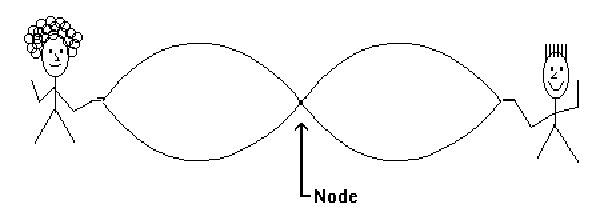
Figure 10.1 Two children swinging a jump-rope can produce a node in the rope by swinging the ends assynchronously (out of synchronization) with each other.
If you have ever seen children playing with a very long jump-rope, you will note that occasionally, the two children holding the ends of the rope by swinging the rope assynchronously (out of synchronization with each other), are able to cause two loops in the rope to appear, as shown in Figure 10.1. When they do this, if the rope is long enough, two children can jump in the rope but each jumps at opposite intervals of the swing.
The point at the center of the rope that appears not to move (in fact, it does not except to precess) is called a node. This node, however, is a quasi-spatial node-that is-it exists in q-space and has a q-spatial dimension to it.
Since space does not exist, the universe can be essentially described as a node. It is a temporal node. Note here, that I have said "is," not "has." What we perceive as our universe is what we have abstracted from the things we see around us, which are different temporal aspects of the same node.
For example, if the jump-rope is spun fast enough, every part of the rope goes beyond our perception except for the node at the center and the two ends which would not be moving (so we would see them). We would see the node at the center as a small, precessing ball. Our universe is far more complex than this, and what we visualize is many nodes (an almost infinitely large number).
But since these nodes are temporally associated, they can only appear to us one at a time. It is our mental abstraction of a q-spatial visualization that causes us to believe that they are all occurring at once.
So where is the rest of our "universal rope", you might ask? From our point of view, and the time-energy viewpoint, it does not exist-at least in our universe. But its effects can be detected in the form of quantization of temporal separation.
This is much akin to watching a movie at the theater. We know consciously that the movie frames are flipping by at thirty frames per second-too fast for human perception. To us, we have mentally abstracted a visual picture of a semi-reality-we have essentially fooled ourselves into believing that the movie we are watching is a continuous, uninterrupted reality.
If we were to slow the movie down to the point that we could see the "stop action" of each frame, we would realize that our brains have only filled-in the missing parts of the "moving" picture. The question then would simply be; "What happened to all the motion between the frames?"
The answer of course, is that it does not exist just as that part of the universe that we cannot see or detect does not exist (at least, in this reality). One might suggest that these could exist in some form of a hyper-temporality-a reality presently not available to us. (Some sci-fi fans might like to call this "hyper-space"-a phrase totally out of step with the time-energy concept.)
In one sense from the time-energy viewpoint, if these two realities were to intermix somehow one would find ordinary q-space literally jam-packed full of q-matter-so full in fact, that we would simply not be able to move.
The results of this and arguments of the previous chapter suggest that there are indeed, better ways to describe the universe and quasi-spatial relationships between bits and pieces of matter. Furthermore, the results of the Theory of Relativity have shown us that our ideas about space (curved, bent, dilated, contracted or otherwise) are in dire need of revision.
From the quantization of energy and the proofs of the relativity theory, we have surmised the quantization of quasi-spatial separation of particles and note that since space does not exist, any two particles in q-space may only be separated in time.
This case, being applied to any two particles in the universe, must therefore extend to all particles in the universe such that all matter in the universe is temporally connected. This concept is embodied in the first theorem as follows;
|
Theorem 1: Every particle in the universe is connected in time to every other particle in the universe. |
The most important relationship between any two particles is where they are in time relative to one-another. Let me see if I can clarify this point. Suppose we choose to examine a ball instead of a particle, in this example.
If we look at the ball in the quasi-four-dimensional way of the space-time continuum where we use the four-dimensional coordinates, x, y, z, t, then we choose to look at the ball at two points along the t-axis (the time axis). Let us suppose that we examine the ball at 3:00 P.M. today and then again at 3:00 P.M. tomorrow, verifying that they are both the same ball.
Since the ball has been "continuously connected" (respecting previous arguments regarding continuity), then the ball we examined today is the very same ball (relatively speaking) we examined yesterday. We say that these two balls are connected in time.
It is the very same argument we have for any particular particle; if we follow one particle around for a day or so, we find two particles which are temporally connected and therefore, the same particle.
However, these two examples of "connectivity" do not do the concept justice. Theorem 1 goes far beyond this. It explains that since space does not exist, temporal connectivity must extend to all matter since there is no such thing as spatial separation. Certainly all matter cannot exist at once and in the same moment. For that matter, no two particles of matter can exist at the same point in time.
From this, I come to the singularly important conclusion that any two particles of matter are one and the same. By induction, I conclude that the entire universe is composed of one particle. This gives and proves the second theorem.
|
Theorem 2: The universe is comprised of only one particle (including its anti-particle). |
A result of these two theorems is that if any two particles in the universe do not have a temporal relationship, there will be no way for those two particles to interact. The next two corollaries can be written from this.
|
Corollary 2: The probability of collision between two particles which are not connected temporally is zero (absolutely). |
Here, I am less concerned about physical collision and more concerned about quasi-spatial fields and forces. Quasi-gravitational and quasi-electromagnetic fields of two non-temporally connected particles have no basis for interaction, and so, are not able to influence each other's motions.
While Corollary 2 is a very important one, I can write a far more important corollary which also extends from Theorem 1.
|
Corollary 3: There can be no interaction between any two particles which are not connected temporally. |
I establish one more theorem relating to the non-existence of space.
|
Theorem 3: Since space does not exist, particles of matter have no true spatial dimension. |
The effect of Theorem 3 is that since particles of matter have no extension in space, then they must have extension in time relative to other particles. This will be discussed in further detail shortly.
Before I can proceed with further arguments, certain other theorems must be established. These mostly deal directly with the existence and creation of the universe and are strictly a matter of formality.
|
Theorem 4: If there exists only one particle in the universe, the only way for that particle to differentiate the passage of time is to exist in different states of temporal passage which are detectable to itself in other states. |
In essence, a particle will not be able to recognize another version of itself unless it has different qualities and a different "place" in time. In particular, these will be temporal qualities. The next two theorems fall directly from Theorem 4 and are concluded logically.
|
Theorem 5: If there is only one particle in the universe and it exists in only one state of temporal passage, it will have no way of differentiating that passage, and the period of its existence will be zero (absolutely). |
At this point, I have established several theorems concerning the existence of the universe and the matter within it. I am prompted to ask how the birth of the universe might have come about, given these conditions. From the time-energy viewpoint, the universe is envisioned on an infinite scale of time extending in both directions. If someone were to ask where it all began, I might readily suggest, "in the middle."
Imagine the creation of the very first particle. This is a very hard thing to do, since no one really knows how to envision this. Let us suppose that we simply create in our minds, the picture of a "spike in time." In the creation of this particle is implied a beginning. Because there are no other particles (from Theorem 5), the same moment, and subsequently, the end of the universe is established in its annihilation. As such, the beginning and the end of the universe occur essentially simultaneously, which demands that the particle once again be created. But since the processes which created the first particle remain (no time has expired), then the beginning of the universe must bring about the existence of both the first and a second particle.
Those two new particles are likewise annihilated, bringing about the end of the universe. On the next cycle, a third particle comes into existence, as well as the first and the second, then a fourth, and so on. In essence, an infinite number of particles are instantaneously created.
But this situation causes a problem; it is contrary to what we know. For example, we know that all particles of matter are (at least) q-spatially, and therefore temporally separated, which means that somewhere along the line the instantaneous production of an infinite number of particles had to cease1. In other words, the number of particles in the universe is finite. It also means that the passage of time is not the same for all, or for that matter, any two particles. This gives us the next theorem.
|
Theorem 6: The number of particles in the universe is finite. |
|
1. In a later chapter, I will clarify this statement. In fact, an infinite number of particles are created, but the number of convergent sequences within a confined temporal region (the number of particles in the universe at a particular point in time-and even this is an inaccurate statement) is finite. This may seem contradictory to Theorem 6, but in actuality the problem here is in the definition of a "particle". What we view as particles and what were being created at the beginning of time are different things-both are being called particles for the moment. |
Every duplication of this particle in the universe is connected in time. Matter and space do not exist, except in our perceptions. All matter consists of duplicate-particles (d-particles) which are merely perturbations of time. The nature of the most basic d-particle is oscillation in time relative to a temporal frame, not a spatial frame. From Theorems 4 and 5, I may also derive the next theorem.
|
Theorem 7: No two d-particles may occupy the same point in time. |
Suppose that as the build-up of matter at the "middle of time" grew to a certain point, some defining law or rule of the universe came into effect, causing all matter to come into existence in a particular way. Obviously, during this interval, there was some amount of disorder and chaos (in human psychological terms), but there was also a great deal of order and structure.
One might suppose that a virtually infinite improbability had occurred. Perhaps a "non-particle" had been "accidentally" created, which might have created a "space" in time, which other particles would have allowed as "place" to go. It did not really matter how large that space would be. It would be scaled (normalized) accordingly.
The Time-Energy Theory makes no claims with respects to the "Big Bang" Theory, since, from the time-energy viewpoint, the Big Bang may occur many times between the absolute Creation and Annihilation. But there is some correlation between the Time-Energy Theory and recently developed theories concerning the beginning of the universe. In particular, recent astronomical observations have made note of a large-scale bubble-like structure in the universe which seems to contradict many of the old theories guiding belief in the Big Bang.
One of the theories involved in attempting to explain the problems associated with this is Alan Guth's Inflationary Universe Expansion Theory. In Guth's inflationary universe, there is a sudden expansion in the very small of time, 10-35 second after the beginning of the universe, from about the size of the molecule to about the size of a softball (1050 times its original size) in 10-32 second, at a velocity many times the speed of light. This idea actually coincides to some degree with the Time-Energy form of the beginning of the universe. There is however, a slight difference here; in the Time-Energy Theory, the period prior to Guth's inflationary expansion (often referred to as the Planck time-since from the principles of Quantum Mechanics what occurred prior to that time cannot be known), is zero (0)-absolutely.
What Guth suggests is actually not too far-fetched, since an example of this sort of expansion could be the stacking of a huge number of perfectly round marbles, one atop another, and their subsequent instantaneous release. Since it would be impossible to keep even one perfectly round marble right on top of another for any period of time, watching the chaotic event of a very tall stack of marbles falling would certainly prove interesting. But what would be more interesting than this would be to see what two dimensional pattern emerged in a sandbox below, and even more interesting when translated into a three (or four)-dimensional pattern. (We might note, for example, a quantization in this pattern.)
Of course, this does not say anything about a second particle (source particle-not a d-particle) in the universe. Suppose that another particle was created in the universe, but was not temporally associated with the first particle. From Corollary 3, the second particle can have absolutely no interaction with the first. In this, there can be no collisions, no exchanges of energy, no forces acting between them, etc. The next theorem can be written from this.
|
Theorem 8: If there were a second particle in the universe, it would be another universe in another dimension, and would be completely undetectable by any presently known means in this universe. |
Since this universe consists of only one particle and only one time-line, another particle would simply be on another time-line-another universe.
One of the great results of the Time-Energy Theory is the complete conservation of the matter/energy content of the universe. I have not quite defined energy yet, so I can write this next theorem to establish an important basic principle in reference to it.
I have established in previous theorems that all of q-matter is temporally connected so that if we envision all of the universe along a single time-line, then energy exchanges between bits and pieces of q-matter2 must take place along the single temporal line connecting them. In essence, every d-particle in the universe is connected in time and is in fact, one particle, energy cannot be transmitted away from the universe. The result of this is summarized in the following theorem.
|
Theorem 9: Energy cannot go to a q-place where q-matter does not exist. |
|
2. Actually, this is an improper characterization of energy, but it will suffice for the present argument. Later, I will clarify it without damaging this argument. |
This particular theorem can help us to understand why the universe must have a finite life-span. There are two popular possibilities to consider here, and those are that, either there is an "edge" to the universe beyond which nothing exists, or that matter exists out to infinity.
In the first case, it is believed that energy given to the edge of space is lost forever and cannot be recovered, and since energy comes from matter, eventually all matter will be lost to energy given off to the vast emptiness beyond. What will remain in the end will be a large chunk of iron at the center of the presently known universe, which can neither be made fusible or fissionable. The universe begins with a "bang" and ends with a "thud." Theorem 9 does not allow this, however, since energy at the edge of "space" will not be allowed to leave the universe. As a result, the combined "matter-energy content" of the universe is conserved.
Furthermore, high q-mass-velocity-energy bodies at the edge of the universe must "give off" excess energy in the general q-direction of the universe. This process is exactly the opposite of a recoil, and the effect is a slowing of the body's q-motion. This greater q-velocity however, increases the (generalized) probability of spontaneous energy emission, so the body must eventually stop moving. Gravity will do the rest, bringing the body back to the center of the universe.
In the second case, Theorem 6 is violated and the universe would not exist in a way that we would be allowed to exist to talk about it. It is in complete discordance with the Time-Energy Theory.
From Theorem 9 and this argument, I can write the next theorem.
|
Theorem 10: The universe from our perspective, will be annihilated. From the time-energy perspective, the universe has been and will be annihilated an infinite number of times. |
While the argument is sufficient explanation for this theorem, the next chapter will provide some much more powerful arguments. This is accomplished through the principles of recurrence and quantization.
Home Begin Preface Acknowledgements Contents Chapter 1 Chapter 2 Chapter 3 Chapter 4 Chapter 5 Chapter 6 Chapter 7 Chapter 8 Chapter 9 Chapter 10 Chapter 11 Chapter 12 Chapter 13 Chapter 14 Chapter 15 Chapter 16 Chapter 17 Chapter 18 Appendix A Appendix B1 Appendix B2 Appendix C1 Appendix C2 Appendix D Appendix E Appendix F Appendix G General References Future Books About the Front Cover About the Author Index