
|
The Theory of the Time-Energy Relationship: A Scientific Treatise |
12
THE TEMPORAL QUALITIES
I am prompted now to ask another question about matter; What is a d-particle? In order to properly address this question, I might ask myself what was being created at the "beginning of time." From the time-energy viewpoint, a d-particle is nothing more than a pocket in time-a temporal oscillation. So what is a "temporal oscillation," and how can it affect other versions of itself?
In order to answer this question, we must examine the nature of time itself. Note first, that time has no obvious physical representation other than its passage-from our perspective. Here, we view time from a macroscopic perception. We see it as the difference between one moment and the next, while its true nature can be more appropriately described as a kind of "hardness," having properties that might be better understood in terms of "tendencies."
This question is paradoxical-one of those similar to; "If God can do anything, can He make a rock so big that even He can't lift it?" The pursuit of the answer to it might be likened to finding the very smallest d-particle of the universe and then trying to discern what it is made of; there is no basis for making such a determination. It would be easy to suggest that time has essence of some sort, but even this would be dangerous since we cannot really know if it does. In a word, time cannot be defined in terms we can understand. The nature of time however, can be described.
One might be tempted to view the nature of time as something along the lines of a string. It is in fact, very tempting. I shall resist this temptation because time is not a string. If it were, I would be constrained to attempting to describe what this "string" is made of. Time is and of itself. Beyond this, time cannot be defined in terms that fall within the experience of our perceptions.
In essence, time is the only "thing" that does exist. Time however, is not a thing-it is a causality; it is in fact, the causality of the universe. We look upon time as being one of the gauging variables in the interaction of q-matter with other q-matter. For example, we might be able to know how fast a car is moving if we measure the time interval required for a car to move from point A to point B.
The basis for relativity theory however, tells us that this is not the case. Time is not a fixed and unchanging quantity. The passage of time for each observer in each reference frame is different. Even at very low speeds-such as the speed of a car passing by, the passage of time is different for the driver of the car from that of the stationary observer measuring its speed. This difference exists only minutely and is not measurable with the instrumentation available to us even today (Galileo and Newton were not the only ones to be without sophisticated measuring devices).
The problem of time is not one of understanding-it is one of perception. We perceive time as flowing-going smoothly from one moment to the next. We know from quantization that this cannot be the case. Q-motion and energy exchange occur in jumps and bits-"now it's here, now it's not." I ask then, what is meant by a d-particle having extension in time?
I must remember that as I look at this question, I am rather intimately involved with it. Since I, as a being in this universe, am comprised of d-particles, I also have extension in time, so I must describe what is meant by extension in time as viewed microscopically, i.e. by a d-particle.
In classical, and even in quantum physics, we think of particles as having mass and volume. From the time-energy viewpoint, these two descriptors are meaningless. They must therefore be related to something more temporal in nature, say, their extension in time.
In essence, I suggest that d-particles exist only for certain periods of time, and these periods can be measured almost directly from their masses (or energies). But as I consider this relation, I see that it must be relative. That is to say that, I might define a d-particle as having a sort of "temporal length." I write a theorem to establish this.
|
Theorem 14: All d-particles have extension in time, and therefore have the property known as temporal length. |
I am particularly interested in the fact that electrons and protons attract each other with a (quasi-spatial) force equal and opposite to that with which they repel one-another. The effects of this q-force are most imminently embodied in the concept of the electric field, discussed earlier. I recall from the time-energy viewpoint that there is no such thing as an electric field. It is in actuality, nothing more than a mathematical construct used to describe the forces between charged particles such as electrons and protons.
I suggest then, that since these d-particles have charges exactly equal and opposite, this particular property must reflect some temporal aspect. In search of this aspect, I consider certain physical aspects and what they mean.
Note that the charge of any d-particle is unaffected by relativity and time dilation, and furthermore is quantized, which implies that this attribute has one degree of freedom-that is-to be either positive or negative. This is known as invariance of charge or charge invariance.
In essence then, the charge of a d-particle is entirely unrelated to its q-motion. The force due to a charge however, does appear to change according to q-proximity to other d-particles. The existence of charge in q-matter tends to imply an attraction (or repulsion) of a general sort-and all q-matter (even highly theoretical sub-particles) seems to have it.
This suggests that without a charge, a particle cannot exist. Actually, this statement is somewhat inaccurate-it would be more accurate to say that without a charge, a particle cannot interact with other particles in this reality. This is very nearly the same thing as saying that it cannot exist since, if it cannot interact, then certainly there is no way of detecting its existence.
From the time-energy viewpoint then, the temporal density of a d-particle is directly related to its charge. So why do I make this choice and what does it mean?
Temporal density, as the name suggests, has to do with either the contraction or dilation of time. In particular, when I speak of a d-particle, I want to know what the time of a d-particle is, or more precisely, what does the temporal density of this d-particle do to other d-particles-how does it affect them?
To answer this, I want to liken time to a special kind of thread. Suppose that this thread has an underlying, unchangeable length overall, but the outer surface of it is a covering which can move around and "bunch-up" in places. However, the outer layer also has restrictions and may only bunch-up a certain amount before it runs out of material. Imagine in this metaphor that you are "riding" the "thread of time." If we were to come upon a time where the temporal density changed, everything would suddenly speed up or slow down in front of and behind us. In the metaphor, this is similar to coming along points where the outer layer is either very bunched-up or very thinned-out. These are very similar effects to time dilation in relativity theory (except that the effects, in this case, go either way).
Remember however, that these differences are quantized. This means that since time is what connects all of q-matter (and, in fact, makes it up), what lies outside the boundary of the densified region must compensate with either a dilated or contracted temporal separation from the next d-particle. Another way to compensate for this is to add a second region of densification, but in the opposite way. I give a theorem to support and verify the concept of temporal density.
|
Theorem 15: All d-particles produce either a temporal contraction or dilation in time. This property is quantized and called the temporal density. This value is directly proportional to the q-spatial charge of a d-particle. |
When I combine the two temporal qualities of density and length I arrive at what can be seen as a typical d-particle. Figure 12.1 shows this relationship in a temporal setting. The time-energy mass of a d-particle may be calculated as the product of the temporal density and the temporal length as shown in Equation 12.1.
Figure 12.1
A d-particle exists only momentarily in time with a certain temporal density and temporal length.m
= τΔt (12.1)where: m is the mass
τ is the temporal density
and Δt is the temporal length.
The units of τ (pronounced tau) are "seconds per second" and Δt is simply in "seconds." The "mass" described in Equation 12.1 is the total value of a d-particle's temporal perturbation, but only from what might be called the "zero temporal baseline." We are not yet able to describe the true q-mass relationships between d-particles because we do not "see" d-particles from this baseline. Note from dimensional analysis that the units of mass and energy are "seconds" and that the speed of light-c-is a scalar (dimensionless) quantity.
This expression of mass is not the classical mass that we are used to seeing. The ones we see are not measured from the zero temporal baseline. They are measured from the macroscopic q-mass/kinetic/inertia baseline and do not take into account the concept of temporal direction. I can however, draw a picture of the zero temporal baseline and show how they will appear measured from different baselines. Figure 12.2 shows these masses as we presently measure them.
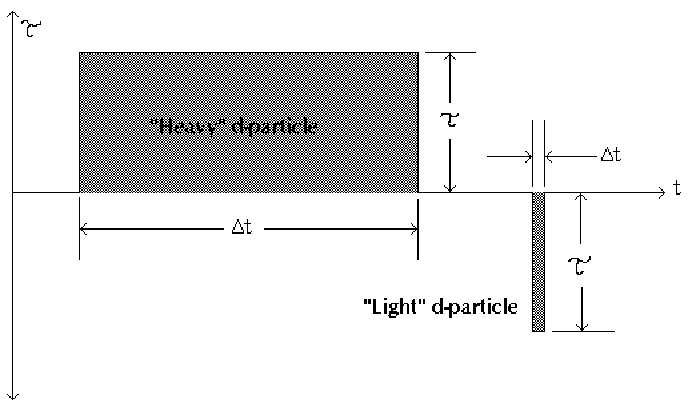
Figure 12.2
The respective q-masses of a "heavy" d-particle and a "light" d-particle as we presently measure them.Note in Figure 12.2 that the temporal density is quantized, but more importantly, it represents a very important aspect of a d-particle's charge. From our measurement, the heavy d-particle has a much longer temporal length than the light d-particle, hence it exists for a longer period of time (from our perceptual viewpoint) and appears as a result, to have a much greater mass. Note also that the overall temporal density for both d-particles is the same.

Figure 12.3
The respective q-masses of the heavy d-particle and light d-particle as measured from the "microscopic" baseline. Note that the relative q-masses are reversed from Figure 12.2.Figure 12.3 shows what this figure looks like measured from the microscopic q-electric/energy/light baseline. Note in this figure that the respective q-masses are reversed and the light d-particle is much larger than the heavy d-particle.

Figure 12.4
The respective q-masses of the heavy d-particle and the light d-particle as properly measured from the zero temporal baseline.Finally, examine Figure 12.4 which shows what this drawing should look like when properly measured-that is-from the zero temporal baseline.
The perception of interest to us now is the contrast of the masses of the electrons and the protons. Again, it should be recognized that this perception must reflect some temporal attribute. Since these particles have charges exactly equal and opposite, this suggests that they have quite a bit in common in the first place, which means that at some level deeper than this, they must have something more subtle in common-some aspect having to do with their respective masses-since we perceive very little else about them. From the time-energy viewpoint, I see that this attribute can be reflected most distinctively as temporal direction.
Temporal direction as most people might suspect, is the direction of the "flow of time" for any particular d-particle. Most scientists recognize this as entropy, which will be discussed in more detail shortly. For the time being, I will ignore the subject of entropy since it is more of a thermodynamical affectation than a theoretical one- from the time-energy viewpoint.
What this means is that d-particles must either move forward or backward in time. I choose (temporarily) that electrons move (generally)1 backward in time, protons (generally) move forward in time and that neutrons are simply a combination of the two.
|
1. I say "temporarily" and "generally" here because protons and electrons, as we will see, are much more complex than this. |
The question that arises from this choice is: With respect to what? For lack of a better choice, I choose psychological entropy. Note also, that the subject of neutrons has been glossed over and not discussed in detail. This is because we need to examine the make-up of protons and electrons a little more closely since current experimental evidence tends to suggest a rather large array of sub-nuclear particles. For now I want to keep things simple, so I will assume that other sub-nuclear particles, such as quarks, pions, muons, bosons and mesons are simply side-effects of their interactions.
From modern physics, we suspect that neutrons are composed of one electron and one proton, but the difference in the total mass is more than the two separately. Accounting for this difference has been a "sore spot" with physicists for many years. To wit, the respective masses2 (in electron volts-Ev/c²) of these particles are;
|
Electron mass |
.51099906(15) MeV/c² |
|
Proton mass |
938.27231(28) MeV/c² |
|
Neutron mass |
939.56563(28) MeV/c² |
|
2. CRC Handbook of Chemistry and Physics, 72nd Edition, 1991 - 1992. |
|
3. Parenthesis' around the last two digits of each number indicate that the values of those two digits are uncertain to some degree. The "M" stands for millions, so this value is read as millions of electron volts. |
The difference between the neutron mass and the proton mass is 1.29332(00) MeV/c²-about two and a half times the mass of an electron.
What this means is that, when a proton and a electron get together (in the quasi-spatial sense) to form a neutron, the total mass does not add up as we would expect it to. All of this information is actually meaningless unless we reconsider the fact that electrons and protons have equal and opposite charges.
As proposed earlier, we measure things (like matter and energy) from non-zero temporal baselines. But because there are at least two baselines to measure from (neither of which are zero), there is plenty of room to make an error by taking the measurements from one and subsequently concluding that there is no other.
As an example of how and why we measure things the way we do, suppose that we are driving a car down the highway at a pace much slower than the surrounding traffic. Instead of driving 60 miles per hour we are going 30. On the side of the car is a measuring device which determines how long it takes for another car going 60, to move completely past (from the front to the rear) a point on our car.
The differential velocity of the two cars will be 30 miles per hour, and the time it takes for the second car to move past will be based on that differential.
Suppose now, that we make the very same measurement on another (third) car also going 60, but moving in the opposite direction from us. The differential velocity of the two cars this time is 90 miles per hour, and the time required for it to move past the point on our car is one-third that of the second car.
From here, it is easy to discern that since electrons generally move backward in time their period of existence is much shorter from the "heavy" baseline. Similarly, since protons generally move forward in time with respect to the heavy baseline, their period of existence will be much larger. Note that the ratio of these values is roughly 1836:1. The question which arises here is; what sort of temporal displacement rates would yield such a differential? (I will not answer this question yet, since there are some other factors that must be dealt with first.)
To generalize this whole concept, I will now include in this scenario, not just the electrons and protons but all particles, since there seems to be such a vast array of them. The heavy particles in physics these days are generally referred to as hadrons and the light particles are referred to as leptons. The next theorem relates d-particle q-masses to their respective temporal directions.
|
Theorem 16: Some d-particles move forward in time with respect to psychological entropy and some d-particles move backward in time with respect to the same. This property is called temporal direction. |
The reader will please be aware that, in this theorem, as previously indicated, hadrons and leptons are not the particles being referred to directly, but that the difference between "heaviness" and "lightness" is being differentiated here.
For those not familiar with it, entropy is part of the second law of thermodynamics, which suggests that the entropy, or amount of disorder, in any closed system must increase (unless acted upon externally) over a period of time.
For many years, scientists have used this definition as marking the direction of the "arrow of time." This supposed arrow of time essentially told us very little more about our universe than what we already knew. From our own psychological viewpoint, we are fairly aware that the past is clear to us and the future is yet to be seen.
As I examine the entropic process from the time-energy viewpoint, I envision the process of entropy as the result of two co-dependent systems of temporal activity. The first and most apparent activity that we are accustomed to "energy/electric/magnetic" system. This is the one that essentially operates in "negative time." This one is most apparent because we do not have to go far to see it-we need only look around. Energy in the form of light and heat is constantly interacting with our eyes and body.
The second temporal activity is the least apparent but nearly as visible as the first. This one is the "gravity/mass/inertia" system, which operates in "positive time." This one is only marginally less apparent since all we need do is attempt to move something (ourselves for instance) and take note of the fact that doing so requires the use of force.
What is referred to as the energy/electric/magnetic system is everything we observe relating to the action of electrons in our universe and in our perceptions. The gravity/mass/inertia system is the one that we observe relating to proton and neutron activity. Neither of these two systems acts alone or is even able to. What we can see this as, is a quasi-moving body system.
The concept of entropy suggests that as the result of separating two masses (usually liquid) of different heats (energies), the two masses when brought together and left for a period of time, will eventually share the same heat. This is suggestive of an ordered system coming to a disordered state. This is only marginally similar to taking a deck of cards which has been ordered according to rank (Ace, King, Queen, etc.) and suit (Hearts, Diamonds, Spades, etc.), and shuffling it, thereby bringing the card deck from a state of high order to a state of low order.
From the much larger view of the universe, many scientists today, suggest that the universe as a closed system, is increasing its entropy-or amount of disorder. From the time-energy viewpoint, this is not possible since quantization requires recurrence and existence requires that the total mass/energy content of the universe be conserved. This suggests that in the total q-moving body system, the overall entropy cannot change. As energy leaves one place it gathers in another.
A simple example of a q-moving body experiment would simply be a long, enclosed and insulated tub filled with liquid at some (moderate) temperature. At one end of the tub there is a churning machine which gives motion (kinetic energy) to the liquid. At the other end of the tub is a cooler which removes an equal amount of energy. We assume that the energy required to rotate the churn is dependent upon the heat supplied by the liquid at the cool end of the tub and that the system is 100% efficient-that is-there is no loss of energy in the system.
Once the system is placed in motion, it must remain in motion. If the system is, at the beginning, in a disordered state, it will eventually increase its order (thereby decreasing its entropy) until it arrives at one state of order, assuming that there is a conserved damping process occurring. If there is not a damping process in the system, then the system will oscillate between states of order and disorder and the entropy will vary accordingly.
A simple example of this is the Earth, which gives off approximately as much energy as it absorbs. We observe that during the winter the northern hemisphere of the globe is cloaked in snow and cold weather while the southern hemisphere is warm. During the summer just the reverse is true. This is an ordered and (somewhat) closed system since theoretically, we could enclose our world in a perfectly insulated Dyson Sphere4 and move this energy around as we pleased.
|
4. The Dyson Sphere (named after the man who suggested it) was to enclose the Earth, Moon, Sun and the two inner planets Venus and Mercury in an effort to conserve the energy from the Sun in preparation for its eventual burn-out. The energy "harvested" by the Dyson Sphere would be used to keep the inhabitants of the Earth alive for many millions of years after. Dyson certainly must have been unaware at the time that the Sun would nova shortly after its burn-out and destroy the sphere and the first three planets anyway. |
The concept of entropy from the time-energy viewpoint, is therefore not so much antiquated as it is useful, but only as a tool for writing simple thermodynamical equations.
One final concept I want to deal with in this chapter is that of potential energy. In classical physics we speak of the potential energy of a macroscopic q-mass as "having the ability to do work." From the time-energy viewpoint, potential energy is the most important driving force to both macroscopic and microscopic motion.
The potential energy of a d-particle is the most revealing thing that can be determined about it. From previous chapters it was determined that d-particles cannot q-move continuously-that they q-moved only discretely, and furthermore that they oscillated in and out of existence.
From this it is understood that since any d-particle only comes into existence for a moment, another d-particle must take its place in the next-one that has never existed before (in this cycle of the universe). How is it though, that another d-particle of the same variety, q-energy, q-momentum and etc. can suddenly just "pop" into place as though nothing had changed. And the answer is that it cannot. The reason for this is that things have changed, and one thing that has changed is the potential energy of the q-space point.
The reason for that d-particle to exist at that point in time is that there existed a potential for it to. When the potential no longer existed, then the d-particle could no longer exist. However, the potential for a d-particle to exist does not simply go away-it q-spatially moves but does not do so in a continuous sense. In a hyper-temporal sense, I suggest that it may do so, but discrete q-motion (temporal quantization) will not allow a d-particle (in our universe) to exist there.
I suggest then, that whenever an electron or a proton moves out of its q-space quantum position, it leaves behind a "moving" potential (either temporally positive or negative-or a combination of both) near that temporal point. If the next temporally approaching particle is matched to the new potential (that is-it is a similar particle and it is discretely out of transition phase with the original potential, and further, its energy-temporal length-may be different), it will take its q-place at the next possible nodal intersection (nodes were discussed in a previous chapter).
I want to give names to these d-particles so as not to be confusing about what is meant when I speak of the difference between particles in general, or a series of d-particles "following" a potential. For the case of d-particles in general, I suggest the name of next-particles, or n-particles. For the specific case of d-particles that move forward in time (relative to our psychological concept of entropy), I suggest the name of follower-particles, or f-particles. For the case of d-particles which move backward in time, the name of leader-particles or l-particles shall be applied. The following is a list of these;
|
next-particle |
n-particle |
any d-particle |
|
follower-particle |
f-particle |
|
|
leader-particle |
l-particle |
|
Because electrons generally move backward in time the next electron, from our entropic point of view, will be the one previous. Hence, the next electron will be the leader-the one before.
I take particular note of the fact that a potential does not necessarily move to the very next q-position. Depending on the potential energies of the q-surrounding particles, a potential may move across an atom or across the universe. Note that I am not using the q-prefix on the word "move" when I speak of a "moving potential." The reason for this is that this potential is more of an abstraction than a reality, and is very much akin to the electric field.
In fact, all forms of potential energy can be represented as such only because there abstractly exists a field of one sort or another. For example, because of the force between any two charged particles, there is a certain amount of potential energy as a result of their quasi-spatial separation. Another form of potential energy is that of a ball held above the ground in a gravitational field. Because of the ball's, separation from the ground it has "built-up" (potential) energy which results in some ability to "do work," such as crushing a bug.
To see how this sort of d-particle layout would appear in the temporal setting-the time-line of existence- see Figure 12.5. D-particles occur as a series of n-particles, each one following a potential.
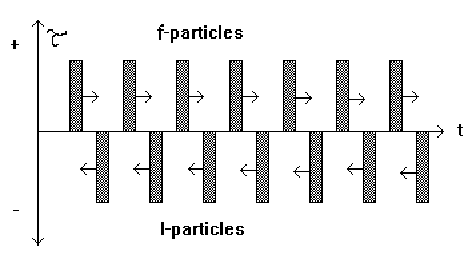
Figure 12.5
Two lines of n-particles following potentials. L-particles move backward in time and f-particles move forward.This quality emerges from Theorem 12, which dictates a minimum value of quantized temporal displacement between any two d-particles in the universe. This quality is different from the others in that another d-particle is required for it to have meaning, whereas other qualities work in the general sense (as long as other d-particles are simply in existence).
This quality is a bit more complex besides this however, since time is inherently two-dimensional (at least) and q-space-time is four-dimensional. Temporal separation is quantized, but has other degrees of freedom not readily apparent as with the other temporal qualities. This particular quality needs a separate discussion and will have one in a later chapter.
Summary of the Temporal Qualities
Summarized, here, are the temporal qualities discussed up to this point:
1. Temporal density.
2. Temporal direction.
3. Temporal length.
4. Temporal separation.
Note, also, that each of these qualities is quantized (discrete).
Home Begin Preface Acknowledgements Contents Chapter 1 Chapter 2 Chapter 3 Chapter 4 Chapter 5 Chapter 6 Chapter 7 Chapter 8 Chapter 9 Chapter 10 Chapter 11 Chapter 12 Chapter 13 Chapter 14 Chapter 15 Chapter 16 Chapter 17 Chapter 18 Appendix A Appendix B1 Appendix B2 Appendix C1 Appendix C2 Appendix D Appendix E Appendix F Appendix G General References Future Books About the Front Cover About the Author Index