
|
The Theory of the Time-Energy Relationship: A Scientific Treatise |
14
THE ORTHOGONALITY OF SPACE
In this chapter I want to talk about one of the most important aspects of this theory. It has to do with our perception of orthogonality in space and time. In a previous chapter I remarked that the apparent perception of space could be described in other ways and this is the chapter that deals with that particular notion.
Also very importantly, I will provide an answer to one of the original questions put forth in this book; "What is light?". Since I have spent so much of this book doing away with earlier perceptions of it, I think that I could not escape without replacing those perceptions with something more serviceable. This will be a generalized construct within which the theorems of the time-energy relationship can operate. I will also present a few additional theorems.
There is an additional need, in order to make this theory a little more accommodating, to provide at least one application for it. For this I have chosen to explain the Twin Paradox in the Special Theory of Relativity. Certainly while many scientists before me have provided fine explanations of this peculiar difficulty, none of them have been to my own satisfaction, as I will explain.
As I showed earlier, space does not exist, and it is for this reason that I can make the subsequent statement that light does not "move" from one place to another. So how does light "get around?" How is it that light seems to "go" from one place to another? In order to answer this, my original question, "What is light?" I must first take a look at our perception of orthogonality and understand why we see things the way we do.
The problem of orthogonality poses itself in the perception of three-dimensions and, in particular, the concept of the space-time continuum which actually gives us four dimensions of perception to contend with. From the time-energy viewpoint, all of q-matter is on a one-dimensional time-line, holding that "adjacent" d-particles on this time-line may or may not "communicate" with one another.
The relative view is the one taken mostly by scientists, but may also be taken by a typical bystander in this world-such as yourself (if you are not a scientist-at least at heart). This view portends to represent a relativistic characterization of orthogonality, which it is. This is to say that any view of the world is taken from the observer's relative position-and velocity. The difference between the relativistic viewpoint and the time-energy viewpoint is that the time-energy "observer" is a d-particle as opposed to a macroscopic (large-bodied) "detector."
The macroscopic detector observes many events in the same "moment" and as a result, cannot represent the singular activities and reactions of individual d-particles. Please note that I have put the word moment in parenthesis and why; Here, I am not referring to the "nick-of-time" (a misunderstood phrase) which defines an infinitely small instant in time. I am referring to a time interval, defined by our ability to observe separate events in time. In a previous chapter, I remarked on the way movie films worked, in which the frames of a film flipped by at thirty frames per second-those events being inseparable by the human cognitive process.
For example, the macroscopic detector, which I will call the relativistic observer from here on, may detect a photon striking one of its detecting elements, thereby recording an event. But since it does not "know" its own internal processes, it cannot record anything beyond that. Further, its relevance in time cannot be known either, since time elements of variously moving and shifting bodies cannot be perfectly well-known1.
|
1. This is a result of Heisenberg's Uncertainty Principle, wherein both the position and momentum of a quantum particle cannot be well-known to a degree finer than Plank's constant divided by 2 times π or h/2π, sometimes represented as h. The value of Planck's constant (h) is 6.626 x 10⁻³⁴ Joule-second, which is an extremely small number. I note here, with some irony, which you may already see, that the units of Planck's constant are energy-time or time-energy. This is only a coincidence for my part. I have not discussed this in previous chapters, since it is not a large issue in this book |
The time-energy observer (the d-particle) on the other hand, "knows" its temporal relationships since it exists only because of them. As it detects, it relies on even the faintest shift of potentials to determine its q-motion.
Another difference is that the relativistic observer relies on causality ("cause and effect") relationships and places itself in a position of taking measurements of time along its own comprehension of time-that of holding to the idea that time progresses in only one direction and that only an event from its "past" may affect an event from its "future." This of course, creates conflicts with things recorded by measurements of the quanta and makes us believe strange things and live in confusion.
The time-energy observer records and responds to events in both the past and the future. The d-particle "knows" that its momentary temporal existence is a singular event in an unending chain of events consisting of its past and future existences. It exists at a particular point in time because other d-particles have created the potential for it to do so.
Certainly, some of you are complaining right now, demanding justification for the time-energy observer since no person, device or experimental apparatus may act as one. However, the justification will become apparent as I develop my argument.
In a previous chapter, I suggested that some d-particles move "forward" in time and some d-particles move "backward" in time. Now, I want to clarify what I mean by this. If I suggest as described in previous chapters, that a d-particle exists only momentarily in time, then it is difficult to ascribe a definition as to which direction (in time) it just so happens to be "traveling."
Figure 14.1 Which came first, leading edge or trailing edge? In "forward" time, the leading edge comes first, but in "backward" time the trailing edge comes first.
I could suggest that it would depend upon which "edge" appears first, leading edge or trailing edge. But then I would have to ask; with respect to what? If I suggest that a d-particle moving forward in time appeared with its leading edge first, I can run that same d-particle backward in time and say that the trailing edge came first. So this is not be a proper characterization, which forces me to characterize the nature of "psychological time" and distinguish it from d-particle time. This is the perception that we, as humans, see as our cause-and-effect world-some things happen "before" which causes other things to happen "after."
This perception has for some time now, been in question as a result of the EPR (Einstein, Podolsky, Rosen) experiments, and the impact of other more recent quantum mechanical experiments. Some physicists have recently even proposed the existence of particles that move backward in time such as the positron, as suggested by Richard Feynman.
The odd thing about all of this is that our perception of the world overwhelmingly tells us that it is a causal reality, and that "things that go bump in the night" (particles that move backward in time) are more the exception than the rule. However, physicists like to see nature as having "balance," which means that if there are any particles in existence which move backward in time, then there should be a large number of such particles-equal to the number of particles moving forward in time. Since most of what we observe (as relativistic observers) seems to move forward in time, then at least somewhere in the universe, even if not within our immediate perceptible vicinity, there should exist a huge number of particles moving backward in time.
So, what is it that makes us think in terms of a single, unalterable direction to time? The answer to this is that we tend to see everything in our "perceptible" past as unchangeable. The future is seen as something yet to be formed, and can be modified according to our present moment actions. And barring the impact of other, unforseen variables-also consequences of the unchangeable past-it may be alterable to some degree.
Now some folks may want to believe that at this point, I am suggesting that the universe is deterministic. But I am not (and I will explain this later). However, there is a great deal to be said for an isolated system of particles, not in the quantum sense, but in the macroscopic sense, whose actions have been determined long before they occur, which suggests that I could run the very same experiment backward in time and still be able to predict the results.
For example, suppose we decide to make a short movie of a very smooth ball bearing rolling back and forth inside of a very smooth, perfectly round bowl. If we can eliminate all of the friction and energy losses, the ball bearing will roll back and forth inside the bowl indefinitely. Now, when we play the film of the ball rolling back and forth and some relativistic observer is watching it, he will not be able to tell us whether the film is rolling forward or backward. Or will he?
Let us suppose that the bowl is large enough that the ball bearing can develop sufficient velocity for us to detect a relativistic difference in its motion. We will not put a clock on the ball bearing (since that will give away the time direction), but we will observe a length contraction, which will tell the observer how much of a relativistic effect is being achieved.
The funny thing that occurs here is that the ball bearing will always achieve a relativistic effect as a result of its velocity near the bottom of the bowl. The effect unfortunately, is the same no matter which way you run the movie, so the relativistic observer still cannot tell us which way the movie is being played.
Now, I do not need a macroscopic mechanical system to show this. I can also use a charged oil droplet inside an electric field. Suppose I have two positively-charged plates, and in-between them, a positively charged oil droplet inside a vacuum in space (or q-space-actually), away from gravitational fields.
Placing the droplet in motion between the two plates and insuring that it does not move out from between the two plates by using other electrified plates to keep it centered between the two main plates, will be similar to the ball bearing, except that the charged oil droplet will remain in straight lines, bouncing back and forth between the two plates (assuming that it does not touch either plate).
Using a movie camera to record this, I can later ask a relativistic observer to tell me whether the oil droplet movie is running forward or backward and he will not be able to tell me.
The point of this argument is this; whether the system is "heavy" (gravity/mass/inertia/slow) or "light" (electric/-magnetic/charged/fast), its temporal direction may not necessarily be described in terms of thermodynamics. And the reason is that they are reversible. Also, in both systems the total energy of each system is conserved.
If I were to show a film of water boiling or a man running to catch a frisbee, it would be simple for our relativistic observer to tell us whether the film is moving forward or backward. This is because the observer is viewing (or experiencing) two q-spatial systems working together.
Previously I argued against the notion of entropy as the rationale for defining the direction of the arrow of time, but today scientists have no argument since even the principles of Quantum Mechanics argue against this. It does this with the many worlds interpretation.
The many worlds interpretation says that for every quantum decision in which a particle must choose between one state and another, two separate worlds-or universes-are created. According to this interpretation, not only are two separate worlds actually created at every point of quantum decision, but a virtually infinite number of worlds are created as a result of there being so many of them.
This means that every possible event must occur, at least in some version (or dimension) of the universe. And since the universe has been "running" for a very long time, there are an uncountable number of universes out there (somewhere? somewhen?) which we might think of as "parallel" dimensions. In some of those dimensions, I exist and you do not. In others, you exist and I do not. In some of them, I was killed yesterday by a "freak" meteor shower that came out of nowhere. In some of them, you were actually the opposite sex of what you are now. And so on.
And in every moment of time which goes by, an uncountable number of new universes emerges out of this one, not including the uncountable number of universes which emerges out of the one nearest to ours at this very moment, and especially out of all of those other uncountable universes which are also constantly splitting into uncountable numbers of other universes.
Since according to the concept of the quantum all things are possible, such as a baseball being dropped above a kitchen table and falling straight through without making a hole or even slowing down (there actually exists a very minute possibility of this occurring-every time a ball is dropped on a kitchen table), then somewhere (or somewhen) there must be a parallel universe in which the thermodynamical arrow of time runs backward-perfectly. In fact in some universe somewhere (or somewhen), scientists will never know about the quanta because matter always acts the same way-as do their experiments, always choosing one response over the other.
Now here is a problem; suppose that in one particular dimension the arrow of time runs perfectly forward for the first half of time (for that universe), and then turns perfectly around and runs backward for the second half of time. Does everything just stop in its tracks and go backward at that point in time? Does the Earth stop and reverse its spin? Does ice suddenly form in a cup of steaming hot water?
But this is the argument of the quantum, and it defies the concept of the thermodynamical arrow of time. Once again we are left "empty" of sight and understanding. So what are we missing? Perhaps it is that we are failing to see ourselves at the "center" of time, and that the ends of time extend perpendicularly to our perceptions. This was actually "purported" by the relativity theory, but never properly characterized by anyone. The closest approximation to it was called the space-time continuum, and it was represented by this equation written by Albert Einstein
x
2 + y2 + z2 = c2t2 (14.1)Our present understanding of the theories of physics tells us that anytime we look at something, we are always looking into the past. This was shown to us by Einstein when he defined simultaneity of clocks (discussed in a previous chapter). For example, the light we get from the sun which arrives at say this very moment, left the sun about eight minutes and twenty seconds ago. For things at closer ranges, for example this book you are reading, the times are much smaller. For some stars and galaxies you might see in the night sky, the time for the light from those stars and galaxies to get here could be anything from four years to fifteen billion years.
No matter which way you look at it, you are always seeing the past-from your relativistic observer viewpoint. Why is this? And why is this particular issue so important? Is this the reason that you are always the last person to find out about things? Why don't we see the future?
The answer to these questions has to do with what we are actually seeing.
There still remains a large question about current theories as to how light is transmitted and received. Light, theoretically speaking, is a form of energy. As I explained previously, everything that you can visibly see around you is the result of light transmission-the q-spatial movement of energy from one q-place to another.
And this is the first great hint about the nature of light. Before I go into this argument, I want to talk about these understandings concerning the transmission of energy-that is-how energy is moved from one q-place to another.
Typically there are three modes of energy transmission:
1) between any two nucleons (proton and neutron),
2) between any electron and any nucleon and
3) between any two electrons.
The evidence for any of these can be shown as the interaction of the electrical forces or the gravitational forces.
The first mode of energy exchange, between any two nucleons, is due to the heavy or kinetic/gravitational force which causes matter to react to other matter by being drawn toward it by gravitational fields. Of course, most physicists refer to these as the strong and weak nuclear forces.
The second mode of energy exchange, between any electron and any nucleon, can be shown to occur in at least two ways. First, there is an electrical force between any proton and any electron, which pulls them together. It is the quantized energy of the electron in orbit which keeps it from losing energy and falling to the center of the atom, thereby causing the atom ( and the universe, incidentally) to collapse. In the case of electrons and neutrons, we know that when a
neutron decays, it decays into a proton and an electron, and the result is a change in the angular momentum (and total energy) of the two masses. Therefore, we know that electrons may also affect neutrons in some way, even if only indirectly. What we do not know is if they can affect them "at a distance," which is the way that most forces are understood to work.
The third mode of energy exchange is the one I want to focus on right now. This is the exchange of energy between electrons-particularly between electrons in different atoms. This is the embodiment of that strange phenomenon we call "light." What theoretically happens is this; whenever an electron receives a photon of light, this is seen by the electron as "extra energy." As a result, the electron cannot remain in its current orbit, it must rise to a higher orbit because of the excess energy it now carries.
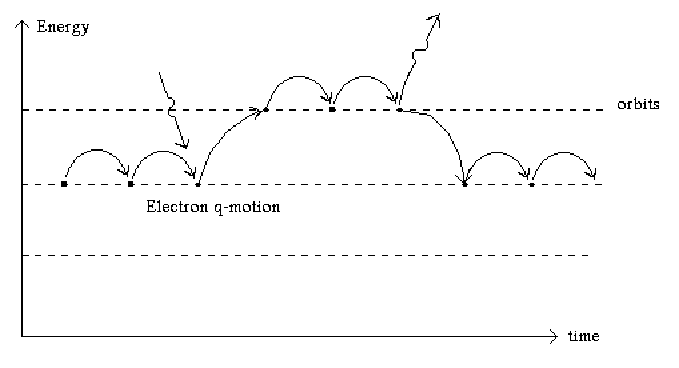
Figure 14.2 When an electron intercepts a photon, it rises to a higher energy level. Soon after, though, it must "throw-off" the excess energy by emitting a photon.
However, an electron cannot remain in that orbit indefinitely and must eventually "throw-off" the excess energy. It does this by emitting another photon, then it falls back down to its previous orbit representing the lower energy state it had earlier. This is shown in Figure 14.2. This is what we basically understand as light reception and transmission.
If I cannot detect a photon or a ray of light (light wave) in-between a light source and a lit object, the next best thing I can do is to describe what happens at the source and at the object (which I have just done). I may also describe the time interval between the two events, but only from the standpoint of the relativistic observer (at this point in time).
From our new understanding of the non-existence of space, I must now ask the question; How does a photon or a wave "know" which quasi-spatial direction to go? Further, how does it "know" that it has a quasi-spatial choice to make in the first place?
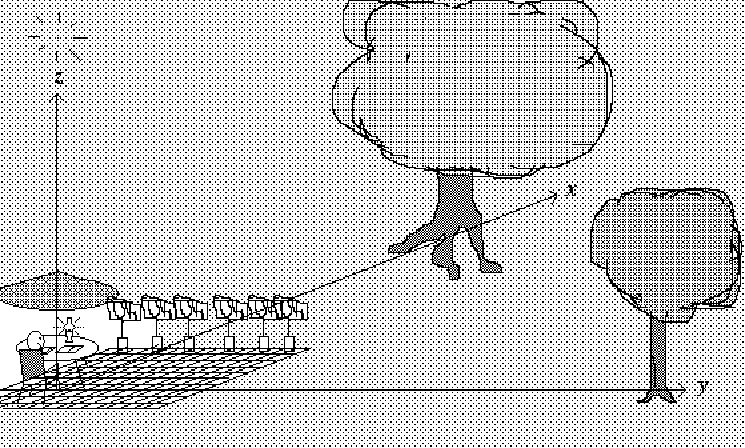
Figure 14.3 From my relativistic vantage point, I see three objects, an oak tree, an orange tree and a star, which create the perception of three-dimensionality for me.
As I look straight ahead of me, I see an oak tree (I happen to be sitting outdoors as I write this) and I view the line between myself and the tree as being "straight." This is a result of my perception of the world and seems perfectly natural at first. So, if I want to take the shortest route to get to the tree (failing to avoid the thorn-covered rose bushes barring my path), I shall follow that line and remain on it until I reach it2.
|
2. Note, of course, in this argument, that I am ignoring the "curvature of space" due to the gravitational field of the earth-or other gravitational fields, since they have no place in this argument-yet. |
Instead, I prefer to remain sitting comfortably where I am and happen to notice that directly to my right, at a 90 degree angle is an orange tree. The line between myself and the orange tree I also perceive as straight, and the same case applies to it as applies to the oak tree.
Now if I look straight up, I take note of a star in the sky directly above me which is again at right angles (90° ), from my relativistic vantage point, to both the oak tree and the orange tree (it will move shortly, though, because of the earth's rotation).
If I have properly (and precisely) located these items, then I (as the "origin"), the two trees and the star above define the three axis' of a Cartesian coordinate system. They represent non-relativistic q-space at a point in time. The addition of the temporal element will make this a four-dimensional continuum.
The strangest thing to me is that we see this as natural-that Cartesian axis' in q-space should be at right angles to each other. Suppose that the angles were not 90° apart? Suppose instead, that they were 100° apart? Or 80° apart? Imagine, instead, that you are looking at the world through a "fish-eye" lens, or instead perhaps a "zoom" lens.
But of course. We would have a similar perception of orthogonality-and it would, again, be "natural" for us, but there would be a different definition of the universe from what we now perceive. A full 360° circle might be a full 320° circle, or a full 400° circle.
Light would still appear to move in "straight" lines, but the objects around us would exhibit greater or lessor curvature than they do in this reality. Our world (universe) would actually be either larger or smaller than it is. In addition, (and very importantly) the speed of light would be different.
So light provides some definition to orthogonality. It tells me a few very important things: First, the q-speed of light tells me the q-spatial "size" of the universe (and everything around me as well). Second, the q-speed of light defines the "angle of orthogonality." Third, and most importantly, it tells me that all temporal action in the universe takes place (nearly) perpendicularly to its q-spatial direction of motion. This is the true definition of orthogonality.
What this means is that if I want to move from here, where I am sitting, to the oak tree by the shortest route, I cannot follow the straight line between us to get there. I must move perpendicularly (at q-spatial right angles) to do so.
More properly stated, the d-particles, particularly the quarkets which comprise my body, must move perpendicularly to the direction of my q-spatial motion.
But since q-matter (quarkets) cannot continuously q-move and may only move discretely, it is temporally bound to move only along intervals in time, relative to other d-
particles. This interval is approximately the life span of the universe.
So, if I label the interval of the life span of the universe as "L," then the interval of existence for any quarket will be "L ± a." I use the symbol ± (meaning plus or minus) to indicate whether the particular quarket is moving forward or backward in time. I note here that the value of a describes, not only the temporal differential of the quarket, but its kinetic energy as well.
We recall that any d-particle appears only once in the life span of the universe-which is stated by previous theorems concerning its creation and annihilation. The d-particle itself however, must occur many times in resonance in order for the universe to form and change. It sees only other versions of itself.
The perpendicular motion takes place temporally but q-spatial motion (and temporal motion) may only occur as a result of the moving path potential.
The concept of the path potential offers an explanation for many of the phenomena we presently observe- particularly the phenomena of light and force-and is given without proof. It is however, firmly rooted within the framework of the Time-Energy Theorems. This result should be fairly obvious, however.
Before I go any further, I want to establish another facet of the time-energy relationship as a corollary;
|
Corollary 4: Light does not q-move from one quasi-spatial point to another. |
Next I want to define what I mean by "path potential." If light cannot q-move, then obviously, at least in the quasi-spatial sense, something must. I call that something the path potential. This is more importantly recognized, if we have followed the arguments closely, as light. This is essentially the path that a "ray of light" will follow. But I have stated in Corollary 4 that light does not q-move from one place to another. What does happen is that, because of shifting path potentials, "energy" (or potential) q-moves from one q-place to another-in essence-a temporal displacement of q-matter.
However, this is not the sole activity of the path potential; it also serves to implement the temporal displacement of q-matter. In a butchery of correct wording (in plain english); The path potential creates (or causes) both light and motion. Its definition follows as the next theorem, but I will explain it better;
|
Theorem 17: The path potential of any d-particle motion is quasi-spatially perpendicular to its temporal direction. |
In order to explain the concept of the path potential, I must first introduce the three important concepts from which it emerges. These are the universal time-line, the time-coil of the universe and the relative transition phase angle.
From previous chapters we observed that each d-particle has a time of existence and a time of non-existence, and that the frequency and period of oscillation varies for each d-particle. Each d-particle exists in some energy state related to other d-particles.
The universal time-line is the line upon which all matter, all energy, all interactions between d-particles and all path potentials reside. Nothing takes place in our perceptible universe which does not occur on this time-line. The universal time-line is infinite in length, but "enjoys" cyclic patterns which repeat in perfect expression (i.e. the repeating universe).
The universal time-line is a reflection of the expansion of the universe from its beginnings, in which no time exists. Time, or its appearance, is the result of temporal perturbations equal and opposite to one another, which in their destruction, produced temporal "flats" in the universe allowing the apparent existence of q-matter. Fluctuations in the temporal "flats" are recognized as path potentials, into which q-matter is "drawn."
The essence of the universal time-line may be continuous, but having allowable discontinuous (discrete) processes occurring within its boundaries, which are infinite, but limited to this universe and the time-line itself. It may also be discrete in its nature, but I am not at this point able to determine which. At any rate, all "activity" on the universal time-line is discrete. It may be that it is necessary for the universal time-line to have a continuous essence in order for this to be the case. It may also be that the universal time-line must have a discontinuous essence in order for discrete processes to be the rule. The greatest hint about this is given in the creation of the universe, in which there was a breakdown in the continuous production of d-particles at the beginning of time.
The cause of this breakdown could have been anything from the production of a d-particle of a different temporal length than the ones previously produced to a d-particle of a different temporal density. This assumes that a probability existed for such an occurrence, and that the probability was remote in the extreme. Any one of these cases may constitute an argument for continuity of the universal time-line.
However, there are arguments for discreteness also. One d-particle without its corresponding anti-d-particle could have been produced, which would have produced a temporal flat which would have in turn, given other d-particles a q-place to go. Also, if a d-particle pair were not produced at one interval of d-particle production, this would have also produced a temporal flat. In this case, the universe would have been confined to having a discrete essence. The arguments are endless without knowing (or at least being able to theorize) what caused the initial breakdown in d-particle pair-production.
The characteristic trait of the time-coil of the universe is that of there being only one d-particle in existence on any particular loop in the coil. Each loop in the coil represents the entire life span of the universe, since only one d-particle is in existence for that entire span, and only exists momentarily. Any point in time from the relativistic observer's viewpoint, may be represented by a curve arcing from any point on any loop (the point must be occupied by a d-particle), and spiraling away in both directions from that point, but not at the same spiral pattern as the time-coil itself. Note that the spiral pattern is superimposed over the time-coil and does not change "direction" as it crosses the point on its particular loop.
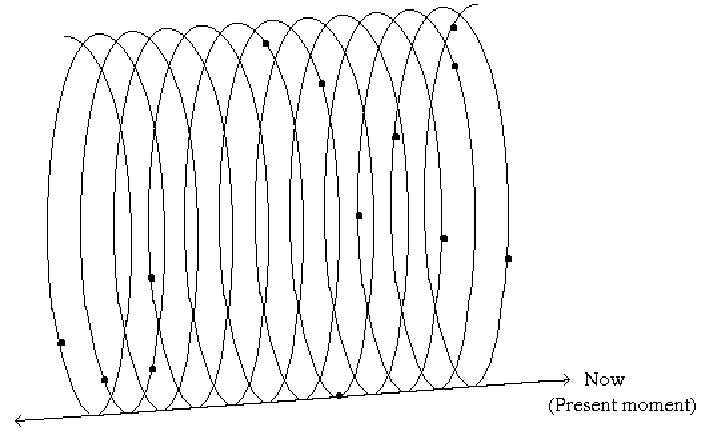
Figure 14.4 The time-coil of the universe is a continuing series of coils, each one having only one d-particle and each being the life span of the universe. The straight line representing the "now" is a spiral.
Because the spiral pattern superimposed over the time-coil is closely related to the q-speed of light, a close-up "view" of this intersection would appear to us as being approximately straight (i.e. perpendicular to the loops in the time-coil). However, an extreme compression of these loops would show us a spiral pattern.
As I refer to the time-coil of the universe, I want to speak in terms of discrete resonances. This is to say that the appearance of a d-particle at a particular point in time (and q-space) is a result of resonance with a path potential, that path potential being very closely related to the spiral which is imposed on the time-coil. If the path potential does not exist at that point in time, then the d-particle will not materialize since there is no intersection with it.
This is to say that a d-particle will exist at a certain point in time, but only if there exists a potential for it to do so. In this sense, the characterization of any d-particle is to resonate at a particular frequency, this frequency being directly related to its wavelength, L ± a.
The temporal length of the time-coil of the universe is finite-relating to the amount of matter, light and action in the universe-but repeats identically beyond its boundaries. It is essential to note that q-matter does not move on this time-coil. The reason for this is that q-matter is merely a perturbation in the time-coil itself. With expansion due to temporal development, the time-coil itself may in fact distort and flex, perhaps even causing new q-matter to be created. This is understood as the motion of the path potential.
The Relative Transition Phase Angle
The relative transition phase angle determines "when" a d-particle will act upon another, which is represented by the interaction of various path potentials. Three d-particles on the universal time-line will produce a perceptual sense of two-dimensionality in the q-spatial environment. A minimum of four d-particles are required to produce a perceptual sense of three-dimensionality in the quasi-spatial environment.
The mathematics of this are just a bit trickier since we have not only the quantized angle displacements to deal with, but also the effects of quantized temporal displacement, temporal direction and the quantized path potential. The quantized path potential is very important since this is precisely the only way that d-particles can "know" of each others' existence. The problem of orthogonality becomes meaningless if you cannot "see" the line you are measuring. In essence, we cannot measure the length of a line if it does not quasi-spatially exist (at least in our perceptions).
We observe that the phase angles of the transition states (the transition phase angle between states of existence and non-existence) vary discretely between d-particles.
The transition phase angle is of little or no consequence in relating two d-particles to one another. It becomes of great importance in relating one d-particle to two or more other d-particles. Since each d-particle exists alone in the universe, each has its own hoop in the finite "time-coil" of the universe.

Figure 14.5 When q-matter moves from one q-place to another, it must move perpendicularly to its q-spatial line of direction. In this figure, d-particles move forward in time.
Suppose then, that we have a moving ball consisting entirely of d-particles which move forward in time (as unlikely as this is might be). Depending on their respective relative transition phase angles, all of these d-particles will leave that point in time (and q-space) and reappear at the next intersection with their respective path potentials. This is depicted somewhat, in an extreme case of exaggerated motion, in Figure 14.5. The arrow labeled v(t) in this figure represents the q-spatial direction of the path potential. The arrows leaving the ball in this figure that are perpendicular to the path potential represent the direction of resonance of those particular d-particles.
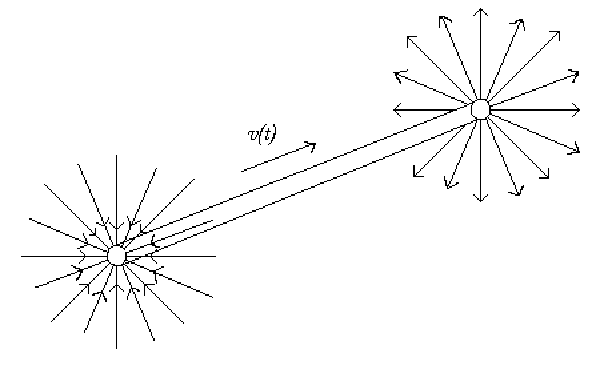
Figure 14.6 When q-matter moves from one q-place to another, it must move perpendicularly to its q-spatial line of direction. In this figure, d-particles move backward in time.
On the other hand, suppose that we have d-particles which move backward in time instead of forward. In this case, the q-spatial motion is the same, as depicted by the arrow labeled v(t) in Figure 14.6. The path potential still retains its q-spatial aspect-that of appearing to move forward in time-but the d-particles are "arriving" at the old position and "leaving" the new one. Again, it is the relative transition phase angle which determines the q-spatial direction of their respective resonances.
As an important note, although the angle of resonance appears perpendicular, it actually is not, as can be seen in Figure 14.7. However, it is almost virtually so for our ability to comprehend it. In fact, the angle is only slightly bent toward the next q-position. In the opposite case, the angle is bent only slightly toward the previous position.
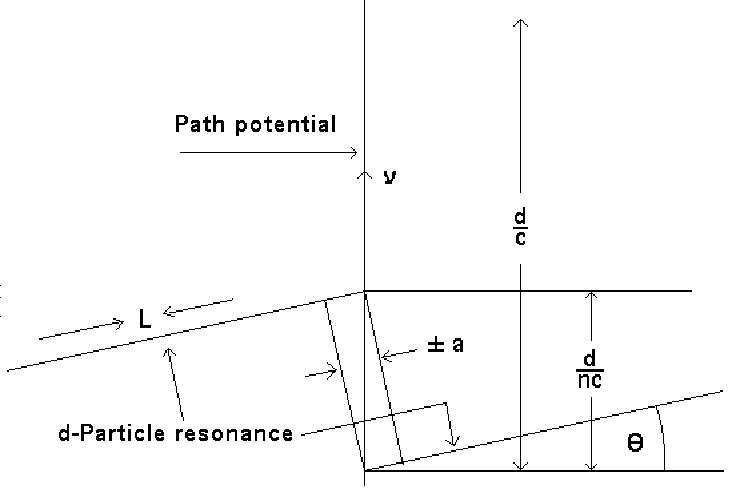
Figure 14.7 The angle of dimensionality is defined by the path potential and the direction of the time-line, these being almost perpendicular to each other.
The reason for this may be fairly obvious. It is because these arrows point to the next d-particle existence on the time-coil of the universe which is at least, at some temporal angle with respect to its previous existence, this angle being less than 90° . This implies of course, that what we view as spatiality or three-dimensionality really is not. Given three absolutely perfect right triangles, you would not be able to construct a perfect Cartesian Coordinate system. Measured to perfection, they would come out larger than what we naturally perceive them to be.
Measurement of the difference between this angle and a perfect 90° angle would be simple to determine if we knew the life-span of the universe. It would be
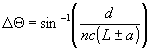 (14.2)
where: Δθ is the difference angle, in degrees,
d is the q-spatial distance (s),
c is the q-speed of light (dimensionless),
n is the number of universal life-spans traversed,
L is the lifespan of the universe (s)
and L ± a is the d-particle "wavelength" (s)
As small as this angle is, it varies discretely because the values of a vary discretely for the different d-particles. As a note to this, I want to remark that this is not the relative transition phase angle I referred to earlier. That angle must be dealt with in other ways.
As an illustration of these concepts, and particularly to help understand the relative transition phase angle, I want to apply them to one of the simpler mathematical models we often use; the right triangle. The attributes of the right triangle are important because I can use it to demonstrate how the perception of a q-spatial aspect (orthogonality) can come about.
Suppose we have three d-particles in a row on our time-line. These three d-particles are temporally separated but also have a quasi-spatial relationship.
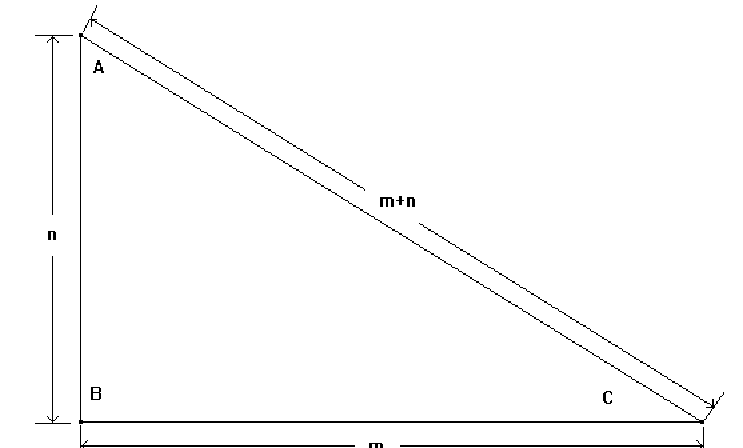
Figure 14.8 The quasi-spatial right triangle is a classical tool of mathematics, which makes it a fine example of application for the time-energy relationship.
For example, let us make these three d-particles the corner-pins of a right triangle, and label them A, B and C. Figure 14.8 shows this relationship.
Suppose that d-particles A and B are n units apart and that d-particles B and C are m units apart, and further, that these are temporally separated by equal amounts. It follows logically from the time-energy viewpoint, that d-particles A and C shall be, as connected on the time line, m+n units apart, at the very least. In the q-spatial sense, this is definitely not the case and so it must be analyzed since it defies our perceptions.
Suppose that d-particles A and B have a relative transition phase angle of zero. This relationship will establish a straight line in q-space. The addition of d-particle C forms relative transition phase angles between d-particles A and C and d-particles B and C. This works fine as long as the number of units of temporal separation between each d-particle is the same. But as soon as I attempt to form a right-triangle I run into problems.
First, I will actually be able to form a right triangle with three nearly discrete sides (they will be off by merely a small angular difference of less than one temporal unit). This tells me that my model is too primitive and needs development.
In order to properly develop this model I must first realize that I cannot use individual d-particles as the points of my triangle. In this specialized case, since d-particles A and B are in phase, the only way that d-particle C can detect them is if it is also in phase with them. So I will have to use a group of d-particles to establish each q-point on the triangle-a q-space mass. Of course, as we all know, a group of d-particles cannot establish a point in q-space. I will assume for practical reasons, that it can (especially since I am able to do so with a simple pencil mark).
It is noted here because of this, that there is no such thing as a true q-space right-triangle. Those exist only in mathematical theories of continuous systems, and so I will write the next theorem to support this.
|
Theorem 18: A true right-triangle in q-space cannot be formed out of d-particles. |
What I have then, are three q-space masses representing points A, B and C. Between points A and B, points A and C and points B and C, there are d-particles contained within each q-mass point which have respective identical transition phases. This is quasi-spatially depicted in Figure 14.9.
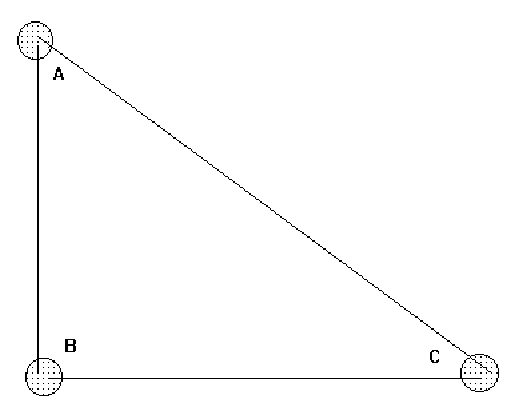
Figure 14.9 A true quasi-spatial right triangle cannot be formed out of d-particles-but an approximation is possible using a pencil mark.
Now if you have been paying close attention, you can see that the right triangle represents the very embodiment of the difference between the relativistic observer and the time-energy observer.
Suppose that the relativistic observer resides at point C on the q-spatial right triangle. In this example, the relativistic observer is represented by the group of d-particles which comprise the point3 "C" in q-space.
|
3. I hope that mathematicians will pardon the liberties I am taking with my idea of a "point." For their edification; In the true mathematical definition, a point is an infinitely small, and therefore occupies no "space." In current usage, it is defined by a specific coordinate on an axis or in a set of coordinates on two or more axis'. |
As a relativistic observer, he/she/it observes many events in a "moment," depending on the temporal span of a so-called moment, but also he/she/it observes many q-spatial directions. And it is important to understand that the reason for this is that the relativistic observer is comprised of many d-particles.
If the situation were as in Figure 14.7 where each point on the triangle is represented by a d-particle, then any two of the three might "recognize" each other's existence. But no matter what the scenario, the third will invariably be "left out."
For the d-particle, there is no such thing as a "triangle." The reason for this is that either two of the three may be in phase, to the exclusion of the third. This is the result of the relative transition phase angle.
The relationship between time and energy may be described as the result of changing relationships between d-particles-although this may be understood as a constant. But there is a much more important result, which is a change in the changing of temporal relationships. In essence, the change in the energy states of d-particles-with respect to other d-particles-is the result of a change in that d-particle's temporal "expression" (i.e. how quickly it moves through time relative to other d-particles and how long it remains in existence-also with respect to other d-particles).
The inherent meaning of this argument is embodied in this equation4;
Δ
E = ΔΔt (14.3)|
4. It is tempting, of course, to try and simplify Equation 14.3 by removing one of the Δ's from each side of the equation and discover that the energy of a d-particle is simply; E = ΔtBut this may or may not be the case. If anything, it is merely a representation of the kinetic energy-which may also be its total energy. |
Most notably, this change does not occur in d-particles unless they intersect with path potentials. But path potentials are caused by d-particles as they come into existence. At the very least, the path potential is altered as a result.
This is light, or the transmission of energy from one q-place to another. The q-speed of light is really the q-speed of the path potential. But since the path potential is
really only an abstraction representing the propensity for q-motion in the universe, it cannot have an actual q-velocity.
The closest thing I can relate to this is the rate of time development in the universe-in essence, how quickly time (our perception of it anyway) goes by.
So when you gaze up into the nighttime sky and you see light from a star from far into its "past," you really are seeing its present, with respect to yourself. With respect to the time-energy observer, the star's future is already fixed. For the relativistic observer, there can be no instantaneous, infinitesimally small present moment. This is reserved for only the time-energy observer-the d-particle.
Relativity and the Twin Paradox
This is a minor application of the Time-Energy Theory, in its ability to explain otherwise unexplainable phenomena. There will be many of these to come, and probably most of them will not be explained by me. For me, there are so many of them that I simply do not have the time to write them all down. But this one was a curiosity for me, so I decided to include it here.
For a long time (roughly 90 years-since the introduction of the Special Theory of Relativity), scientists have vexed and argued over this problem and have, somewhat vaguely, concluded a solution. So I will explain this solution, somewhat vaguely, after I first explain the paradox.
As I explained in an earlier chapter, one of the most important predictions of the Special Theory of Relativity was time-dilation. In the Twin Paradox scenario, two twins begin the experiment both having the same age by having one remain on Earth while the other takes to the stars in a spaceship. Let us call them Jay and Joe-Jay stays and Joe goes.
Because Joe's spaceship travels very near to the speed of light relative to Jay's position on Earth, Joe experiences time-dilation, in which time slows down for him relative to Jay. Suppose it takes a year of Joe's time to go to a new solar system and return. He returns to Earth one year older for the trip.
Meanwhile, Jay has remained on Earth awaiting the return of his twin brother, but because of time-dilation has aged ten years for Joe's one year in space.
From Jay's point of view (as a relativistic observer), he has watched his brother hop in a spaceship and move away from him at near-light-speed (he has a very powerful telescope for this). Radio communications have given him the times from the ships clocks and has indicated that relative time has slowed down for his brother-who is aging less quickly than him.
From Joe's point of view, he is communicating with his brother and finding that the clocks back on Earth are running faster relative to him, so his brother is also aging much more quickly than he is. So far, no problem...
But the point of the Special Theory of Relativity was the relating of variously moving reference frames and particularly, their independence in the measurement of c-the speed of light. But when he wrote it, Einstein was very clear about the separation and independence of these inertial reference frames. Motion was relative.
So here comes the paradox; Suppose that from Jay's point of view, Joe's spaceship was not moving away from him but instead the Earth and Jay were moving away from Joe and his spaceship. And from Joe's point of view, instead of his moving away from Earth, the Earth and his brother Jay, were moving away from him and he is standing still. Now, Joe is watching Jay's clocks slow down and Jay is watching Joe's clocks speed-up. What went wrong?
Now, many scientists have tried to answer this paradox by suggesting that the reason Joe's clock should slow down instead of Jay's, is because Joe is experiencing an acceleration. But this answer is vague and not very coherent. Meanwhile, we accept it because we have no other explanation-and time-dilation has been observed in real experiments.
However, we on Earth also experience an acceleration-due to gravity. That acceleration factor is called "g." We experience this acceleration constantly; every moment of every day of every year. We are never out of it (unless we are astronauts).
Suppose then, that we accelerate Joe's ship at a factor of one g-identical to the acceleration factor we experience on Earth. It will take a little while longer to get Joe's ship up to a relativistic velocity, but it will eventually happen. Meanwhile, back on Earth, Jay is also experiencing an acceleration factor of one g. And from Einstein's General Theory of Relativity, these two effects are identical in every respect. So, acceleration is not a good explanation for the Twin Paradox.
If you have been paying close attention to what you have been reading so far and if you are thinking only slightly ahead of what you have been reading, then you already know the answer to this paradox-it is easily resolved within the framework of the Time-Energy Theory.
And the answer is this; in the Theory of Relativity, reference frames are indeed relative as explained earlier. These, however, we will carefully note are quasi-spatial frames of reference-they have no origin. The temporal frame, which is purported by the Time-Energy Theory, is absolute-not relative, and does have a fixed origin. This is important to remember.
When a stream of l-particles or f-particles (leader-particles or follower-particles) is forced into a change of q-motion, it is drawn out of the path potential since the resonances no longer match. It is required of the universe (and other surrounding matter) to supply a new stream of l- or f-particles (n-particle, or next-particles) having different resonances.
In essence, in order for a set of n-particles to respond to a new path potential, something must be given up elsewhere. In other words, for every action there is an equal and opposite reaction (Newton was actually right about this).
From the Time-Energy viewpoint, when matter is accelerated to near "light-speed," its temporal existence is reduced-d-particles occur less often than elsewhere in the universe because temporal development in a moving q-mass is slowed with respect to the rest of the universe. Quite literally, time really does slow down.
Oddly enough, this subsection was added to the second edition of this book, although I was not quite sure where to put it (hopefully where it could "do no damage"). I had actually considered not including it, even though the phrase had been advertised. My thoughts were that it should be obvious to the reader after reading this book and further that it was not necessary. I decided to put it in anyway. However, if you are reading this subsection only to find out what it means, you are out of luck-you have to read the rest of the book to find that out.
Anyway, here is how it came about and how it fits; For a long time, I had been contemplating a means of replacing the concept of the Space-Time Continuum, but I had not had much luck (or inspiration). I had considered such replacements as: Discretum (not quite...), Discretium (no, not that either), Temporality (not very descriptive), and so on.
Then one day I was suggesting phrases for the advertising agency to use (throwing out ideas, etc.), and Time-Energy Temporium popped-up. I do not know where it came from, but it seemed "just right." It is fairly descriptive of what the theory purports, and it supplants the notion of the space-time continuum. It goes well with time and the path potential (energy), without making an implication about the underlying nature of time, since I have neither defined the universal time-line as discrete nor as continuous.
The word Temporium (being new), relates to the word temporal, and implies a "wholeness," or "singularism." At the same time, the Time-Energy Temporium comprises all "things" (in the universe), so it also implies a "plurality" about itself. In this way, the arguments conceived 2500 years ago by Zeno and Aristotle are both satisfied, the universe being a single object and also a multitude of objects, but separated temporally.
This completes the "technical" part of this book. The reader is reminded of a fairly comprehensive index and a number of useful appendices in the back of this book.
Home Begin Preface Acknowledgements Contents Chapter 1 Chapter 2 Chapter 3 Chapter 4 Chapter 5 Chapter 6 Chapter 7 Chapter 8 Chapter 9 Chapter 10 Chapter 11 Chapter 12 Chapter 13 Chapter 14 Chapter 15 Chapter 16 Chapter 17 Chapter 18 Appendix A Appendix B1 Appendix B2 Appendix C1 Appendix C2 Appendix D Appendix E Appendix F Appendix G General References Future Books About the Front Cover About the Author Index