
|
The Theory of the Time-Energy Relationship: A Scientific Treatise |
2
IDEAS OF LIGHT AND SPACE
Light is that stuff that comes from the sun, or a light-bulb or even a lit candle. In fact, it comes from everything around us that we can see-and also things we cannot see. Look around you for a moment... everything that is visible to you is only visible because light is coming from the objects around you to strike the biological detectors in your eyes.
As we examine the nature of light, we note certain things about it that we are able to describe in terms we understand. A few of these things are as follows;
The speed of light is measured to be about 186,000 miles per second, or about 669,600,000 (6.7 x 10⁸)† miles per hour. Scientists prefer to use the metric system, in which they measure the speed of light in terms of kilometers per second, which is about 300,000 kilometers per second, or about 1,080,000,000 (roughly one billion or 1.08 x 10⁹) kilometers per hour.
|
Scientific Notation † In this book I will use scientific notation often. The reason for this is so that I will not have to write out very large numbers which can take up entire lines of text. However, I will explain scientific notation for the "uninitiated" here and now; Scientific notation is a "shorthand" means of writing very large or very small numbers which would otherwise have many decimal places. For example, the number 1,230,000,000,000 can be written as 1.23 x 10¹², in which the decimal place has been moved to the left 12 places and then made into powers of 10. On the other hand, the number 0.000000000000000000354 can be written as 3.54 ´ 10-19, in which the decimal place has been moved to the right 19 places and then made into powers of 10ths. Note here that a negative sign has been placed before powers of 10ths to indicate that this number really has powers of 10 in the denominator (i.e. is divided by powers of 10). |
The different colors you see around you are because of the many different frequencies of light that exist. The spectrum of visible light is on the order of 1,000,000,000,000,000 (one-million, billion or 1015) Hertz. But if we limit the spectrum of light to what our eyes can see, we leave out the vast majority of the electromagnetic spectrum, since, by present understandings, light can be treated as electromagnetic waves.
If we include everything in the electromagnetic spectrum (see Figure 2.1) as part of our definition of light, then we include everything from radio waves, at about a frequency of less than one Hertz (100) and lower, to Gamma rays, which transmit at about a frequency of 10,000,000,000,000,000,000,000 (ten-billion, trillion or 1022) Hertz and higher.
Figure 2.1 Electromagnetic Spectrum showing the different forms of light and energy. Note that this is a logarithmic (base 10) scale. Also note the smallness of the visible spectrum.
Presently, light is considered the most primary means by which energy is moved from one place to another. There are two modern competing theories as to the mode of light transmission; these are as waves and as photons.
The study of the nature of light probably goes as far back as the ancient Greek philosophers. Galileo once tried to measure the speed of light, but because of the lack of modern instruments, was unable to do so. His reaction to his attempts to measure it was, "...if not infinite, then exceedingly fast..." It was Sir Isaac Newton who made the first definitive statements about light and what it was actually "made of."
Newton had done many experiments with light, including the use of prisms, in which he noted that ordinary white light, when refracted through a prism, was composed of many colors. Unfortunately, he also lacked the modern technology that we have today for making more accurate measurements of light. Eventually, however, he arrived at what was called the corpuscular theory of light.
This theory suggested that light was made up of many small corpuscles, or tiny particles that moved from one place to another very quickly. But Newton was unable to support his conclusion since he had observed many phenomena in his experiments that could not be explained with this theory. In the end, when he wrote his findings, he "glossed-over" his reasons for concluding that light had a corpuscular nature. His findings, of course, were inconclusive.
The first person to suggest that light may occur as waves was Christian Huygens in 1678. This helped to explain many of the strange observations that Newton was finding. Unfortunately, Newton, at the time, was recognized as a far greater authority on the subject and because of his fame as a prominent scientist, the wave theory of light was quickly discarded in favor of the corpuscle, or particle theory of light.
Things did not just die there, of course, and much later, other scientists began doing experiments which suggested that the wave theory of light may, indeed, be the correct one.
Eventually, a very brilliant fellow by the name of James Clerk Maxwell came along and produced theories that helped to explain the peculiar observations made by those other scientists, thereby supporting the wave theory of light, saying that light was nothing more than very high frequency electromagnetic waves.
Finally, Heinrich Hertz, who became a very famous experimentalist, came along and performed experiments which could prove Maxwell's theories about the wave nature of light. By this time, the whole idea of the particle theory of light was ready to be wiped out. Light could now be envisioned as moving, like waves in water, through an invisible aether which permeated all of nature and space.
Ironically, in the very process of proving that the light was wave-like in nature, Hertz's experimental apparatus produced a strange phenomenon, which later came to be known as the photoelectric effect, in which light was shown to be particle-like in nature. The results of Hertz's subsequent experiments on this strange effect ran entirely contrary to the wave theory of light. The particle theory was suddenly back in the arena.
Later, in 1905, Albert Einstein proposed some ideas in support of the particle theory and won a Nobel prize for this. Particles of light were now given a name and called photons. The particle nature of light had been proven. Of course about this time, another type of experimental science was on the rise and had very big names to back it up.
It was called Quantum Mechanics, and some of the big names in this new arena were people like Max Planck (Planck's constant), Niels Bohr (Bohr's model of the atom) and Erwin Schrödinger (Schrödinger's wave equation). Of course, Quantum Mechanics purported nothing about the nature of light, but simply treated its odd behavior as variations of probability functions. There was a storm brewing and things were expected to come to a head.
The Special Theory of Relativity
Einstein did not even care about being in the arena for this battle. He was fairly busy playing his own game, writing theories that would set the scientific community on its collective ear. He had extensively studied the works of Newton, Planck, Maxwell, Hertz, Faraday and others, and began gathering his own conclusions about things. He had even, as a student, repeated some of the experiments performed by earlier scientists so that he could see, for himself, what those men had proposed.
Finally, in 1905, he formally introduced his Special Theory of Relativity1. In this theory, Einstein proposed two major ideas about the nature of things: One was that, in the universe, there was no such thing as an absolute reference frame from which all motion could be measured. The other was that the speed of light was the same in every reference frame.
|
1. The year 1905 was somewhat prolific for Albert Einstein, in which he produced no less than three significant papers: one on Brownian motion, one on the Photoelectric Effect (for which he received his Nobel Prize) and one called "On the Electrodynamics of Moving Bodies," later to be popularly known as the "Special Theory of Relativity." |
The first idea suggested that, if you wanted to measure the speed of something, for instance, a moving train, you could only measure it from a particular frame of reference, for instance, the earth. We know, of course, that the earth rotates on its axis and moves around the sun, so if you wanted to know the absolute motion of the train, you had to include the velocity of the earth's rotation and its velocity around the sun in your calculations.
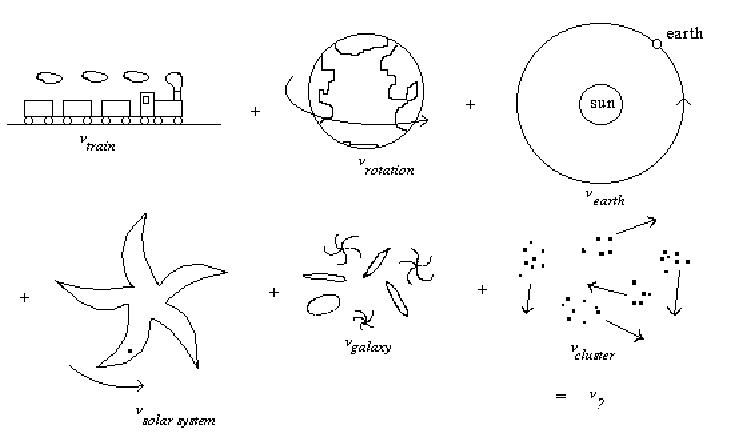
Figure 2.2
Absolute motion cannot be determined since there is no frame of reference from which to measure.But we also know that the sun moves around the center of the galaxy, so that our first calculation would be incorrect. We would also have to include that motion into our calculation. On top of this, however, we know that our galaxy moves around in space at some velocity that we can only guess at. But now we have to ask, with respect to what?-the center of the universe?
Einstein claimed that all of this calculating was unnecessary. There was no such thing as an absolute place from which you could measure motion. In essence, all motion was relative and you could only measure the speed of something, a moving train, for instance, relative to (hence "Relativity") something else, for instance, an observer standing at a train station.
The second idea suggested that, if a person standing in the train station flashed a beam of light at another person, say, standing on the moving train, and then both persons, having the appropriate equipment to do so, measured the speed of the light beam, both would come up with the exact same measurement.
An extreme example of this would be a person standing on earth with a laser beam projecting it at two other persons, one on the moon and one in a spaceship traveling away from the earth at half the speed of light. Then both persons measured the speed of the light beam. Common sense suggests to us that the person on the moon will measure the
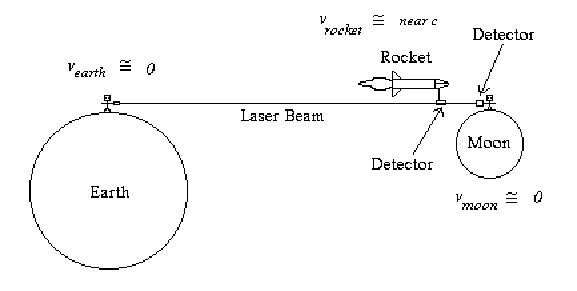
Figure 2.3
Two observers, one on the moon and one on a spaceship speeding away at near light-speed would measure the speed of a laser beam (light) to be the samespeed of the light being emitted from the laser to be its correct value, while the person in the spaceship will measure it to be half that value.
Einstein suggested and then proved, mathematically, that this could not happen. Both persons would measure the speed of the light (laser) beam to be the same, which would be its true and correct measured value.
Einstein had tipped over the bucket. At first, people could not decide whether light was made of waves or photons. But now, with this new theory taking hold, things had gotten so complicated that nobody knew what to think. Light was suddenly transformed into some enigmatic wave/particle that could only be measured at one speed no matter how fast the observer was traveling with respect to the source. The implications of Einstein's theory were staggering, and only proved to confuse the issue even more.
The storm, of course, came and went and, in the end, nobody won. The evidence for each theory had individually provided almost positive proof that both theories were correct, the relativity theory notwithstanding and, to date, there has not been an experiment performed which could undeniably involve both theories and prove one while disproving the other.
Today, both theories have strong experimental evidence acting in their support. Light is seen as having a dual nature-as particles and as waves-sometimes even referred to as "wavicles." And, until now, no theory has been proposed which could successfully explain this strange duality of light2.
|
2. Although some recently prominent scientists have claimed the contrary-see Feynman: QED-in the reference section of this book. |
The Michelson-Morley Experiment
The experiment performed initially by Albert Michelson and later, again with his colleague Edward Morley, called the "Michelson-Morley experiment," seemed to disprove any notion of the "aether" which was believed to permeate all of space and provide a medium for light waves to move through.
Prior to Michelson's experiment, it was strongly believed among scientists that all electromagnetic waves were carried through an invisible, all-permeating aether3 which existed throughout the universe. (This idea, however, was not entirely new4.) Like waves in water, light and energy moved through the aether from one place to another. If this were true, Michelson suggested, then the aether should be detectable by measuring a decrease in the velocity of light due to the motion of the earth through it.
|
3. The concept of the aether was the invention of Descartes, who rejected the emptiness of space and suggested that all of space was filled with matter. This "matter" was seen to be in motion about the center of the solar system, acting like a vortex-drawing the planets inward, with the sun at its center. This all-permeating matter came to be known as the aether. Descartes published these theories in his books, "Principles of Philosophy" in 1644. |
|
4. The Greek philosopher Xenophanes (circa 450 B.C.) suggested that "The essence of everything is 'being'". His idea was that "being" filled all of space so that everything was connected in one huge continuum. Likewise, the Greek philosopher Zeno also argued that the essence of the universe was "singular," opposing other Greek philosophers who argued that the universe was a "plurality." |
The experiment failed to prove the existence of the aether, but two scientists, Edward Fitzgerald and Hendric Lorentz, held that this did not necessarily disprove its existence. Both scientists believed that the motion of the earth through the aether caused a "pressure" contraction in the direction of motion which, in turn, caused the experiment to misread. Eventually, Lorentz and Fitzgerald were outvoted by the scientific community, but the famous equation known as the "Lorentz contraction" (Equation 2.1) survived the argument and is currently used widely to solve the problems of special relativity.
 (2.1)
(2.1)
where: γ is called the Gamma Factor,
v is the relative velocity of a moving object and
c is the speed of light (300,000 kilometers/second).
In this equation, the gamma-factor5 tells us by what factor certain measurable quantities differ between two frames-particularly, the moving frame and the reference frame. For example, if a person in a spaceship traveling past the earth at a sufficiently high speed to have a gamma factor of 2 were to measure a time period of ten minutes on the clock inside his ship, then a person on the earth would simultaneously observe a period of twenty minutes. This is called "time dilation", since time actually slows down for the person inside the spaceship with respect to the person remaining relatively motionless on the earth.
|
5. The character "γ" is a letter out of the greek alphabet. In this book I will use the standard characters in places where they are typically used by scientists. For non-scientists I have included a list of the greek alphabet at the back of this book in both capital and small letters. |
Time is only one of the measurable quantities that changes. Other things, like mass and length, also change. Of course, in order to achieve a gamma factor of 2, one would have to travel at a very high speed-more than half the speed of light.
This is the main reason that we do not observe the effects of special relativity at speeds that we are used to. If you try "plugging in" the speed "v" of a car on the highway (65 mph or .01805 miles per second) to Equation 2.1, you would find the gamma factor to be extremely close to 1 (one). This means that the relativistic effect is negligible, or so small that we would never be able to see it or notice any difference at all.
Upon the introduction of the special theory of relativity by Albert Einstein, all notions about the possibility of there being an aether disappeared.
Hertz did not pay much attention when he first discovered the photoelectric effect accidentally in 1887 while performing an experiment to prove that light occurred in the form of electromagnetic waves. But later, the problem was taken up by Max Planck, and even later, still, by Einstein, himself. What they discovered, as they unraveled the mysteries of Hertz's and other's experiments to follow, was that the energy of light was directly proportional to its frequency.

Figure 2.2 Wavelength. The length of a "light-wave" is inversely proportional to its energy. The shorter the wavelength, the higher the energy.
This was to say that, the higher the frequency of light, the greater its energy. But more importantly, they found, the shorter the wavelength (see Figure 2.4), the higher the energy. This was no small fact to contend with; what it meant was that there had to be a limit to the shortness in the wavelength of light. If there were no limit, then certain forms of light would be able to "carry" infinite amounts of energy.
This idea came to be known as the "ultraviolet catastrophe." It was, of course, a catastrophe since no one believed that any form of light could have an infinite amount of energy.
From the electromagnetic view of light, it meant that energy had to occur in discrete quanta-that is-it only came in one "size," and all other sizes were simply made up of two or more of the smallest. All forms of light energy were suddenly quantized! Many experiments have been performed since to verify this phenomenon.
Home Begin Preface Acknowledgements Contents Chapter 1 Chapter 2 Chapter 3 Chapter 4 Chapter 5 Chapter 6 Chapter 7 Chapter 8 Chapter 9 Chapter 10 Chapter 11 Chapter 12 Chapter 13 Chapter 14 Chapter 15 Chapter 16 Chapter 17 Chapter 18 Appendix A Appendix B1 Appendix B2 Appendix C1 Appendix C2 Appendix D Appendix E Appendix F Appendix G General References Future Books About the Front Cover About the Author Index