
|
The Theory of the Time-Energy Relationship: A Scientific Treatise |
9
QUANTUM REPERCUSSIONS
Before I go into this subject, I want to explain that this was one of the last chapters to be written. The conclusions I reach by the end of this chapter were taken by me at one time as assumptions-but more importantly as intuitive understandings.
Unfortunately, many individuals I spoke with about this theory either did not directly "see" the intuitive logic of it or simply could not accept such bold statements without better arguments. What this meant was that I was forced to write out a formal, logical proof of it, which is the content of this chapter.
My intent here is to prove the non-existence of space which quite naturally should, in view of all that we know today, be rather obvious. Before I wrote this proof, I was often quite surprised to find that some individuals would immediately challenge this assumption-which was fine, but tended to get in the way of the exchange of ideas and particularly, hindered the advancement to some of the obvious, but far more important conclusions.
|
Addendum to the 2nd Edition It was between the first and second editions of this book when I discovered that it was Zeno who first challenged the concept of the existence of space. In a much earlier, un-published version of this book, I had included a short "blurb" about Zeno's Runner Paradox, but later removed it since I felt it had no place in any of my arguments. However, for a long time I had been attempting to construct arguments against the infinite continuity of matter, space, time and energy. After some lengthy consideration I finally decided that certainly somebody must have constructed an argument before, especially since I knew that Descartes and Einstein argued against it. My search sent me back to the library, and somehow I managed to land in the Greek Philosophy section, poring over the works of the ancient Greek philosophers-particularly, the works of Zeno. I ran into one small problem, however; I was faced, quite literally, with a mountain of books, all just on the ancient Greeks, no small part of which can be attributed to the Pre-Socratics, of whom Zeno was one. My first impression of the ancient Greek philosophers was one of amazement-particularly at the intellectual prowess they demonstrated, especially considering their lack of technical data and instrumentation. These were definitely not "neanderthals," and had an uncanny grasp of logic, reason and structure. Nor were they prone to "worshipping the Gods." Moreover, I was shocked to find out that I was not the first person to suggest that "space does not exist." Certainly I could not have reasonably expected to be so. But for it to have taken place so long ago was a "blow" to my own "ego," however slight that may have been. There was another side-effect to this jaunt, however, even more important than finding the arguments I had been looking for. After "plying" through several of the volumes I had selected (out of the hundreds), and read through several of the arguments (for and against), I began to realize that none of their arguments could hold on the basis of pure logic. What they lacked were the experimental data, which were not available until the early part of the twentieth century-which data are certainly available to me, which is why the solution to this problem could not be written until then. In fact, proof of the non-existence of space should have been written by Albert Einstein, who instead argued against it, unconvincingly, I might add. However, two things may have gotten in his way, both having little to do with the logic of it: First, he would have had to argue against one of his own devices (the calculus), which he used to solve the relativity problem in his original treatise', and Second, he would have had to accept several of the premise' which established the principles of Quantum Mechanics-instead which, he argued so bitterly against. Why he choose such a path may someday be discovered; perhaps it may have been, as I suggested earlier, only politics. It is almost as though, being upset with himself for "giving-in" during the first round, he refused to do so during the second. Indeed, had he followed his original instincts concerning the space-time continuum, thereby rejecting the notion, he might have accepted a few of the premise' of Quantum Mechanics, and might have even discovered the "deterministic solution" he so eagerly sought. For me, I find myself arguing the "down-side" of a losing battle, having to strive against ideas which have been fiercely embedded in scientific thought for a very long time. Oddly enough, current scientific theory is in such a dispirited state, being unable to explain even the simplest of observations, that the time may be "ripe" for change. My preference right now is to avoid becoming a victim of my own prejudices. |
At times this became rather frustrating for me since my only (good verbal) argument was to ask how one could possibly argue its existence. I was attempting to force the other to prove that it did exist-which naturally no one could do. They, being aware of this, would return the ball to my court insisting that I was the one making such a bold statement, and it was therefore my responsibility to prove my own argument.
So I have written this chapter as a solution to this problem. The irony of this is that the reasoning I used to arrive at my understandings and the reasoning behind this formal proof take two different paths to the same conclusion.
Quantization of Particle Motion
I want to start out by showing that all particle motion is quantized. I will begin by assuming that all particle motion is continuous1 (as in a continuum)-with the intent of showing that it is not.
|
1. Here is a paradoxical question that seems to boggle the mind, in consideration of our current view of "spatiality;" If there are an infinite number of points between two points separated by one inch distance, does this mean that there are twice as many points between two points separated by two inches? (Some mathematicians claim that some "infinities" are larger than others, but to me, twice infinity equals infinity.) |
First however, let me explain what is meant by the difference between discrete and continuous motion. Suppose that there is a particle moving along a straight line (note that mathematically speaking there are an infinite number of points between any two discrete points along a straight line).
If the motion of the particle is discrete, then it will only exist at certain points along the line (see Figure 9.1a) and each point will be separated by a minimum unit of distance. Say for instance, that the minimum unit of distance is one inch. Then any two consecutive points of existence (of the particle as it moved) would be a minimum of one inch apart. However, any two consecutive points could also be two or three (or more) inches apart.
Figure 9.1
Discrete and continuous motion of particles. A. Discrete motion of a particle is represented by a dotted line. B. Continuous motion is represented by a solid line.No two points of existence (consecutive or otherwise) could be separated by a distance of any value other than a whole (integer) number of inches. For example, two points could not be separated by 6.5 inches, 1/2 inch or 9.37156 inches. They could be separated by one inch, 6 or 7 inches or 9 inches. There could be no separation by zero inches since that would be the same point. This is what is meant by discrete motion.
If the motion of a particle is continuous, then it will continuously exist at every point along the line, and since there are an infinite number of points along any line, then the particle will never cease to exist. A plot of its motion (see Figure 9.1b) will be a solid, continuous line. Note, incidentally, that this plot takes place not only in space but in time as well.
Since light (photopic) energy is transmitted in discrete units, this must also be the case when energy is imparted to a particle by a gravitational field. The connection here can be made through two ideas; First, light energy is quantized, which we know from blackbody radiation experiments performed around 1900. Max Planck was the first to suggest that quantizing the energies could lead to a better formulation of the results that were being recorded from experiments. Later, in 1905, in his paper on the photoelectric effect, Einstein suggested that the quantization of light was one of its natural characteristics.
From this characterization we know that since the energy of light is quantized, any change in that energy must also be quantized. This must however, somehow imply that the absolute form of light (whatever it is) has a discrete nature about itself and may only interact with matter in discrete ways; in a word, light has a discontinuous form. Now I want to ask this question; If light is naturally discontinuous, can it be acted upon by a "continuous" force-such as gravity? (I am assuming initially that gravity is continuous-for the sake of the argument.)
The previous arguments by Einstein, and subsequent "proofs" (I put the word proofs in quotes to denote the possibility that the proofs in question could be the result of other factors, and will always remain to be absolutely proven) appear to suggest that gravity does indeed interact with light. We know that gravitation is chiefly involved in the calculations of mechanical energy-specifically that an object held in a gravitational field has a certain amount of potential energy and that an object released (a ball dropped, for example) in a gravitational field will acquire mechanical energy.
From Newton's classical laws, in order to change the motion of an object, a force must be applied to that object. If as a result of that force the object changes its motion, then the mechanical energy of the object also changes. Suppose that a ball is dropped from a twenty-story building. By the time it reaches the ground, it will have a certain amount of mechanical energy, the amount of which can easily be calculated, but which was only acquired from the force produced by a gravitational field.
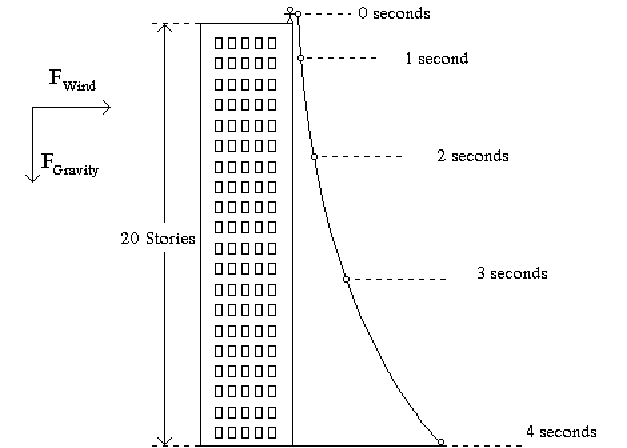
Figure 9.2
A ball dropped from a twenty-story building with gravity and wind forces.Suppose now, that while the ball is dropping, a cross-wind is blowing steadily along the side of the building and as a result of this wind, a force is applied to the ball in the form of the pressure from air molecules striking the ball on one side. The obvious result of this is that the ball now acquires mechanical energy and being accelerated in two directions at once: one from gravity and one from the wind. The net result is an increase in the overall energy of the ball before it hits the ground.
The wind, while supplying "mechanical" energy, is supplying it only in discrete quantities. This is because the molecules of the air striking the ball are surrounded by orbiting electrons, as are the molecules that make up the outer skin of the ball. So the only parts of the matter which are exchanging energy are the electrons. In this scenario, a (fast) moving air molecule comes into "contact" with a "relatively" motionless ball molecule and electrons in the respective outer orbits of the ball molecule and the air molecule exchange energy, thus imparting rather specific directional motions to each of the two respective molecules, thereby changing the mechanical energies of each of the two molecules.
Quantization of Mechanical Energy
These energies are not however, simply mechanical; in this case they are quantum mechanical energies. From Niels Bohr's model of the atom and Quantum Mechanics, we know that the energy of electrons in orbit about a nucleus must be quantized in order to keep the atom from collapsing. Therefore, the mechanical energy imparted by an air molecule to a ball molecule must also be quantized. In the final count the total change in the mechanical energy of the ball due to the wind has an exact, discrete value.
By far the vast majority of the mass of a molecule is contained within the nuclei of the atoms within the molecule, so the energy of motion transmitted between electrons is in turn transmitted to the heavy particles (protons and neutrons-which are roughly 1836 times heavier than electrons) within the nuclei by the electrons. However, the energy transmitted to the nuclei may only be a quantized amount since that is all of the energy which is exchanged between the molecules. So mechanical energy exchanged between pieces of "solid" matter as a result of impact or touching may only be quantized.
Light energy does the same thing! Light which is incident upon a molecule will strike the outer electrons of the molecules, thereby imparting energy in discrete amounts to them. This energy, if not subsequently given off (reflected), can actually produce mechanical motion of the incident body.
This suggests from the mechanical viewpoint of electrons that spatial, motional energy of electrons is also quantized, at least from the point of view of other electrons since an electron in an air molecule can impart energy to a ball molecule only if it has a certain (quantized) degree of mechanical energy.
The second idea is this; In the General Theory of Relativity, Einstein claimed that gravitational inertia and mechanical inertia were identical properties of matter. Through his calculations, he was able to show that gravitational acceleration and mechanical acceleration were also identical properties of matter.
This being the case, it is easy to translate this into meaning that since the energy of electrons in orbit about atoms is quantized, then the energy imparted by a gravitational field to the nuclei of those atoms may also only be quantized since the mechanical energy of the nuclei must be translated in motion to the orbiting electrons. In this case, it makes no difference whether a gravitational field is quantized, since the energy of the field may only be imparted to matter in discrete units.
More importantly however, we "know" from general relativity that light bends in a gravitational field, and further that the energy of light is quantized according to its wavelength. When light bends in a gravitational field, we also know that this produces a discrete shift in the wavelength of the light. Therefore, gravity may only discretely bend light and may therefore only act quantum mechanically on any form of energy-including matter. Since the source of gravity is matter (and energy-as its alternate form) then gravity must be quantized.
Ultimately this means that when energy in any form is imparted to a particle, that energy may only be imparted in discrete units. As a result, this statement includes electric and magnetic fields, which must also impart energy in quanta. If we continue under the assumption that all particle motion is continuous, we must now conclude that any change in that motion must be discrete.
We must also include the energy of particle annihilation and creation in this definition, which must also be quantized. But since the energy of annihilation or creation includes both the internal energy of the particle itself and its initial kinetic energy, we can then conclude that its kinetic energy is quantized.
Another less notable energy attribute of any particle is its potential energy. Potential energy of matter is dependent on its spatial proximity to other matter. Since we know that energy, in any form, must be delivered, acquired or held in discrete units, we must conclude that potential energy also may only be acquired or held in discrete units.
Transition States Are Quantized
Even within these limitations we may still have continuous motion with discrete motional transitions. The only problem remaining is to see how particles make transitions from one quantum energy state to another. If particle motion is, indeed, continuous, then we must observe continuous transitions between energy states-but we do not.
We can deduce that particle motion cannot be continuous during quantum energy state transitions, otherwise we would have to assume infinite acceleration of the particle. But since the transitions do indeed take place, we must finally deduce that particles cannot exist during quantum energy state transitions.
Now I ask, if a particle can have a period of non-existence, is this period oscillatory, or does it only occur during transitions between energy states? In order to answer this question, we must examine the problem very carefully.
Within the innards of any atom we find (just examining electron orbits) that an electron moves around the nucleus at very high velocities and even as it moves, must have a certain amount of kinetic, potential and mass energy (energy due to its mass). There is no problem here with its mass energy-we can assume that this remains constant. But particles are constantly changing positions with respect to other particles within the atom. This means that they are also constantly changing their kinetic and potential energies, not so much with respect to other particles within an atom-although this is important-but with respect to every other particle in the universe.
Suppose we examine particles A and B in "orbit" about some nucleus. Neither particle is in transition, so both particles are experiencing "simple" orbital motion. As a result of their spatial proximity to one-another there is a certain amount of potential energy shared by the two particles. If the distance between them changes, then the potential and kinetic energies of the two particles must also change.
But since the potential and kinetic energies are separately and independently quantized, I have no choice but to conclude that the motion of particles within atoms cannot be continuous. It must be discrete and particles must oscillate. By induction, it must be concluded that motion within a nucleus is also quantized. We can surmise from this that the very nature of any particle is one of continuous transition-that is-it oscillates.
In other words, for any motion to occur, particles must make quantum jumps. This means that when a particle moves from one quantum position to another, it cannot exist anywhere in-between those two points. I will therefore give a corollary to the principle of quantization of energy.
|
Corollary 1: All spatial motion is quantized. |
Now, this first corollary is essential to the argument at hand, but will also be essential for later arguments in this book. For now, it is necessary to establish that there is no such thing as continuous motion. While by itself, it cannot disprove the existence of space, it is important in showing that spatial motion and separation can be defined in other terms.
More importantly however, it gives us the glimmer of the hint that the true nature of space is quite different from what we perceive. For the remainder of this argument we must examine that rather odd conceptual notion called the space-time continuum.
Does Space-Time Continuum = Aether?
We recall that it was Minkowski who first introduced us to the idea of the space-time continuum after reading Einstein's General Theory of Relativity. Before Einstein, time and space were considered to be completely independent of one-another.
Minkowski never knew how close he was to the truth. Perhaps his untimely death did not allow him time to consider the problem more deeply. Unfortunately, this idea seemed to implant once again, the notion of an "aether"-but of a different sort. The addition of a temporal2 element (time) to this notion was very revealing, but still did not resolve the problem of the apparent motion of light through this "continuum." In essence, the space-time continuum purported itself as a means of resolving the lack of aether. In reality it was as Einstein himself originally suggested, nothing more than an "aether-in-disguise." We had salved our collective consciences for a while, but had not solved the problem. It is the existence of matter that makes the perception of space significant and it is the motion of matter that makes the perception of time significant.
|
2. The word "temporal" will be used extensively throughout the remainder of this book, and, in this context, will mean, "having to do with time." |
We found from the Michelson-Morley Experiment that spatial separation is not an independent variable and is directly related to the relative velocities of the "participants." From the "spatial" aspect of the space-time continuum, this only served to allege that space itself could contract, which was Lorentz's original conclusion, but actually contradicted the results of the very experiment (Michelson-Morley) that disproved it.
The idea of the space-time continuum suggested that time and space are "interactive," which in turn suggested that space had some "flexible" element or property (as yet, undescribed, undetected and unnamed-except for its previously given name; aether) which responds only temporally. This gives us the largest hint about the true nature of space.
The first and most important thing to recognize about empty space is that it is just that-empty. There is nothing there. There is nothing to "support" a field or "carry" a wave. This must immediately preclude any notion of a light-wave "moving" through (or a magnetic field "existing" in) space. Understanding that what we have presently are models, many of these "models" are based upon the notion of spatial separation. But if we were to eliminate that notion, our work might be made a little easier and some of our observations made a little more understandable.
From the previous discussions about particle motion and the calculus, we already know that the idea of a continuum as referring to space-time, is an improper characterization of reality. Were we to even accept the notion of space-time at all, we would at least know that it is not continuous. Now, we want to know whether space-time coordinates really do exist as we believe-that is to say-were we to actually plot them, would they really be as we believe they would? And indeed I say they would. But we may only ever know about them or be able to prove their existence in the presence of matter or energy.
For example, many college physics students will study the concept known as the "electric field." The electric field can be visualized by students and can even be drawn on a sheet of paper as we can see in Figure 9.5.
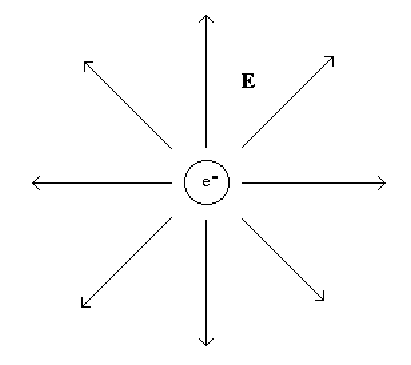
Figure 9.5
Electric field surrounding a charged particle, in this case, an electron.In this picture, I show a negatively-charged particle (an electron) and its electric field denoted by the symbol E which indicates that at any point in space throughout the entire universe (especially very near to the particle) its electric field will have both a magnitude (value) and a direction. This is known as a vector.
Away from the presence (or influence) of other matter, those field lines are said to terminate at infinity-that is-they go on forever. They can however, terminate in the presence of another positively-charged particle such as a positron, as shown in Figure 9.6. This particular configuration is known as an electric dipole (dipole simply means two poles). Almost all of these field lines will terminate at the two particles. The field lines at the end of each particle will not; they are said to terminate at infinity.

Figure 9.6
Electric field lines resulting from the proximity of two oppositely charged particles.Now, an in-depth mathematical discussion of electric fields would be fairly heady stuff for most folks, but I do not see a need to go into it. However, it is important to know that the electric field of either particle grows weaker as measurements are taken farther away from it. The electric field strength is said to fall off as the inverse of the distance away squared (1/r²), where r is the distance away.
For example, given the appropriate units if the magnitude (value) of the electric field at a unitary distance of one were equal to one (see Figure 9.7), then at twice that distance the electric field strength would be only 1/4th that value. At three times the distance the magnitude would be only 1/9th, and so on. So the strength of an electric field falls off very quickly with the distance away form its source.

Figure 9.7
The strength of the electric field falls-off as the inverse of the square of the distance.In passing, I want to note here that gravitational fields and magnetic fields can also be described in similar ways, and their respective field strengths also fall off as 1/r². Here is the actual formula for an electric field
 (scalar form)
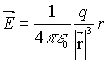 (vector form)
where: E = electric field intensity3 (N/C), scalar form
E = electric field intensity (N/C), vector form
ε0= constant, which is 8.85 x 10⁻¹² (C2/N-m2)
q = charge (C)
r = distance (m)
r = vector distance (in x,y,z coordinates4, m)
| r| = magnitude of the vector5 (= r)
|
3. The characters in parenthesis here are the SI (International System) units of the various activities at work. For those not familiar with them, I will identify them as follows: N - Newtons; a measure of force, C - Coulombs; a measure of charge andm - meters; a measure of distance. |
|
4. Actually, there are several coordinate systems in which vectors can be written. The three most common are Cartesian (x,y,z), Cylindrical (r,θ,z) and Spherical (r,θ,φ). |
|
5. Here and above, the vectors E and r are shown in boldface type, indicating that they are vectors. In the equations above, they are shown with overhead arrows, indicating that they are vectors. |
It is not important to know this formula, but I have decided to put it here for people who know a little bit of math and might be interested.
The scalar form simply yields the magnitude of the electric field at any point in space while the vector form gives both the magnitude and direction. As you might imagine, calculations of electric field lines can become rather complicated.
Now, in and amongst all of this I have not said the most important thing yet. And this is that electric fields do not actually exist! What we have been looking at here are mathematical representations of generalized force computations. What does this mean?
What it means is that electric fields (as well as magnetic and gravitational fields) are mathematical abstractions based on the experimental measurements of forces between particles. For electric fields, it is the measurements of forces between charged particles.
In other words, in order to even know to think of an electric field, first we had to discover that there were forces between charged particles. This is to say that two charged particles exert a force on each other, and the electric field is a generalized representation of the force by any one charged particle which will be exerted on another charged particle placed anywhere in its field.
For example, if there are two particles in proximity of each other (see Figure 9.8), one electron and one positron, and each one has a charge of e (1.60 x 10⁻¹⁹ Coulombs), they will each exert a force on the other. In this case, as opposites, they will attract each other with equal force. If either one or both are able to move, then they will begin to move towards each other, drawn by the force that pulls them together. If the two have like charges such as two electrons or two positrons, then they will repel each other and move apart.
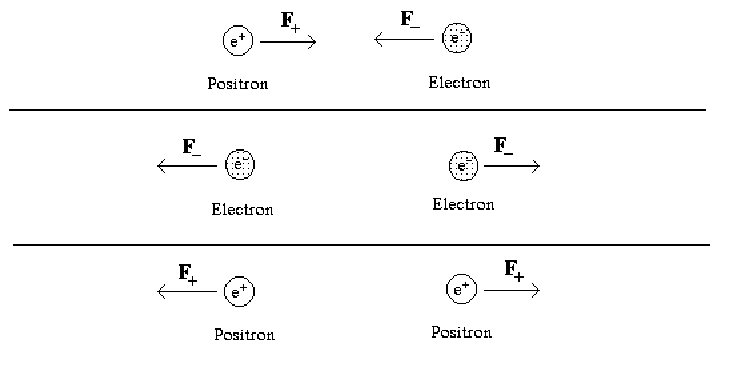
Figure 9.8
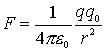
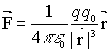
Electrons and positrons attract each other with a force. But two electrons or two positrons will repel each other with equal forces.A hundred years ago, physicists (like Hertz, Faraday and others) did a whole bunch of experiments on charged particles to figure all of this out and came up with this formula for the force (again we do not need to know or understand this formula-it is only here for those who are interested)
 (scalar form)
 (vector form)
where: F = electric force (N), scalar form
F = electric force (N), vector form
ε0= constant, which is 8.85 x 10⁻¹² (C2/N-m2)
q = charge (C)
r = distance (m)
r = vector distance (in x,y,z coordinates-m)
q0= charge of the second particle (C)
| r| = magnitude of the vector (= r)
If you have been paying attention to these two sets of formulas, you will notice a remarkable similarity between the first two formulas and the second two. In fact, you would have noticed that they are almost identical. The only difference is the addition of the variable q0, which is the charge of the second particle.
Knowing this, I can rewrite the formula for the force as
F = q0E (in scalar form)
or F = q0E (in vector form)
where: F = force (N)
F = force (N-vector form)
E = electric field (N/C)
E = electric field (N/C-vector form)
q0= charge of the second particle (C).
In fact, this is exactly where the conceptual abstraction of the electric field comes from! The electric force between the two particles is real. The electric field of a single charged particle is not real-it is a mathematical abstraction.
The very same thing holds true for magnetic and gravitational fields. Many people do not know this. This is because it is so easy to visualize and draw pictures of electric, magnetic and gravitational fields.
The only reason that we can "abstract" them (or pretend that they exist) is because we have done many experiments with charged particles, heavy masses and magnetic objects. All of these exert forces on each other, so physicists measured those forces, plotted their data on charts and then came up with neat, handy mathematical formulas to represent their generalized results. Then they came up with fields.
The point is that although a field may exist, it cannot be proven to exist except in the presence of matter or energy. And this very fact, for all practical purposes, makes them non-existent.
So this gives us a spatial anomaly to deal with-that forces exist between particles of matter and in fact, vary according to spatial separation, but nothing can be shown to exist between particles of matter without introducing matter or energy into the experiment, which again we are at a loss to explain.
And if a field cannot be detected or shown to exist without the presence of matter or energy, then neither the field nor the space between any two particles of matter can be said to exist. Apparently, our perceptions are very deceiving, because what we do see tells us otherwise. The very essence of spatiality simply reeks of somethingness, which separates bits and pieces of matter, but at the same time, holds the universe together. This somethingness was at one time believed to be the aether. Some time ago, Michelson, Morley, Einstein, Bohr, Planck and several other scientists inadvertently put that notion to rest. At the time, they did not realize it.
Quite literally then we are left with the obvious conclusion that "space" does not exist and our notions about it must now be left behind. It is no longer useful to us unless we properly redefine it.
Space can be defined quite simply as "nothingness," and in that single statement can be found a myriad of implications about its perceptible nature. But more importantly, another entirely different set of implications arise out of "somethingness" or what is. The most immediate and strongest perception about space seems to be its four-dimensionality or spatial-temporal structure. But what we are really seeing here are relationships-that is- relationships between bits and pieces of matter (and their related motions). Without the existence of matter, the notion of space or three-dimensionality becomes meaningless.
This being the case, the word space can no longer be used to describe reality since it describes things in terms of spatial relationships. It is not only confusing, but inaccurate. So it must be renamed for what it really is (or appears to be). Space is a "quasi-thing," a perceived "thing," or a perceived "nothing." At this point, space must be renamed for what it is, not real; appearing to be but in fact not, it is in actuality, quasi-space or q-space6
|
6. New words and prefixes will be introduced in this book as a result of this definition, such as "q-motion", "q-velocity", "q-position" and others, as they pertain to anything spatial. |
What remains to be used in defining our universe is time, energy and matter. There is still the perception of four-dimensionality to deal with, but this can be defined in other terms.
Temporal Displacement Gives Structure
Consider two particles A and B separated by some distance, except that in reality (the new reality in which space does not exist), "distance" is a meaningless word. We can however, represent this distance in terms of temporal separation-that is-their separation in time. For example, instead of saying that particles A and B are "one light-year" apart, one might say that they are "one year" apart.
There is still a problem with the speed of light, and that is that it makes use of velocity since velocity represents spatial displacement. And since we have eliminated the notion of space, we can no longer work in terms of velocities. So we must have a word to represent what is meant-a quasi-velocity, or q-velocity, which is a temporal displacement rate.
The "speed of light" however, still remains outside of this definition since light does not "move." And so, we must still define what light truly is. We are not however, prepared to surmise this until a few other things are understood.
Home Begin Preface Acknowledgements Contents Chapter 1 Chapter 2 Chapter 3 Chapter 4 Chapter 5 Chapter 6 Chapter 7 Chapter 8 Chapter 9 Chapter 10 Chapter 11 Chapter 12 Chapter 13 Chapter 14 Chapter 15 Chapter 16 Chapter 17 Chapter 18 Appendix A Appendix B1 Appendix B2 Appendix C1 Appendix C2 Appendix D Appendix E Appendix F Appendix G General References Future Books About the Front Cover About the Author Index