
|
|
SEAPAVAA Newsletter |
|
SOFIA conducts intro course in AV archives
Philippine cinema and television and the Trips Agreement: Access to the heritage
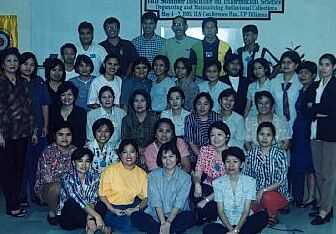
Students and resource persons of intro course in AV archives. The Society of Film Archivists (SOFIA) designed and conducted a four-day seminar to introduce audiovisual archiving to professional librarians and AV technicians charged with keeping AV collections. The course was a joint effort between the University of the Philippines Institute of Library Science (UP-ILS) and the Society of Filipino Archivists (SFA). The course entitled "Organizing and Maintaining Audiovisual Collections" became part of the 14th Summer Institute on Information Science Program, held every year at the University of the Philippines. The seminar dates were 4-7 May 1999. Topics for discussion were: The nature of the AV media; Relationships of collecting institutions; Basic tasks of audiovisual archives; Selection and acquisition, cataloguing, routine maintenance of film and video recordings and equipment; Access services, promotion, and policy. Workshops immediately followed presentations. These topics were discussed within the framework of AV archives even if the institutions represented were not planning to have archive facilities. Emphasis on long-term considerations for acquisitions and routine care of AV collections — especially relevant for organizations with limited resources — easily fitted in with the more familiar library principles. It was challenging for SOFIA members to be able to fuse all common elements of archives and library disciplines so that AV archiving did not sound too "exotic". Participants easily learned and accepted the FIAF cataloguing rules for film archives. Inspection and care of 35mm films, for example, immediately translated into maintaining the microfilm and photo negative files. There was certainly a big demand to know more about the properties of and care for video and audio tapes prompting SOFIA to fast-track developing its program on organizing and preserving magnetic materials. There were 31 participants, 15 of whom were licensed librarians. The rest included AV technicians, teachers and production assistants. Their evaluation of the seminar proved encouraging. A repeat of this seminar is scheduled for October this year, providing another opportunity for SOFIA members to improve their teaching skills in an academic environment.
Trips Agreement and Access to HeritageA casual reunion last May of two SOFIA members and a lawyer friend gave occasion to discuss the implications of the Agreement on Trade-Related Aspects of Intellectual Property Rights (or TRIPS Agreement) and the audiovisual industry in the Philippines. TRIPS, an off-shoot of the agreement between the World Intellectual Property Organization (WIPO) and the World Trade Organization (WTO), requires compliance with provisions for protection of intellectual property (i.e., copyrights and royalties) and is tied up with the vital industries supporting member countries' economies. It suggests that a country, for example, may receive a "favored nation" status for its textiles if it avoids distribution of say, pirated Hollywood films. TRIPS will enter into force in the Philippines on 01 January 2000. The country, in fact, has updated its Intellectual Property Code to anticipate this. The Code took effect in 01 January 1998. From that meeting, the three friends pictured a bleak scenario. Is TRIPS application retroactive? Fifty years back maybe? If so, can archivists promote the old movies that feature the "Elvis Presley of the Philippines" if they are not sure that royalties were paid by the producers? Even the country's best directors have used American popular music to establish the prevailing mood of the city at that time. Were royalties collected then? Not sure. Can Manila-based TV stations broadcast these otherwise meritorious works? Will screenings be confined to archives premises? What are other countries doing to comply with TRIPS? There are more questions than answers this time. SOFIA members are beginning to think that TRIPS is actually the AV archives' Y2K! On 27 August 1999, SOFIA and the Institute of International Legal Studies of the University of the Philippines Law Center sponsored a symposium on the TRIPS Agreement and how it affected, specifically, the film and TV industries. Invited guests were leading personalities in the AV industry and the legal specialists in intellectual property. The Philippines' Press Secretary Rod T. Reyes was invited as keynote speaker.
|